The Effects of the Nigerian Civil War on Women in Isidore Okpewho’s Last Duty and Festus Iyayi’s Heroes

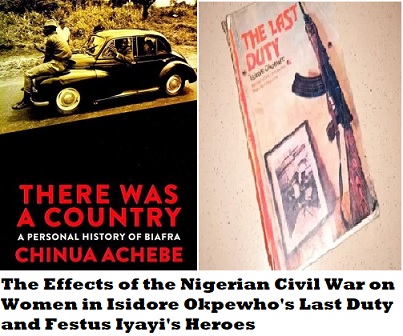
The Effects of the Nigerian Civil War on Women in Isidore Okpewho’s Last Duty and Festus Iyayi’s Heroes
CHAPTER ONE
INTRODUCTION
1.1 BACKGROUND TO THE STUDY
The Federation of Nigeria has never really been one homogeneous country, with its widely differing peoples and tribes. This obvious fact notwithstanding, Aguh (2009) assets that Britain, decided to keep the country one in order to effectively control her vital resources for their economic interests. Thus, for administrative convenience the Northern and Southern Nigeria were amalgamated in 1914. (12). Thereafter the only thing the people had in common was the name of their country since each side had different administrative set-up. This alone was an insufficient basis for true unity.
Under normal circumstances the amalgamation ought to have brought the various peoples together providing a firm basis for the arduous task of establishing closer cultural, social, religious, and linguistic ties vital for true unity among the people. There was division, hatred, unhealthy rivalry, and pronounced disparity in development. The immediate background to the war was a complex situation of tensions and violence between Nigeria’s regions and ethnic groups, especially between those from the east and the north.
Achebe in his work, There Was a Country writes that In January 1966 Army officers had attempted to seize power and the conspirators, most of whom were Ibos (from the East) assassinated several leading political figures as well as officers of northern origin. Army commander Major General Ironsi, also an Igbo, intervened to restore discipline in the army, suspended the constitution, banned political parties, formed a Federal Military Government (FMG) and appointed military governors to each of Nigeria’s regions. (54).
Because the Mid-Western area was at several times under the control of the Biafran and the Federal forces respectively, it experienced most of the fiercest battles and gruesome acts that occurred during the civil war as the area was occupied and re-occupied by the two contending armies at different times. As a consequence of this, the people suffered tremendous hardship and humiliation as they were ultimately victimised and traumatised by the forces of both armies who defeated and took over control of their area on several occasions; a situation which made them bear severe cruelties and indignities of the war. Thus, this area serves as an apt metaphor of the totality of the realities, ugly and beautiful, of the Nigerian civil war, and therefore acts as a viable platform for examining the gender dimensions of the conflict.
Festus Iyayi’s Heroes and Isidore Okpewho’s The Last Duty engage in a constructive reenactment of the experiences and ordeals of the men and women of Mid-Western Nigeria during the Nigeria civil war couched in distinct and conscious linguistically-sustained metaphorical paradigms.
The economic blockade used as a weapon of warfare which led to mass starvation of Biafrans in 1968 however played a crucial role. Unarguably, the victims were mostly children and women. Many resorted to many unthinkable substitutes for survival. A few desperate women who had passes picked refuse dumps in the barracks in search of discarded food items. Partly decaying tubers of yam, bags of rice, and garri, and other items were retrieved from the garbage heap. The edible portions of the salvaged items became food to these women and their house hold (Uchendu, 2007).
Women made use of their little daughters and wards, to carry their products around. At their age, their mothers and guardians assumed that they would not be easy targets of sexual abuse by soldiers, but this was not always the case (Uchendu, 2007). Some were raped or enticed to undulysexual acts. For many who had no opportunity to foods became victims of kwashiorkor. For the first time, photographs of emaciated children started to circulate widely. Humanitarian actors also became more vocal and campaigned against the deadly Nigerian blockade. This and many more sad events were meted out on women during the war.
The novels Last Duty and Heroes, set in parts of the defunct Mid-Western area (presently part of the Niger-Delta region) of Nigeria, a location which witnessed intimate encounters of the civil war, narrates significant first-hand accounts of the trauma and calamities of the war, showing how war situations subject human beings to intensely agonising degrees of violence and bestiality, and consequently affect the way men and women interact amidst the pervading situation of insecurity and suffering of war. This research therefore seeks to discover the effects of the Nigerian Civil War on Women in Isidore Okpewho’s Last Duty and Festus Iyayi’s Heroes.
1.2 STATEMENT OF THE PROBLEM
In a largely patriarchal society such as Nigeria, the wartime picture of ‘man does’ ‘woman is’ perhaps only an extension of what obtains in times of peace. A close examination of the portrayals of women in literature and myth reveals that the entire female experience is one to which very little freedom is accrued. The war trend has obviously imparted negatively on Igbo women. Having interacted with soldiers, especially those from Nigeria’s side, the psychological guilt and barrier for illicit relationship has been conquered. Having been raped, used and dumped by the alien Unknown Soldier, the Igbo woman has become hardened and could undertake many ventures including ones, which could provide opportunities to carry out revenges on the men folk.
Fortunately unfortunately, the new trend coincides with the contemporary campaign for the female gender empowerment. Capitalizing on this, women establish leadership over their husbands and male counterparts. Much as this is beneficial to interfaced societal development, it has also eroded the conventional ‘grace and virtuousness’ which pervaded the aura about the female folk. Festus Iyayi‘s Heroes and Isidore Okpewho’s Last Duty portray the horrors and viciousness of the Nigerian civil war on the ordinary people in general and women in particular. The major challenge of this work is therefore to identity the effects of the Nigerian Civil War on Women in Isidore Okpewho’s Last Duty and Festus Iyayi’s Heroes.
1.3 OBJECTIVES OF THE STUDY
The main objective of this study is to examine the effects of the Nigerian Civil War on Women in Isidore Okpewho’s Last Duty and Festus Iyayi’s Heroes. However, the specific objectives of this work shall be;
- examine the various forms of oppression that women undergo in a male dominated society during the war
- examine the identity of women as portray the effects of the Nigerian Civil War on Women in Isidore Okpewho’s Last Duty and Festus Iyayi’s Heroes by men in a male ruling society
- also examine the trauma and abused faced by women in the search for survival during the war
1.4 SIGNIFICANCE OF THE STUDY
This research critically examines the ordeals of Biafran women in the Biafra area during the Nigerian Civil war, their struggle for survival and the trumatic scars of such struggles on their psyche as found in the selected works of Isidore Okpewho’s Last Duty and Festus Iyayi’s Heroes. The study will serve as reference material for future researchers on related subject. Above all, the study hopes to contribute to the existing body of knowledge and scholarship on War and it’s effects on Women.
1.5. RESEARCH METHODOLOGY
This research is a qualitative research, and relies on textual analysis of the selected texts of Isidore Okpewho’s Last Duty and Festus Iyayi’s Heroes, which serve as primary sources of data for the study while other relevant internet and library materials form the secondary sources of data. The texts are purposively selected based on their relevant contents
1.6 SCOPE/DELIMITATION OF THE STUDY
This study is being limited to the effects of the Nigerian Civil War on Women in Isidore Okpewho’s Last Duty and Festus Iyayi’s Heroes. This is to enable the researcher to complete the work within the stipulated time. Therefore, all conclusions are based on textual analysis of the selected texts.
1.7 THEORETICAL FRAMEWORK
Psychoanalysis Theory
The theoretical model adopted as theoretical frameworks for this study is the Psychoanalysis Theory by Sigmund Freud. Psychoanalytic criticism (emerged in the 1960s), the most influential interpretative theory among the series of waves in the post war period is based on the specific premises of the workings of the mind, the instincts and sexuality, developed by the 19th century intellect, Austrian Sigmund Freud (who along with Marx, Darwin and Nietzsche, subverted the centres of Western society by boiling down the human individuality into an animalistic sex drive).
Freud, greatly influenced by the psychiatrists Jean-Martin Charcot (an exponent in hypnosis) and Josef Breuer (pioneer of “talking cure”) proposed his theoretical opus, the notion of the unconscious mind (disseminated in his significant works like The Ego and the Id, Beyond the Pleasure Principle, The Interpretation of Dreams, Totem and Taboo etc.), which proved fatal to the Enlightenment ideals, Auguste Comte’s Positivism etc., the pivots of Western rationalism. This stream of criticism has become one of the most exciting and challenging areas of literary and cultural studies today.
A well-known example of this is the Freudian slip, which Freud himself called the “parapraxi” whereby repressed material in the unconscious finds an outlet through such everyday phenomena as slips of the tongue, pen or unintended actions. Thus, for psychoanalysis, the unconscious is not passive reservoir of neutral data; rather it is a dynamic entity that engages us at the deepest level of our being.
Id, Ego, Superego
Later in his career, Freud suggested a tripartite model of the psyche, dividing it into id, ego and superego. The id, being entirely in the unconscious is the most inaccessible and obscure part of our personality. It is the receptacle of our libido, the primary source of our psychic energy. Its function is to fulfil the primordial life principle, which is the pleasure principle. It is entirely without rationality and has a tremendous amorphous kind of vitality. Ego, governed by the reality principle, is defined as the rational governing force of the psyche. It is mostly conscious and protects the individual from the id. It is the site of reason and introspection.
It is the intermediary between the world within (id) and the world outside (superego). The superego, which is another regulatory agent, protects the society from id. It is partly conscious and in moral parlance, can be called as the conscience of the individual. It is governed by the “morality principle” and represses the incestual, sexual passions, aggressiveness etc. Being a repository of pride, self esteem etc., it compels the individual to move towards perfection.
Psychoanalysis is not simply a branch of medicine or psychology; it helps understand philosophy, culture, religion and first and foremost literature. In developing his theory of psychoanalysis, Sigmund Freud has often related it to art in general and to literature in particular.
In ‘The Interpretation of Dreams, Freud analyzed Sophocles’ Oedipus Rex and Shakespeare’s Hamlet for their Oedipal elements and for the effects the plays had on their audience. In his ‘Creative writers and Day-dreaming,’ Freud further expanded the connection between literature and psychoanalysis. He compared fantasy, play, dreams and the work of art in order to understand creativity.
In ‘creative writers and Day- dreaming’ Freud first presented his theory on the structure of the literary work and made a psychoanalytic inquiry into the nature of literature. For Freud, a literary work is analogous to a daydream. Like a daydream, the literary work contains in its fantasy the fulfillment of an unsatisfied wish and thus improves on an unsatisfactory reality.
Psychoanalytic literary criticism can focus on one or more of the following:
The author: The theory is used to analyze the author and his/her life and the literary work.
The characters: This theory is used to analyze one or more of the characters, the psychological theory becomes a tool that to explain the characters’ behaviour and motivations.
The audience: The theory is used to explain the appeal of the work for those who read it.
The text: The theory is used to analyze the role of language and symbolism in the work.
The authors and writers are influenced by the psychoanalytic concepts which are reflected in the characters of their works and also in their mind. The psychoanalytic concepts which were propounded by Sigmund Freud influenced the psychoanalysis of authors are:
- The primacy of the Unconscious.
- The Iceberg theory of the psyche.
III. Dreams are an expression of our conscious.
- Infantile behaviour is essentially sexual and
- The relationship between neurosis and creativity.
Thus, we will observe Isidore Okpewho’s and Festus Iyayi’s using the psychoanalytic theory in their works. This theory will be used to capture the aftermath effects of the Nigerian Civil war on the women in Isidore Okpewho’s Last Duty and Festus Iyayi’s Heroes.
1.8 BIO-DATA OF AUTHORS
1.8.1 Bio-data of Isidore Okpewho
Isidore Okpewho (9 November 1941 – 4 September 2016), was a Nigerian novelist and critic. He won the 1976 African Arts Prize for Literature, and the 1993 Commonwealth Writers’ Prize, Best Book Africa. Also a classicist and scholar, he has been described as one of the most brilliant men of his generation and one of Nigeria’s most iconic literary figures. His academic career took him to the US, where he lived with his wife and four children since 1991 until his death, in Binghamton, New York. According to Professor G. G. Darah of the Nigerian Oral Literature Association (NOLA), Okpewho “will be best remembered for his original contribution to the discourse of oral literature and epics. The value of his scholarship in this area is comparable to that of Professor Cheikh Anta Diop of Senegal on Egyptian sciences and philosophy, Professor Samir Amin of Egypt on African political economy, Professor Ali Mazrui of Kenya on African history, and Professor John Henrik Clarke on African American history and arts.”
Isidore Okpewho was born in Agbor, Delta State, Nigeria. His Urhobo father, David Okpewho, was from Abraka, in Delta State, a retired senior laboratory technician, and his Igbo mother was from Asaba. Okpewho attended St Patrick’s College in Asaba, going on to University College, Ibadan, from where he earned a first-class Honours degree in Classics. He obtained his PhD in comparative literature from the University of Denver (1976) and a D.Litt. in the humanities from the University of London (2000).
His early career began with working at the Federal Ministry of Education, the Federal Ministry of External Affairs, and the Longman publishers, where he served as an editor for eight years. Subsequently, pursuing his doctorate in the US, he became an academic there, teaching at the University at Buffalo, The State University of New York from 1974 to 1976, University of Ibadan from 1976 to 1990, Harvard University from 1990 to 1991, and Binghamton University.
He was a fellow at the Woodrow Wilson International Center for Scholars in 1982, Alexander von Humboldt Foundation in 1982, Center for Advanced Study in the Behavioral Sciences in 1988, the W.E.B. Du Bois Institute in 1990, National Humanities Center in 1997, and 2003 Guggenheim Fellowship. He also served as President of the International Society for the Oral Literatures of Africa (ISOLA).
Okpewho died aged 74 on 4 September 2016 in hospital in Binghamton, New York, where he had lived and taught since 1991. Survived by his wife Obiageli Okpewho and children Ediru, Ugo, Afigo, and Onome, he was buried in Gate of Heaven Cemetery, East Hanover, New Jersey, on 18 September.
Prolific in his output, Okpewho wrote, co-wrote and edited some 14 books, dozens of articles and a seminal booklet, A Portrait of the Artist as a Scholar (an inaugural lecture delivered at the Faculty of Education Lecture Theatre, University of Ibadan, on 18 May 1989). He was the author of four respected novels, which are widely studied in Africa and other parts of the world, and translated into other languages: The Victims (1970), The Last Duty (1976, winner in manuscript of the African Arts Prize for Literature, an international competition organized by the African Arts Center, UCLA), Tides (1993, winner of that year’s Commonwealth Writers’ Prize, Africa region), and Call Me By My Rightful Name (2004).
The many honours accorded Okpewho included fellowships in the humanities from the Woodrow Wilson International Center for Scholars (1982), Alexander von Humboldt Foundation (1982), Center for Advanced Study in the Behavioral Sciences at Stanford University (1988), the W.E.B. Du Bois Institute at Harvard University (1990), National Humanities Center in North Carolina (1997), and the Simon Guggenheim Memorial Foundation (2003). He was also elected Folklore Fellow International by the Finnish Academy of the Sciences in Helsinki (1993).
1.8.2 Bio-Data of Festus Iyayi
Festus Iyayi was born in the year 1947 in EsanLand. He started his education at Annunciation Catholic College (ACC) in the old Bendel State, finishing in 1966. In 1967, he went to Government College Ughelli, graduating in 1968. In that same year, he was a zonal winner in a Kennedy Essay Competition organized by the United States Embassy in Nigeria.
Iyayi left Nigeria to pursue his higher education, obtaining an M.Sc in Industrial Economics from the Kiev Institute of Economics, in the former USSR, and then his Ph.D from theUniversity of Bradford, England. In 1980, he went back to Benin and became a lecturer in the Department of Business Administration at the University of Benin. As a member of staff of the university, he became interested in radical social issues, and a few years after his employment, he became the president of the local branch of the Academic Staff Union of Universities (ASUU), a radical union known for its upfront style on academic and social welfare.
Gradually, he rose to the post of national president of the union in 1986, but in 1988, the union was briefly banned and Iyayi was detained. In that same year he won the Commonwealth Writers Prize for his novel Heroes. He was later removed from his faculty position by the Alele Williams administration. He got back his job after winning the court case against the school authority and the government, with the help of a human right lawyer, Mr Femi Falana.
Dr Festus Iyayi was one of the best lecturers at the department of Business Administration, University of Benin and his students span from Undergraduates to Postgraduates. His interest include Behavioural Science in Business, Human Resources Management, key concepts such as Work-Place Alienation, Theory of Needs, Work and Task, Recruitment and Selection, Different Paradigms : radical, system, political etc. DrIyayi was a key resource person that delivered lectures in the University of Benin Business School (MBA). The UNIBEN MBA graduates can attest to the qualities of his lectures and supervisions. He would have been a year into his retirement if he had opted for early retirement but the unexpected happened.
He died in a ghastly motor accident caused by a reckless convoy of Kogi State governor, Idris Wada, while on his way to Kano State to attend an ASUU (Academic Staff Union of Universities) NEC meeting concerning a four-month strike embarked upon by the union. Iyayi was a member of different Nigerian literary organizations and worked in the private sector as aconsultant.
WORK CITED
Achebe, Chinua. There Was a Country. Penguin Classics, 2013
Aguh, Pringle. ‘The Pornification of Julia Gillard’ in Bewitched and Bedevilled: Women Write the Gillard Years ed. Samantha Trenoweth Melbourne: Hardie Grant, 2009
Cham, Maybe. Contemporary society and the Female Imagination: A study of Mariama Ba. Women in African literature Today. London, Curry, 1987.
Chimamanda Ngozi Adichie. The Thing Around Your Neck, Knopf Doubleday Publishing Group. 2010
Darko, Amma. Faceless. Ghana: Sub-Saharan Publishers, 2003.
Fredrickson, B. L., & Roberts, T. Objectification theory: Toward understanding women’s lived experiences and mental health risks. Psychology of Women Quarterly. 1997. 21, 173-206.
Kosack, G. “Migrant women: The move to Western Europe – A step towards emancipation?”, Race and Class, 1976. 17(4): 369-379.
Uchendu, M. “Women in migration: Beyond the reductionist outlook”, in A. Phizacklea (Ed.), One Way Ticket: Migration and Fernale Labor, Routledge and Kegan Paul. 2007