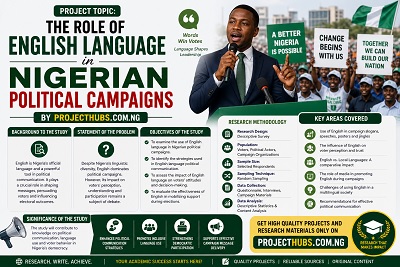
The Role of English Language in Nigerian Political Campaigns
Abstract
This paper explores the critical role of language in Nigerian political campaigns, focusing on how politicians use linguistic strategies such as code-switching, the deployment of indigenous languages, and culturally resonant rhetoric to engage a diverse electorate. Given Nigeria’s extensive linguistic and ethnic diversity, effective communication in political campaigns is essential for voter mobilization and identity formation.
The analysis reveals that language not only serves as a tool for conveying political messages but also as a means of reinforcing ethnic ties, appealing to cultural pride, and shaping voter perceptions. This study underscores the significance of language in the broader context of Nigerian electoral politics, highlighting its power to influence political outcomes.
Introduction
Language is an important instrument of communication in society. Language is essential to political society. Political society exists for the provision of the good life for the citizens. Government is set up in political society so that there will be people to direct and lead the society to foster life, enhance liberty and promote happiness. In order for these to be obtained, democratic societies created political campaigns through which those competing for elective offices to govern society can present their manifestoes and programmes of action to the people. Those campaigning for political offices are called politicians, while the citizens that will vote them into power are called the electorate. During electoral political campaigns, politicians often make promises and use flamboyant languages to persuade the people to vote for them
Language plays a pivotal role in shaping political landscapes, especially in a diverse and multilingual country like Nigeria. As Africa’s most populous nation, Nigeria is a tapestry of ethnicities, cultures, and languages, with over 500 languages spoken across its vast territory (Ethnologue, 2023). This linguistic diversity is both a reflection of the country’s rich cultural heritage and a significant factor in its political dynamics. The interaction between language and politics in Nigeria is deeply intertwined with the nation’s history, colonial legacy, and the ongoing struggles for power, identity, and unity (Adegbija, 2004).
The colonial history of Nigeria laid the groundwork for its current linguistic and political configuration. The British colonizers, in their quest to govern a vast and culturally heterogeneous territory, imposed English as the official language, which became the medium of administration, education, and political discourse (Phillipson, 1992). This imposition of English, while unifying in some respects, also marginalized indigenous languages and created a hierarchy of languages that has persisted into the post-colonial era (Bamgbose, 1991). As a result, English remains the language of power and prestige, often associated with education and socio-economic advancement, while indigenous languages are relegated to the private sphere or local contexts.
In the post-independence era, language has continued to be a tool of political control and a marker of identity. The Nigerian political elite, often educated in English, wield the language as a means of maintaining power and influence (Ayoade, 1988). Political rhetoric, campaign strategies, and governmental policies are often articulated in English, which excludes a significant portion of the population that may not be proficient in the language (Omoniyi, 2007).
The Role of English Language in Nigerian Political Campaigns
This linguistic barrier contributes to the disenfranchisement of many Nigerians and exacerbates existing inequalities. Moreover, language is a critical factor in the negotiation of ethnic and regional identities within Nigeria. The country’s federal structure, which recognizes the autonomy of its 36 states, is often at odds with the centralizing tendencies of the federal government (Suberu, 2001). Language plays a key role in these tensions, as different ethnic groups seek to assert their identity and political interests. For instance, the promotion of Hausa, Yoruba, and Igbo as major regional languages reflects the political power of the corresponding ethnic groups, while smaller ethnic groups and their languages struggle for recognition and influence (Blench, 2012).
The intersection of language and politics in Nigeria is also evident in the media and public discourse. The language used in political communication, whether in print, broadcast, or digital media, can shape public opinion, influence voter behavior, and frame political debates (Bello, 2018). Politicians and political actors often manipulate language to appeal to specific ethnic or regional constituencies, using code-switching, metaphors, and proverbs to convey subtle messages that resonate with their audiences (Ajayi, 2007). This linguistic strategy can both unite and divide, as it reinforces ethnic identities while potentially alienating those outside the targeted group.
The concept of language
Language is a human social phenomenon utilized by people in their everyday life. People often wrongly perceive the term in an abstract way. However, on the contrary, much of our understanding of reality is dependent on language. Language determines our models of the world and the way in which we represent the wrong. It is in view of their reality of language that Victoria, et al (2007:407), quoting Whiteman, warns that “language is not an abstract construction of the learned, or of dictionary makers, but is something arising out of the work, needs, ties, joys, affections, and tastes of long generations of humanity”.
This phenomenon undoubtedly permeates every aspect of man’s life. The qualities of language, as highlighted above, aptly apply to the English Language. It is now universally accepted that English is a world language. The language is used in all the corners of the globe. As McCrum (1986:56) succinctly puts it, “The English language surrounds us like a sea and, like the waters of the deep, it is full of mysteries”. Stressing the universal nature of the language, Brumfit (1995:14) makes the following observation:
Certainly it is now true that the English language is no longer the exclusive property of speakers of English as mother tongue or first language. The ownership of English rests with the people who use it, however, multi-lingual they are, or however monolingual they are.
Similarly, Baugh (1959:61) sees English as the mother tongue of nations. Adducing reasons for this status of the language, he asserts that the combined political influence, economic soundness, the commercial activities, the social well-being, and the scientific and cultural contributions of these nations to civilization account for the large number of the users of the language at the international level. The contributions of English to world civilization are undoubtedly, immeasurable.
The concept of politics
The concept of politics can be understood in both broad and narrow terms. Broadly, politics encompasses all activities related to the governance of a society, including the creation and enforcement of laws, the negotiation of social contracts, and the establishment of institutions that mediate social conflicts (Leftwich, 2004). In this sense, politics is not confined to government or formal political structures; it also includes informal processes and interactions through which individuals and groups influence each other and make decisions that affect the community (Crick, 2005).
In a narrower sense, politics refers to the specific activities associated with the governance of a state or a political entity. This includes the actions of political leaders, parties, and institutions, as well as the strategies they employ to gain and maintain power (Lasswell, 1936). Political science, as a discipline, often focuses on this aspect of politics, studying the behavior of political actors, the functioning of political institutions, and the outcomes of political processes (Almond, Powell, & Dalton, 2008).
Politics also belongs properly to man’s nature. It concerns the organization of the affairs of a society for the common good of the society members. Every political system in a country strives as a duty to achieve peace, prevent social strife. Language emphasis on good citizenship, uphold justice and fair play and emphasises respect for people’s fundamental rights, accepting as a fact with the people’s ethics. In short, politics is so relevant to human society that it is often asserted that man is a political animal. On the other hand, some people regard politics as a dirty game. In actual fact, politics in itself is not dirty.
The Role of English Language in Nigerian Political Campaigns
The problem is that some people play it in a dirty way. If it is played according to rules, people benefit immensely from it. This is why Ojukwu (1989:23) in recognition of the need to play politics according to rules stresses that; every game, whether we call it football or politics, has its rules which must be obeyed. While in politics, we should avoid intellectual conceit or dishonesty. We should shine the light of conscience on the darkest crevices of our thoughts. It is this background that the thrust of the paper is to interrogate the nexus between politics and the use of English language.
The Relationship between the English Language and Politics in Nigeria
The role played by English in politics in this country can be viewed in several respects. One of these respects is its relevance in the political education of Nigeria. Political education of the citizens of a nation is of crucial importance in politics. As obtained in the areas of other human behaviours, handling politics successfully requires some skills. Handling political issues and people effectively by a politician entails possessing high level political skills. English plays an important role in the acquisition of political skills and is an important instrument in the hands of politicians as far as handling political issues and people is concerned.
The language is an important medium through which politicians acquire political awareness from both books and the speeches of more experienced politicians. In fact, a politician who is well versed in English can easily win support from his listeners through the way he manipulates the language. The usefulness of the English language in political education in Nigeria quite understood. The language is the main medium through which politicians acquire political education.
Furthermore, it is the major medium through which politicians educate their followers. Politics as a course of study features prominently in the curriculum of the Nigerian educational system. English is the major language through which this course of study is taught and studied in the country’s educational institutions. Similarly, it is an incontrovertible fact that the majority of the textbooks on politics are written in English. In short, English is often the medium used by people who decide to give one written political account or the other.
The place of language in the thinking ability of an individual should not be ignored while considering the role of English in politics in this country. For a politician to be able to influence and convince his followers, his ability to think effectively should not be in doubt. Language enhances people’s ability to think. It is a creative power, as means through which we do most of our thinking. This is why Benzies (1940:22) emphasis that “We can scarcely think at all without using words. Even if we do not speak, we are constantly using words in our heads to help us to think. It is hard to imagine thought going on at all without using words.”
As the major language of politics in Nigeria, English performs the role of enhancing the quality of thought of Nigeria politicians in their political engagements. It is mainly in the English language that the majority of political activities are carried out. Speech making, declaration of manifestoes and electioneering campaigns are carried out mainly in the English language. In addition to that, the English language plays a crucial role as far as Nigerians’ participation in international politics is concerned. English is the major language of globalization. It is through the use of English that Nigerians participate in international politics. The participation of Nigerians in international politics can hardly be possible without the English language.
It is the major language of globalization. It is pertinent, however, to point out here that politics has also negatively influenced the use of English in Nigeria. The way most Nigerian politicians use the language has corrupted the English of Nigerians, particularly the young users of the language. As Ezema (1996:41) puts it, most speakers of political rallies and other public gatherings unwittingly corrupt the English of the young ones. In most marathon political speeches delivered by politicians, English is invariably the language used. An obvious fact is that many of the politicians who deliver such speeches are not well trained in the use of English.
The Role of English Language in Nigerian Political Campaigns
How Language is used in Nigerian Political Campaigns
Language plays a pivotal role in Nigerian political campaigns, functioning not only as a medium of communication but also as a tool for persuasion, identity formation, and voter mobilization. Nigeria’s linguistic diversity, with over 500 languages spoken across its regions, presents both a challenge and an opportunity for political actors. To effectively reach and engage the electorate, politicians must skillfully navigate this complex linguistic landscape, employing strategies that include code-switching, the use of indigenous languages, targeted rhetorical devices, and the incorporation of cultural references.
Code-Switching and Multilingualism in Campaigns
In Nigeria, code-switching—the practice of alternating between languages or dialects in discourse—is a common and strategic tool in political campaigns. Politicians frequently switch between English, Pidgin English, and indigenous languages during their speeches and public addresses. This practice is not merely a reflection of Nigeria’s linguistic diversity but also a calculated effort to resonate with different segments of the population.
For instance, during national broadcasts or debates, politicians may begin their speeches in English, which is Nigeria’s official language and is associated with education, modernity, and international engagement. This use of English helps to project an image of competence and global awareness, appealing particularly to urban, educated voters and the international community. However, when addressing grassroots rallies or specific ethnic communities, politicians often switch to Pidgin English or a local language to create a sense of familiarity and solidarity (Bamiro, 2006).
In rural areas, where many voters may not be fluent in English, politicians may rely heavily on indigenous languages to ensure their messages are clearly understood and culturally relevant. For example, a candidate campaigning in the Hausa-speaking regions of northern Nigeria might predominantly use Hausa to communicate key messages, ensuring that the local population feels directly addressed and represented (Igboanusi, 2008). This ability to shift between languages allows politicians to connect with a broad audience, making their messages more inclusive and accessible.
Moreover, code-switching can serve as a rhetorical strategy to emphasize certain points, evoke emotions, or signal a change in tone. For instance, a politician might switch from English to an indigenous language when making a particularly passionate appeal or delivering a culturally significant message, thereby enhancing the emotional impact of their speech (Omoniyi, 2007). This strategic use of language helps politicians navigate Nigeria’s diverse linguistic landscape, allowing them to build rapport with different voter groups.
Indigenous Languages and Ethnic Appeal
The use of indigenous languages in Nigerian political campaigns is closely tied to the country’s ethnic diversity. Nigeria is a multi-ethnic nation, and political allegiance often aligns with ethnic identity. As a result, politicians frequently use indigenous languages to appeal to ethnic sentiments and mobilize support within their communities. By speaking the language of a particular ethnic group, politicians can evoke a strong sense of identity and belonging, which can be crucial in securing votes in regions where ethnic loyalty plays a significant role in political behavior.
For example, in the Yoruba-speaking southwest, a politician may deliver speeches in Yoruba to emphasize cultural continuity and shared heritage. This not only strengthens the candidate’s bond with the electorate but also serves as a subtle reminder of the ethnic and regional loyalties that have historically influenced Nigerian politics (Salawu, 2006). In the Igbo-speaking southeast, similar strategies are employed, with politicians using Igbo language to connect with voters on a deeply personal level, reinforcing cultural ties and appealing to the collective memory of historical events such as the Nigerian Civil War.
Indigenous languages are also used to convey proverbs, idioms, and cultural references that resonate with local audiences. Proverbs, in particular, are a powerful tool in Nigerian political rhetoric because they encapsulate wisdom and moral lessons in a concise and memorable form. A politician might use a Yoruba proverb to underscore a point about leadership or unity, thereby tapping into the shared cultural knowledge of the audience (Oyeleye, 2015). These linguistic choices are designed to foster a sense of cultural pride and to persuade voters that the candidate understands and values their traditions.
The Role of English Language in Nigerian Political Campaigns
Political Rhetoric and Symbolism
The rhetoric employed in Nigerian political campaigns is often rich in symbolism, metaphor, and allusion, reflecting the importance of oral traditions and storytelling in Nigerian culture. Political speeches are crafted to resonate with the electorate’s values, aspirations, and fears, with language serving as a key vehicle for conveying these messages. One common rhetorical strategy is the use of metaphors that draw on everyday experiences and cultural symbols.
For example, politicians might compare the nation to a “family” that needs a “father” figure to guide it, or they may liken political opponents to “thieves” or “wolves” preying on the vulnerable (Ajayi, 2007). These metaphors are not only vivid and memorable but also effective in framing political issues in a way that aligns with the voters’ worldview.
Furthermore, political rhetoric in Nigeria often includes references to national unity and development, which are recurring themes in a country marked by ethnic diversity and economic challenges. Politicians may invoke the idea of “One Nigeria” to appeal to voters across ethnic lines, promoting a message of inclusivity and collective progress (Olagunju, 2014). This rhetoric is particularly prevalent during presidential campaigns, where candidates must appeal to a national audience rather than a specific ethnic or regional group.
The language of fear and hope is another crucial element in Nigerian political campaigns. Politicians may use fear-based rhetoric to warn voters about the dangers of electing their opponents, often highlighting issues such as corruption, insecurity, or economic decline. Conversely, they may use hopeful language to present themselves as agents of change who can deliver better governance, peace, and prosperity (Odebode, 2019). The balance between fear and hope in campaign rhetoric is carefully calibrated to motivate voters while promising a brighter future.
The Role of English Language in Nigerian Political Campaigns
The Role of Music and Slogans
In addition to spoken language, music and campaign slogans play a significant role in Nigerian political campaigns. Campaign songs, often composed in indigenous languages or Pidgin English, are used to rally support, create a festive atmosphere, and reinforce key messages. These songs are typically catchy and easy to remember, making them effective tools for spreading campaign messages among the electorate.
Slogans, which are short, memorable phrases, encapsulate the essence of a political campaign and are designed to be easily understood and repeated by the public. Nigerian political slogans often draw on cultural references, proverbs, or religious language to resonate with the electorate. For instance, slogans like “Change,” “Forward Ever,” or “A Better Nigeria” have been used in past campaigns to encapsulate broader political themes in a few words (Falola & Heaton, 2008). The simplicity and repetition of these slogans help to reinforce the campaign’s message and ensure that it sticks in voters’ minds.
Conclusion
The strategic use of language in Nigerian political campaigns is a powerful and multifaceted tool that shapes the electoral landscape. Nigeria’s linguistic diversity, comprising over 500 languages, demands that politicians adopt a nuanced approach to communication, utilizing code-switching, indigenous languages, and culturally resonant rhetoric to connect with a wide range of voters. Language serves not only as a medium for conveying political messages but also as a means of reinforcing identity, mobilizing support, and fostering a sense of unity or division among the electorate.
Through code-switching, politicians navigate between English, Pidgin, and indigenous languages, ensuring that their messages are both accessible and impactful across different social strata. The use of indigenous languages enables politicians to tap into ethnic loyalties and cultural pride, strengthening their appeal within specific communities. Meanwhile, the rhetoric employed in political discourse, rich with metaphors, proverbs, and symbolism, resonates deeply with voters, shaping their perceptions and influencing their choices at the polls.
Ultimately, the effectiveness of language in Nigerian political campaigns underscores the critical role of communication in the political process. It highlights how language can be harnessed to build bridges across Nigeria’s diverse society or to emphasize divisions, depending on the political objectives at play. As such, understanding the dynamics of language use in Nigerian political campaigns provides valuable insights into the broader mechanisms of power, influence, and representation in Nigerian politics.
The Role of English Language in Nigerian Political Campaigns
References
Ajayi, O. (2007). The role of language in Nigerian politics: A case study of code-switching in political discourse. In O. Adegbite & O. Odebunmi (Eds.), Language, literature, and communication in a dynamic world (pp. 237-246). Obafemi Awolowo University Press.
Bamiro, E. O. (2006). The politics of code-switching: English vs. Nigerian languages. World Englishes, 25(1), 23-35.
Bamgbose, A. (1991). Language and the nation: The language question in sub-Saharan Africa. Edinburgh University Press.
Falola, T., & Heaton, M. M. (2008). A history of Nigeria. Cambridge University Press.
Igboanusi, H. (2008). The Igbo tradition in Nigerian English: A study of language in action. African Study Monographs, 29(1), 1-18.
Odebode, I. (2019). Political rhetoric in Nigeria: A case study of campaign speeches of presidential candidates in the 2015 general elections. Journal of Language and Politics, 18(3), 299-320.
Olagunju, A. (2014). Language and political communication in Nigeria: A sociolinguistic approach. International Journal of Humanities and Social Science, 4(6), 137-144.
Omoniyi, T. (2007). Language and politics in Nigeria. In T. Omoniyi & J. A. Fishman (Eds.), Explorations in the sociology of language and religion (pp. 125-137). John Benjamins Publishing Company.
Oyeleye, A. L. (2015). Language, ethnicity, and political economy: The Nigerian experience. Journal of African Languages and Cultures, 18(1), 1-14.
Salawu, A. (2006). Indigenous language media in Nigeria: Continuity and change. The International Journal of Press/Politics, 11(4), 75-88.