Abject Poverty and Child Development in African Society a Case Study of Faceless by Amah Darko

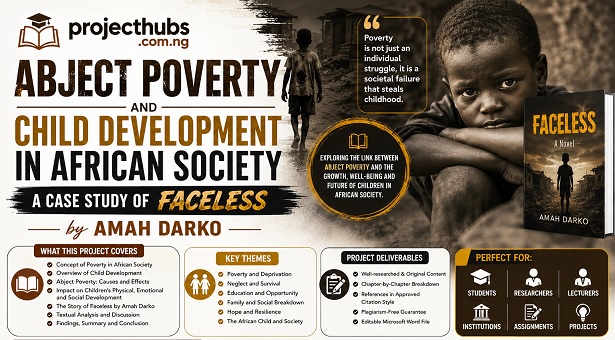
Abject Poverty and Child Development in African Society a Case Study of Faceless by Amah Darko
ABSTRACT
The concepts of abject poverty and child development are not new in any society especially the African society. Many Africans presently live below the poverty line and this is further exacerbated by high level class inequality. Right from the creation of man, there has been class while poverty gradually crept into the society as the supply of the people was not meeting their demands, thus only those who have what it takes were able to survive and stay above-board. There is the classification between good and evil, male and female, white and black, poor and rich, influential and non-influential, educated and uneducated and so on. The class stratification being looked at in this research however has to do with the bourgeoisie and the proletariat and how this has contributed to the advancement of poverty in society. The Nigerian novel purposively selected of faceless by Amah Darko.
The choice of this text is due to the fact that they belong to different generations of Nigerian writings, thus we considered the views of the author on the subjects of discourse. The method of investigation adopted is the critical textual analysis using the Marxist literary theory. The research considered the speeches, actions and events that portray poverty and child development. The author’s’ intentions and views on these concepts were equally established with the hope of an end goal of finding solutions that will take Africa out of the shackles of poverty and inequality.
Introduction
In all countries, poverty presents a chronic stress for children and families that may interfere with successful adjustment to developmental tasks, including school achievement. According to Inyang, “10 Children raised in low-income families are at risk for academic and social problems as well as poor health and well-being, which can in turn undermine educational achievement”. (24)
Poverty is a multidimensional phenomenon, whose contributing factors include unemployment, income inequality and corruption. The World Bank in the World Development Report 2000/2002 sums up the various dimensions of poverty to include lack of opportunity, lack of empowerment and lack of security. The window of opportunity remains closed to the common people, rendering them dormant in society. Thus this social incapacitation limits the choices they would have to make and their lack of security makes them vulnerable to exploitation, diseases, violence and so on. In Africa, widespread and severe poverty is a brazen reality experienced in lack of food, cloth, shelter, education, security and other entitlement programmes.
Indeed literature is life and it provides critical insight about life. Thus a general opinion is that literature mirrors society, because literature relates to all aspects of society: political, economical, historical and social, exposing both open and secret truths. It is a medium of reflecting the contemporary issues of the society—be it class struggle, leadership problems, matters of security or issues on national development. In fact, literature serves as a mirror of society or a channel through which the social, political, cultural and economic issues that ravage a given society are explored. This means that there is a correlation between art and life; hence, literature deals with people and their experiences in a given milieu.
This project, therefore, concerns itself with the contributions of literary artists to the lives and experiences of people in the Nigerian society, especially on matters of wealth and distribution of wealth. This is because the literary artist is seen as a committed person who uses his work to advocate for an egalitarian society, satirize the evils of corruption, exploitation and oppression; and push the proletariats into a struggle towards liberation from all the forces that undermine their existence. The project makes specific emphasis on Festus Iyayi’s Violence and Helon Habila’s waiting for an Angel, Marxist-oriented novels that advocate force against all the forms of exploitation, deprivation and unpatriotism.
Surely, it is in imaginative literature we can fully understand the problems of poverty and inequality. Poverty is a material condition, a class in the social structure. And literary texts: are they not aesthetic artifacts, retreating by their nature into the privacy of the imagination? Only in this retreat from the tactile and the statistical, I contend, can we approach the complexity of poverty as an ideological formation in the texts under study, or understand the inner life of being poor – the tangled web of emotion and behaviour that gets brushed too easily from social study. And literature becomes a crucial tool to understanding economic and cultural condition that is at once urgent and elusive because it cuts across the categories of race, gender, and class by which we conventionally understand social difference.
Abject Poverty and Child Development in African Society a Case Study of Faceless by Amah Darko
However, it needs be said that widespread and severe poverty is a reality in our world. It is a reality that depicts lack of food, clothes, education and other basic amenities. Severely poor people lack the most basic necessities of life to a degree that it can be wondered how they manage to survive.
The link between poverty, hunger and human development is very significant. Indeed, poverty and hunger are the exact opposite of human development. All the attributes of human development are deprived by poverty. Poverty is lack of job. Poverty is hunger, poor health, low education, low self-esteem, lack of adequate housing, lack of land, inability to cloth oneself/family, low economic status and, above all, denial of choices. Maduagwu concludes that poverty creates frustration, loss of hope/prospects and value for life, loss of meaning for life and purpose of living.
It also creates disillusionment about morality, poverty makes people compromise on moral values or abandon moral values completely (Maduagwu, Alleviating Poverty in Nigeria). Okafor stresses that the success or failure of any government is measured by the degree of attainment of human development or the level of poverty prevalent among the people (67). On this note, Nigeria, the referent society in the novels under study, cannot be said to be successful with so many people wallowing in abject poverty.
In this project, an effort is made to examine Festus Iyayi’s and Helon Habila’s representation of poverty in post-independence Nigerian state as reflected in their fictions Violence and Waiting for an Angel respectively. This is premised on the awareness that there is always a close relationship between African literature and the social reality; that social reality in the novels under study being that the literature of Nigeria has remained obsessed with the plight of the underprivileged, exposing a group of people that lie beyond traditional documentary sources. In doing this, Iyayi and Habila select realistic details from ordinary life to chronicle the fate of an impotent silent majority.
The authors present a vision of life as hell, with human concerns such as inequality largely fore-grounded in their novels. In consequence, the novels’ thematic focus centres on the portrayal of the terrifying, the painful and a common insistence on postcolonial disillusionment. The novels also take as their thematic focus the foregrounding of the exploitation of the masses, betrayal of public confidence, highly decadent and socially stratified society that breeds and nurtures exploitation and oppression of the less privileged in society. Therefore, these authors acknowledge a poverty that is as aesthetically and culturally significant as it is socially and materially real. Combining Marxist theory with literary analysis, the authors masterfully bring poverty into mainstream critical idiom, thus validating Ahmad Aijaz’s assertion that ‘all Third-world texts are necessarily national allegories’ (95)
In Faceless, poverty is something one can see by one’s eyes and touch with one’s fingers. It is something concrete, touchable, physical and material. In Faceless, Amma Darko presents through simple words what is the compound yard of poor people where Fofo, if she did not decide to leave for the streets of Accra, should be living.
Evidence from the National Institute of Child Health and Human Development Early Child Care Research Network has shown that children in chronically impoverished families have lower cognitive and academic performance and more behavior problems than children who are not exposed to poverty, partially explained by a lack of stimulating behaviors and home experiences among low-income families.
For instance, Iyayi paints out the humiliation of the working class people in Nigeria and making the reader sympathizes with these wretched of the Nigerian poor masses. He equally paints a critical picture on how the bourgeoisies exploit, oppress and dehumanized the poor masses in post-colonial Nigeria. (27)
On the other hand, Ngugi as Kenyan most prolific novelist dramatizes class stratification, poverty; oppression and exploitation as the two major issues bedevilling the poor people of Kenya. He also portrays how the masses in his environment pass through oppression, corruption, poverty and suffered a high level of class of inequality. (67)
Due to the exposure of these writers to the atrocities being committed by the capitalists against the poor, their focus is on the ordinary people with whom they seek to liberate from all forms of social injustice. To them, there is the classification between good and evil, male and female, White and Black, poor and rich, influential and non-influential, educated and uneducated and so on. The class stratification being looked at in this research however has to do with the bourgeoisie and the proletariat and how they have contributed to the advancement of poverty in their society.
Again, many social injustices arise in their society such as abject-poverty, electoral violence, exploitation, kidnapping, religious crises, political subjugation, arson and wickedness that man faces in society. If these evils are not properly checked, the monster known as social injustice will continue to eat deep into the fabrics of their society.
With the above analogy, it is very clear that poverty and class stratification are responsible for child development in African society and it is the poor children that suffers all these injustices. This also form the background to this research work with reference to the novels under investigation.
Abject Poverty and Child Development in African Society a Case Study of Faceless by Amah Darko
Problem statement
Over decades, poverty has eaten deep in to the livelihood in our society, Nigeria, Africa and the world at large due to the fact that our economy are control by leaders who are corrupt who instead of developing the economic for the citizens rather to their own pocket. Lootings of public funds that were made for development of the society have been diverted to personal accounts, this has lead to abject poverty among citizens and of such, parents are no longer to take good care of their children and this has hinder the physical, psychological, academic and moral development of children in our social . it is on this note that this work seeks to examine abject poverty and child development in African society: a case study of Faceless by Amah Darko
Research Methodology
The research is both qualitative and descriptive, with thematic analysis of the texts. Themes of poverty and corruption are adequately analysed. The methodology approach used for the effective analysis of this study is a blend of Marxist theory and socialist realism theory. This is because the Marxist theorist view society (especially capitalist society) as politically locked down and holds the freedom of the people.
They portray the suffering of the masses in their literary texts and form their analysis and view point, stating that the masses suffer as a result of corruption and stratification which our leaders seem to always ignore. The social realism theory falls in line with human concerns and perspectives. The referent society is Nigeria which is the setting in the selected texts. The use of Marxist and socialist approaches are justified as the two novelists whose work shall be used as the data for analysis share the same ideological approach which is Marxism and Social Realism.
REVIEW OF LITERATURE
Poverty is an exceptionally complicated social phenomenon. Defining poverty is a great challenge to researchers because of its complex nature. How researchers define poverty depends mainly on the theoretical framework researchers adopt. Those coming from the economics point of view will look at economic factors like income, expenditure and poverty lines as a basis for measurement. Others will look at issues of social exclusion, deprivation and incapability to measure poverty.
Here are some definitions of poverty to gain a broad overview of the meaning of poverty. Poverty can be defined as ‘lack of material well-being, insecurity, social isolation, psychological distress, lack of freedom of choice and action, unpredictability, lack of long-term planning horizons because the poor cannot see how to survive in the present, low confidence and not believing in oneself’ (Narayan et al. 4).
Abject Poverty and Child Development in African Society a Case Study of Faceless by Amah Darko
Amartya Sen, one of the most famous researchers on the topic, has given a more appropriate definition of poverty. For him, poverty is the lack of what one needs to live within a society. He characterized poverty as a ‘capability deprivation’, where a person lacks the ‘subsistence freedoms’ he/she needs to lead the kind of life he or she has reason to value (qtd. in Bloom & Canning 7). He further asserts that this subsistence freedom has two faces: opportunity and security. Opportunity requires education and a range of political and economic freedoms. Security is viewed as a consequence of effective utilization of the opportunities provided to a person and/or the household. The above definition implies that poverty is not only a state of existence but also a process with multiple dimensions and complexities. The World Bank has this to say of poverty:
Poverty is an income level below some minimum level necessary to meet basic needs. This minimum level is usually called the ‘poverty line’. What is necessary to satisfy basic needs varies across time and societies. Therefore, poverty lines vary in time and place, and each country uses lines which are appropriate to its level of development, societal norms and values. But the content of the needs is more or less the same everywhere. Poverty is hunger. Poverty is lack of shelter. Poverty is being sick and not being able to see a doctor. Poverty is not having access to school and not knowing how to read. Poverty is not having a job, is fear for the future, living one day at a time. Poverty is losing a child to illness brought about by unclean water. Poverty is powerlessness, lack of representation and freedom. (World Development Report)
And this is Wikipedia‘s definition:
Poverty is the deprivation of common necessities such as food, clothing, shelter and safe drinking water, all of which determine our quality of life. It may also include the lack of access to opportunities such as education and employment which aid the escape from poverty and/or allow one to enjoy the respect of fellow citizens. (Wikipedia)
The definition offered by the World Summit on Social Development in Copenhagen in 1995 has it thus:
Poverty is a condition characterized by severe deprivation of basic human needs, including food, safe drinking water, sanitation facilities, health, shelter, education and information. It depends not only on income but also on access to services. It includes a lack of income and productive resources to ensure sustainable livelihoods; hunger and malnutrition; ill health; limited or lack of access to education and other basic services; increased morbidity and mortality from illness; homelessness and inadequate housing; unsafe environments and social discrimination and exclusion. It is also characterized by lack of participation in decision making and in civil, social and cultural life.
It occurs in all countries: as mass poverty in many developing countries, pockets of poverty amid wealth in developed countries, loss of livelihoods as a result of economic recession, sudden poverty as a result of disaster or conflict, the poverty of low-wage workers, and the utter destitution of people who fall outside family support systems, social institutions and safety nets. (World Development Indicators 2)
There is the equally interesting but completely different definition by Peter Townsend:
Individuals, families and groups in the population can be said to be in poverty when they lack the resources to obtain the types of diet, participate in the activities and have the living conditions and amenities which are customary, or are at least widely encouraged or approved, in the societies to which they belong. Their resources are so seriously below those commanded by the average individual or family that they are, in effect, excluded from ordinary living patterns and activities. (15)
A United Nations’ statement says
Poverty is a denial of choices and opportunities, a violation of human dignity. It means lack of basic capacity to participate effectively in society. It means not having enough to feed and clothe a family, not having a school or clinic to go to; not having the land on which to grow one’s food or a job to earn one’s living, not having access to credit. It means insecurity, powerlessness and exclusion of individuals, households and communities. It means susceptibility to violence, and it often implies living on marginal or fragile environments, without access to clean water or sanitation. (Human Development Report 8)
Similarly, Senguputa sees poverty as not only an insufficient income to buy a minimum basket of goods and services but as the ‘lack of basic capabilities to live in dignity’ (20 – 21). This definition aptly recognizes poverty’s broader features, such as hunger, poor education, poor feeding, exploitation, discrimination, vulnerability and social exclusion. These are essential elements for understanding what poverty is. The International Bill of Rights defines poverty as a human condition characterized by sustained or chronic deprivation of the resources, capabilities, choices, security and power necessary for the employment of adequate standard of living and other civil, cultural, economic, political and social rights (40).
Abject Poverty and Child Development in African Society a Case Study of Faceless by Amah Darko
The international body further asserts that a good deal of individual poverty stems directly from consequences of institutional poverty, such as the lack of access to the basic services mentioned above. Lack of education fosters more poverty and impossibility to climb up the social ladder; restricted access to health care causes diseases to spread wildly across the population. An unintended result is a dangerous lack of confidence in the government, and the poor continues to feel negative, inferior, passive, hopeless and powerless.
In all, poverty is a social handicap. The above definitions show that at the heart of poverty is an idea of basic needs and choices. Typically, a person is considered as poor if he/she does not have the capabilities to meet the basic needs and if he/she is incapable of making choices. There are, of course, many other definitions, but if we stick to these examples and summarize them, we can conclude that poverty is the impossibility to meet certain basic needs or the absence of certain necessities or resources: food, clothing, shelter, sanitation, clean water, health, education, work, power, representation, freedom, information, trust in the future (absence of fear), access to opportunities and choices, respect, self-esteem, dignity, inclusion (participation in social and cultural life), independence. All of these needs are valuable and important in themselves.
ABJECT POVERTY AND CHILD DEVELOPMENT IN AFRICAN SOCIETY: A CASE STUDY OF FACELESS BY AMAH DARKO
In Faceless, poverty and child development is something one can see by one’s eyes and touch with one’s fingers. It is something concrete, touchable, physical and material. In Faceless, Amma Darko presents through simple words what is the compound yard of poor people where Fofo, if she did not decide to leave for the streets of Accra, should be living. Darko describes then a situation which is common to any Heavily Indebted Poor Country (HIPC) where poverty is present and touchable:
Just a few years back, and Fofo could have been one of the numerous screaming children, scrambling with the sheep and goats and chickens for space to play and exist in the common compound. Fofo could have been the girl in the tattered brown underpants with the diseases red hair and a protruding stomach carried on legs that were as thin as two dried sticks. Or the other in the flour sac underpants with a body ravaged by rashes and whose nose seemed to never stop running. Maa Tsuru’s family home was a home of many faces. (62)
Darko wants the reader to recognize the active and evident poverty of people like Maa Tsuru that leads them to urge their children out to the streets. She portrays the victim of this sado-masochistic system in pain: “MaaTsuru broke down. She began to cry again. Don’t talk to me like that, Fofo, she sniffed, “Just because I made a lot of mistakes in life and I am poor doesn’t make me less your mother. So don’t talk to me that way” (63)
Darko continues and gives another reason of people urging their children to leave and go to street: “Hunger is a foe and it is overpowering. When it pushes you, you go. It was the same with Baby T.” (64)
Poverty drags Maa Tsuru’s arms and legs bound to accept money made from what only Amma
Darko knows as “Backpass”. Though feeling great innocence and compassion about her girls’ house leaving and what else they may be enduring in the streets, that means body-merchandizing. MaaTsuru seems not to know where the notes being given by Kpakpo are coming from, but she accepts. This means she approves of it. Darko gives us the point of view of common people when their children are ‘fetched’ by “big Madams” from big cities to work for them for fortune. She justifies their innocence about the situation by saying “While her mother is stuck somewhere in poor village thinking that her daughter who was taken by this ‘kind and considerate’ relation to the city to help her ‘get on in life’ was probably at that moment, learning how to join the seams of a kaba together, the daughter may indeed be busy building a clientele of her own” (65)
The idea of ‘Good Morning Ghana’ in Faceless is Darko’s creation. This show is the voice of the voiceless, the face of the faceless. She wants all the Ghanaians to be informed about what is going wrong in the city. The new Ghana is full of social plights and unsolved problems. Nobody has to be off. Thus, Darko has called for Sylv Po and Ms Kamame, the specialist of street-children whose non-governmental organization had done a study of the phenomenon in Accra a few months before.
She has beeninvited by the GMG producer. On the day of the show, she explains, explains and confirms that poverty is not only the core cause of the condition. She goes on, “because there are some very poor parents we encountered, who in spite of their situation were not allowing their children out onto the streets.” (66) According to Ms Kamame, street-children issue has other sources which will be discussed in the following lines. Interestingly, one of the cause is family disintegration and lack of care which is to be discussed in the below lines.
FAMILY DISINTEGRATION AND LACK OF PARENTAL CARE IN AMAH DARKO’S FACELESS
In the contemporary African countries, the lack of moral values, supportive norms, pauperization, suffering and violence, material ambitions and sexual drive fuel all this disintegration. In Faceless, Darko explores a great number of situations of parents’ carelessness in fiction. She pinpoints the situation that leads Fofo’s mother to let her children go to the streets:
A woman like Fofo’s mother, whose ‘village’ happens to be inner-city Accra, is more likely to lose her sense of onus rather speedily when pushed by joblessness and poverty and the non-existent male support. Her physical and emotional detachment from her children is made less difficult in the harsh conditions of the inner city life. She let go Fofo and her sister out onto the streets with virtually no guilt at all because her psyche had accepted the situation with ample ease.(6)
In that novel, we find another reason why women tend to hallucinate when faced with a crisis.
Society does not offer possibilities for women to vent their frustrations. By this way, Darko gives opportunity to the reader to live directly the real situation of street-children in the new Ghana’s suburbs, Sodom and Gomorrah. The story carried on is not just imaginative but authentic and prevailing that exposes the abandonment, sorrows and danger met by these children because of the irresponsibility of their parents and community. African society accepts insidiously those women in some extended family become “the only caretaker of the child’s emotional or physical or financial needs”. Or all three combined. That means .performing the tasks to two.” Hers and the absentee father.”(68)
This is a situation of a real burden to be carried by only one person “Maa Tsuru”. It is the image of a traditional African family where women’s role is to bear, to care for children, to contribute as mothers particularly in food provisioning and household management. This is the least they can provide to fuel male-dominance world. This presentation of women is mostly sloppy and biased and women have to cope with till it changes. Though are some serious
Points of resistance. The sobriquet ‘Dr. Kwei’ was given by himself just after he finished beating his pregnant wife. Darko informs Ghanaian society that the only way her male characters prove their dominance is violence and abuse. They have no human compassion. The miserable Kwei “pounced on her like a cat on an unsuspected mouse and began a vicious pounding spree. He pounded Maa Tsuru with his fists, landing the blows anywhere and everywhere and on every part of her pregnant body…Kwei grinned Maa Tsuru began to bleed. Then he returned to AgbooAyee and told all there that, with immediate effect, they had better start calling him Dr. Kwei…”(69)
The novel ‘’ Faceless’’ portrays the exploitation of the masses or women by the capitalist class or men in the society (community) the novel tries to exposes the object penury and disenfranchisement that constitutes, social reality of majority of Nigerians (Africans) the author tries to mock at some top government officials (leaders) who devote themselves in exploiting the masses (women) in the society (community) in most societies today, injustice is seen as the order of the day. The wealth of the state (community) is no longer shared equally and also use for the community development, while the rich become richer, the poor become poorer.
This is exemplified by the character of Kpakpo and Onko who are in the exploitation class as well as Maa Turu ,Baby T the heroine of the novel and her mother Maa Turu is been trapped by poverty in to making uncomfortable choice. Baby T engages in selling `her body in prostitution so as to make a living for herself and probably for the family, this represents a great irony because prostitution represent evil. And the act of selling it advocates that nothing positive is a waiting.
Similarly, Maa Tsuru, after many years of loneliness, allows another man, Kpakpo into her life and they cohabit in their one room dingy apartment.
The grown up boys who could not withstand the noise that emanates from the lovemaking between Kpakpo and their mother humbly leaves the apartment and Maa Tsuru bluntly fails to look them. Maa Tsuru becomes pregnant and has a premature labour which forces her to stay away from home. Kpakpo who would have acted like a step father to the two young girls, abuses the opportunity as he orders Baby T to his apartment, undress her, abuse her tender breast finally fingers her.
Abject Poverty and Child Development in African Society a Case Study of Faceless by Amah Darko
Despite the pretence of being asleep, fofo sees all that happens. She relates the incidence to onko thinking that Kpakpo had slept with her sister. When fofo confront Baby T the next day, baby T reveals that KpaKpo did not sleep with her but fingered her. Maa Tsuru returns without birth still does nothing about the incidence. Onko capitalizes on the report made by fofo to him and rapes Baby T. Maa Tsuru could not understand why Onko, a person the children look up to as the one deflowering her daughter.
Maa Tsuru confronts Onko on the despicable act of raping her daughter. However, Onko offers her a huge amount of money and ask him to keep it a secret since if it becomes a case, the name of Kpakpo who started the fingering would be mentioned too. Maa Tsuru overwhelmed with shame takes the money which she needed the most and shamefully walks away. Onko assures that he would be giving her a lot of goodies if she behaves well. Three weeks after recovery from the bleeding from her private parts Onko starts to make further advance to Baby T again.
Abject Poverty and Child Development in African Society a Case Study of Faceless by Amah Darko
The advances infuriate Maa Tsuru and she decides to send Baby T away from Onko’s reach. Kpakpo who happens to be her step father, introduces her to one Maa Abidjan, a returned prostitute who no recruits younger girls to work in bars and as house helps. Through Mama Abidjan, they get to know Maami Broni who opts faint idea of where her daughter works threatens Mama Abidjan with a police but Mama Broni visits her the next day and reveals that Baby T now works with poison, a street lord. Poison threatens Maa Tsuru that if she makes trouble; they will come for her younger daughter fofo.
Maa Tsuru gets to know that the poison has been sending envelopes (money) to them of which Kpakpo has been intercepting. Maami Broni decides to be bringing the envelopes herself. Hoever, Maami Broni breaks the news that fofo he disappeared for three days and the corpse found at the kiosk in the market was her. Again, fofo explains to Dina and Kabira who sit in the living room about herself, her mother and how she starts live on the street. She reveals that her street life starts with begging and gradually graduates to stealing and pick pocketing.
These vices she explains come after she drops out from school in class two, the same with Baby T (the one whose body was found on the street). Another aspect is the aspect of Onko associating the crumbling of his business to the incest he commits. He seeks solution from a native doctor who demands the public hair of the lady she sleeps with. Onko coincidentally, meet Kpakpo at AgoAyee spot and tys him so as to locate Baby T. Kpakpo reveals Baby T’s where abouts and Onko geos there to get one of the most vital parts of the ingredients needed to rejuvenate his business. However, Baby T flatly refuses to sleep with Onko. Poison beats Baby T so as to force her have sex with Onko but Baby T stands her ground. The total refusal infuriates poison, as he brutally beat Baby T to comma. Baby dies as a result of the beating. She was carried to a Kiosk of the market place. Onko later hangs himself, a reward for his atrocities.
Finally, Vickie and Kabira agree to go to the police station to seek some pieces of information about fofo’s family and Maa Tsuru her mother but all is in vain as the police fail to meet their demand. Vickie and Kabira make their way to Naa Yomo’s family’s house where Maa Tsuru lives. Nna Yoma engages them in a chitting chatty about her famil background and the reasons everyone in the compound seems to be avoiding her since the visit of the ‘’evil man’’ to her. Maa Tsuru since then has locked herself in her room. Their attempt to get Maa Tsuru to talk proves abortive as she cries and laments over the conceived ‘’curse’ placed on her, and refuse to open her door. In their confusion, Vickie and Kabira returns back to Naa Yomo for an exploration on what might be this curse that was placed on Maa Tsuru .
Naa Yomo explains that Maa Tsuru was born thirty five years ago by a woman who was impregnated by her lover before her puberty rites and initiation into womanhood. The lover however, denied the pregnancy and even denied over seing Maa Tsuru’s mother. The denials culturally and traditionally was unacceptable and because of that, the young lady placed a mortal curse on the man and his generation (of Maa Tsuru is one) forever. The woman died immediately after giving birth to Maa Tsuru, still cursing both father and child.
Conclusion
In conclusion, poverty defines the history of all existing human civilization. As Class struggle has persisted through history, between freeman and slave, lord and serf, bourgeois and proletariat, oppressor and oppressed, poverty also gradually crept into the fabric of humans and this has lead to children underdevelopment, undue labour and harassment which has remained to date. Two broad ranks in constant opposition to one another, a fight that often end in a revolution changing the social order or at times leading to the common ruin of the contending classes and birth of other social ranks.
Class struggle is an inevitable means to an end; it is not just a battle against capitalism, it is a constant revolt against any social system that creates an immoral hierarchy by which the weak and poor are exploited by the privileged. The class struggle between the proletariats and bourgeoisie mirrors the irreconcilable character of the class interests. A constant struggle is, therefore, going on between employers and workers over wages. Political struggle is also a brand of class struggle, demanding for a change in the social system.