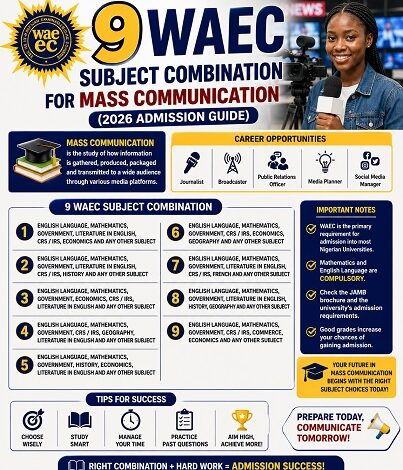
9 WAEC Subject Combination for Mass Communication (2026 Admission Guide)
Mass Communication remains one of the most sought-after courses among Nigerian students seeking admission into universities, polytechnics, and other higher institutions. The course continues to attract thousands of candidates every year because of the growing opportunities in journalism, broadcasting, digital media, advertising, public relations, content creation, corporate communications, and social media management.
One of the biggest mistakes admission seekers make is selecting the wrong WAEC subjects during their secondary school education or misunderstanding the required O’Level subject combination for Mass Communication.
Every year, many qualified candidates lose admission because they fail to meet the correct WAEC subject requirements despite scoring high marks in JAMB.
This comprehensive guide explains everything prospective students need to know about the 9 WAEC subject combination for Mass Communication, including:
- Required WAEC subjects
- Compulsory O’Level credits
- JAMB subject combination
- University admission requirements
- Direct Entry requirements
- Common mistakes candidates make
- Career opportunities
- Admission tips
- Differences between WAEC and JAMB requirements
- Best subjects to choose in secondary school
Understanding WAEC Subject Combination for Mass Communication
Before discussing the nine subjects, students must understand what subject combination means.
A subject combination refers to the group of subjects a candidate registers and sits for during WAEC, NECO, or NABTEB examinations.
Universities use these subjects to determine whether a student is qualified for admission into a chosen course.
For Mass Communication, institutions generally expect students to possess a balanced combination of arts, social science, and commercial subjects.
Why Subject Combination Is Important
Many students focus only on JAMB scores.
However, admission officers also evaluate:
- O’Level results
- Required subjects
- Credit passes
- JAMB subject combination
- Aggregate score
A candidate with 300 in JAMB may still lose admission if the required WAEC subjects are not available.
What Is Mass Communication?
Mass Communication is an academic discipline that studies how information is created, distributed, and consumed by large audiences through various communication channels.
The course covers areas such as:
- Journalism
- Broadcasting
- Public relations
- Advertising
- Digital communication
- Corporate communication
- Media studies
- Film production
- Social media communication
Mass Communication graduates can work in:
- Television stations
- Radio stations
- Newspapers
- Public relations firms
- Government agencies
- Media houses
- International organizations
- Digital marketing companies
General WAEC Requirements for Mass Communication
Most Nigerian universities require candidates to obtain at least five credit passes.
The credits must usually include:
- English Language
- Mathematics
- Literature in English
along with other relevant subjects.
These credits should generally be obtained in not more than two sittings.
The Recommended 9 WAEC Subjects for Mass Communication
Students planning to study Mass Communication should consider registering the following nine subjects.
1. English Language
English Language is the most important subject for Mass Communication.
Communication professionals rely heavily on:
- Writing
- Speaking
- Editing
- Reporting
Universities generally require a credit pass in English.
Without English Language, admission into Mass Communication becomes virtually impossible.
Importance of English in Mass Communication
Students will study:
- News writing
- Feature writing
- Editorial writing
- Media communication
- Public speaking
Strong English skills contribute significantly to academic success.
2. Mathematics
Although many students believe Mass Communication is purely an arts course, Mathematics remains important.
Most institutions require at least a credit pass in Mathematics.
Mathematics demonstrates:
- Analytical ability
- Logical reasoning
- Data interpretation skills
Some communication fields involve audience analytics and research statistics.
3. Literature in English
Literature in English remains one of the most important supporting subjects.
It helps students develop:
- Reading skills
- Writing skills
- Critical thinking
- Communication ability
Many universities specifically recommend Literature for Mass Communication applicants.
Benefits of Literature
Students gain exposure to:
- Language structures
- Storytelling techniques
- Creative expression
- Communication analysis
4. Government
Government is highly relevant for Mass Communication students.
Media professionals frequently report on:
- Politics
- Elections
- Governance
- Public policies
Government helps students understand:
- Political institutions
- Constitutional systems
- Democratic processes
This knowledge becomes valuable in journalism and public affairs reporting.
5. Economics
Economics is another useful subject for Mass Communication candidates.
Media professionals often cover:
- Business news
- Economic developments
- Financial markets
- Government budgets
Economics provides foundational knowledge for such reporting.
Why Economics Matters
Many communication graduates eventually specialize in:
- Business journalism
- Financial reporting
- Economic analysis
6. Civic Education
Civic Education helps students understand:
- Citizenship
- Human rights
- National development
- Social responsibility
Mass Communication professionals often engage with issues affecting society.
Understanding civic responsibilities improves professional competence.
7. Christian Religious Studies (CRS) or Islamic Religious Studies (IRS)
Students can choose either:
- Christian Religious Studies (CRS)
- Islamic Religious Studies (IRS)
These subjects contribute to moral development and cultural understanding.
Media professionals frequently interact with diverse religious communities.
Knowledge of religious issues can be beneficial in reporting and communication.
8. Commerce
Commerce remains valuable for students interested in media business and communication management.
The subject introduces concepts such as:
- Trade
- Marketing
- Business operations
- Entrepreneurship
Many Mass Communication graduates eventually work in:
- Advertising
- Marketing communication
- Corporate affairs
Commerce helps build foundational business knowledge.
9. Any Relevant Elective Subject
The ninth subject can include:
- Geography
- History
- Yoruba
- Igbo
- French
- Fine Arts
- Agricultural Science
depending on personal interests and school offerings.
The most important requirement is ensuring the core compulsory subjects are included.
9 WAEC Subject Combination for Mass Communication (2026 Admission Guide)
Best WAEC Subject Combination for Mass Communication
An ideal combination may include:
- English Language
- Mathematics
- Literature in English
- Government
- Economics
- Civic Education
- CRS or IRS
- Commerce
- Geography
This combination satisfies the admission requirements of most Nigerian universities.
Alternative WAEC Subject Combinations
Students may also consider:
Option One
- English Language
- Mathematics
- Literature in English
- Government
- Economics
- CRS
- Civic Education
- Geography
- History
Option Two
- English Language
- Mathematics
- Literature
- Government
- Economics
- Commerce
- Civic Education
- CRS
- French
Both combinations remain acceptable in many institutions.
WAEC Subjects Required for Top Universities Offering Mass Communication
Many leading universities offering Mass Communication generally require:
English Language
Compulsory.
Mathematics
Compulsory.
Literature in English
Strongly recommended.
Three Other Relevant Arts or Social Science Subjects
Examples include:
- Government
- Economics
- CRS
- History
- Geography
Students should always verify institution-specific requirements before applying.
Common Misconceptions About Mass Communication Subject Requirements
Several myths continue misleading candidates.
Myth 1: Mathematics Is Not Required
This is incorrect.
Most universities require Mathematics.
Myth 2: Science Students Cannot Study Mass Communication
This is also incorrect.
Science students may study Mass Communication if they possess the required subjects.
Myth 3: Literature Is Not Important
Many universities strongly prefer Literature.
Candidates without Literature may face limitations in some institutions.
JAMB Subject Combination for Mass Communication
Apart from WAEC requirements, candidates must also select the correct JAMB subjects.
The standard JAMB combination usually includes:
- English Language
- Literature in English
- Government
- Economics
Some universities may accept slight variations.
Candidates should verify current requirements before registration.
Difference Between WAEC Subject Combination and JAMB Subject Combination
Many students confuse these two concepts.
WAEC Subject Combination
Refers to all subjects written during WAEC examinations.
JAMB Subject Combination
Refers to the four subjects selected during UTME registration.
Both must align with admission requirements.
Admission Challenges Faced by Mass Communication Applicants
Several challenges affect candidates yearly.
High Competition
Mass Communication remains one of the most competitive courses.
Incorrect Subject Selection
Wrong WAEC or JAMB combinations may affect admission.
Low O’Level Grades
Poor performance reduces competitiveness.
Low JAMB Scores
Strong scores improve admission chances.
Limited Admission Quotas
Universities can only admit a limited number of students.
Universities Offering Mass Communication in Nigeria
Mass Communication is one of the most widely offered courses in Nigerian universities. Over the years, the programme has evolved beyond traditional journalism to include digital communication, strategic communication, public relations, advertising, media studies, and content production.
Some universities may offer the programme under different names such as:
- Mass Communication
- Communication Studies
- Media and Communication Studies
- Strategic Communication
- Journalism and Media Studies
- Communication Arts
Students should always check the specific programme structure of their preferred institution before applying.
Federal Universities Offering Mass Communication
Several federal universities offer Mass Communication or related programmes.
Examples include:
- University of Lagos
- University of Nigeria
- University of Calabar
- Bayero University
- Federal University Oye-Ekiti
Admission requirements may vary slightly from one institution to another.
9 WAEC Subject Combination for Mass Communication (2026 Admission Guide)
State Universities Offering Mass Communication
Many state-owned universities also offer the course.
Examples include:
- Lagos State University
- Delta State University
- Akwa Ibom State University
- Ebonyi State University
Private Universities Offering Mass Communication
Private universities continue investing heavily in communication-related programmes.
Examples include:
- Babcock University
- Covenant University
- Afe Babalola University
- Baze University
Polytechnics Offering Mass Communication
Mass Communication is also available at many polytechnics through National Diploma (ND) and Higher National Diploma (HND) programmes.
Graduates may later pursue direct entry admission into universities.
Direct Entry Requirements for Mass Communication
Apart from UTME admission, students can also gain admission through Direct Entry.
Who Can Apply Through Direct Entry?
Candidates with qualifications such as:
- ND
- HND
- NCE
- IJMB
- JUPEB
- A-Level certificates
may qualify for Direct Entry admission.
O’Level Requirements for Direct Entry
Applicants must still satisfy the basic O’Level requirements including:
- English Language
- Mathematics
- Literature in English
- Relevant social science or arts subjects
Advantages of Direct Entry
Direct Entry offers several benefits.
Reduced Study Duration
Students may enter at 200 level in many institutions.
Academic Advancement
Candidates build upon existing qualifications.
Better Career Progression
Higher qualifications often improve professional opportunities.
Core Courses Studied in Mass Communication
Many secondary school students choose Mass Communication without fully understanding what they will study.
The programme covers numerous specialized areas.
Introduction to Mass Communication
Students learn:
- Communication theories
- Media systems
- Information dissemination
News Writing and Reporting
This course teaches:
- News gathering
- News writing
- Reporting techniques
- Interview methods
Broadcast Journalism
Students learn:
- Radio presentation
- Television broadcasting
- News production
Public Relations
This area focuses on:
- Reputation management
- Corporate communication
- Stakeholder engagement
Advertising
Students study:
- Marketing communication
- Consumer behavior
- Campaign planning
Media Law and Ethics
The course covers:
- Press freedom
- Defamation laws
- Media regulations
- Professional ethics
Digital Communication
Modern communication increasingly relies on:
- Social media
- Digital platforms
- Online content creation
Research Methods
Students learn how to conduct:
- Surveys
- Interviews
- Media research
- Data analysis
Skills Required to Succeed in Mass Communication
Academic qualifications alone are not enough.
Successful communication professionals often possess additional skills.
Strong Writing Skills
Writing remains central to communication careers.
Students should continuously improve their:
- Grammar
- Vocabulary
- Composition skills
Communication Skills
Effective speaking abilities help in:
- Presentations
- Interviews
- Broadcasting
Creativity
Creative thinking supports:
- Content development
- Advertising campaigns
- Storytelling
Critical Thinking
Media professionals frequently analyze complex issues.
Digital Literacy
Modern communication relies heavily on technology.
Students should develop skills in:
- Social media management
- Content creation
- Digital publishing
Career Opportunities for Mass Communication Graduates
Mass Communication offers diverse career paths.
Journalism
Journalists gather and report news for:
- Newspapers
- Television stations
- Radio stations
- Online platforms
Broadcasting
Broadcasters work in:
- Television
- Radio
- Podcasting
9 WAEC Subject Combination for Mass Communication (2026 Admission Guide)
Public Relations
PR professionals manage relationships between organizations and the public.
Advertising
Advertising specialists create campaigns promoting products and services.
Corporate Communication
Many organizations employ communication officers to manage internal and external communication.
Digital Marketing
Digital marketers promote brands through online channels.
Content Creation
Content creators develop:
- Videos
- Articles
- Social media content
- Podcasts
Media Consultancy
Experienced professionals may establish communication consulting firms.
Government Information Services
Government agencies employ communication specialists for public information management.
International Organizations
Communication professionals also work for:
- NGOs
- Development agencies
- International institutions
Salary Expectations for Mass Communication Graduates
Earnings vary significantly depending on experience, location, employer, and specialization.
Entry-Level Professionals
New graduates may begin with modest salaries while building experience.
Mid-Level Professionals
Experienced communication officers often earn significantly more.
Senior Professionals
Senior media executives, communication managers, and consultants can command attractive compensation packages.
Factors Affecting Salary
Several factors influence earnings.
Experience
More experience generally leads to higher income.
Location
Major cities often offer higher salaries.
Specialization
Certain areas such as digital marketing and corporate communication may offer higher earning potential.
Professional Certifications
Additional certifications may improve career prospects.
Professional Certifications That Can Boost Career Growth
Mass Communication graduates can strengthen their careers through professional development.
Examples include certifications in:
- Digital marketing
- Public relations
- Media management
- Social media marketing
- Content strategy
Common Admission Mistakes Mass Communication Applicants Make
Many candidates lose admission because of avoidable errors.
Wrong WAEC Subject Combination
Incorrect subjects remain one of the biggest admission obstacles.
Ignoring Literature in English
Some candidates fail to register Literature despite its importance.
Low O’Level Grades
Weak grades reduce competitiveness.
Wrong JAMB Subject Combination
Incorrect UTME subjects may result in disqualification.
Choosing Highly Competitive Institutions Without Alternatives
Students should consider backup options.
Failure to Verify Admission Requirements
Institution-specific requirements may differ.
Expert Admission Strategies for Mass Communication
Students can improve admission chances through careful planning.
Aim for Strong WAEC Results
High grades strengthen competitiveness.
Prepare Thoroughly for JAMB
A strong UTME score significantly improves admission opportunities.
Select Correct Subject Combinations
Always verify requirements before registration.
Consider Multiple Admission Pathways
Options such as Direct Entry and polytechnic routes can provide alternatives.
Develop Communication Skills Early
Students should start improving writing and speaking skills before university admission.
Real-Life Admission Scenarios
Scenario One: Student Registers Correct WAEC Subjects
The candidate includes:
- English
- Mathematics
- Literature
- Government
- Economics
Possible outcome:
- Meets admission requirements for most universities.
Scenario Two: Student Omits Literature
The candidate performs well academically but excludes Literature.
Possible outcome:
- Admission options may become limited.
Scenario Three: Student Uses Wrong JAMB Combination
Despite strong WAEC results, the candidate chooses incorrect UTME subjects.
Possible outcome:
- Admission complications may occur.
Scenario Four: Student Excels in WAEC and JAMB
The candidate combines strong O’Level grades with a high UTME score.
Possible outcome:
- Increased admission competitiveness.
Challenges Mass Communication Students May Face
Students should also understand potential challenges.
Academic Workload
Communication programmes involve extensive reading and writing.
Technology Changes
The media industry evolves rapidly.
Competitive Industry
Graduates often compete for opportunities.
9 WAEC Subject Combination for Mass Communication (2026 Admission Guide)
Continuous Learning Requirement
Professionals must regularly update their skills.
Benefits of Studying Mass Communication
Despite challenges, the course offers numerous advantages.
Diverse Career Opportunities
Graduates can work across multiple industries.
Entrepreneurial Potential
Many communication professionals establish their own businesses.
Global Relevance
Communication skills are valuable worldwide.
Opportunities for Creativity
The field encourages innovation and creativity.
Professional Growth
Communication careers often provide substantial advancement opportunities.
Frequently Asked Questions About WAEC Subject Combination for Mass Communication
How Many Subjects Are Required in WAEC for Mass Communication?
Students typically register nine subjects in WAEC.
Is Mathematics Compulsory?
Yes.
Most universities require a credit pass in Mathematics.
Is Literature in English Compulsory?
Many institutions strongly recommend or require Literature in English.
Can Science Students Study Mass Communication?
Yes.
Science students can study Mass Communication if they possess the required O’Level subjects.
Can I Use NECO Instead of WAEC?
Yes.
Many institutions accept NECO and other approved examinations.
Is Government Compulsory?
Government is highly recommended because it supports communication-related studies.
Can I Gain Admission Without Commerce?
Yes.
Commerce is beneficial but not usually compulsory.
Which Subject Is Most Important?
English Language remains the most important subject for Mass Communication admission.
Final Thoughts
Mass Communication remains one of the most versatile and rewarding courses available in Nigerian higher institutions. As the media, communication, and digital industries continue expanding, demand for skilled communication professionals is expected to remain strong.
For students planning to study Mass Communication, the recommended 9 WAEC subjects generally include:
- English Language
- Mathematics
- Literature in English
- Government
- Economics
- Civic Education
- CRS or IRS
- Commerce
- Geography or another relevant elective subject
Beyond selecting the correct subjects, students should focus on obtaining strong grades, choosing the correct JAMB subject combination, and developing practical communication skills.
With proper preparation, excellent academic performance, and a clear understanding of admission requirements, aspiring Mass Communication students can successfully secure admission and build rewarding careers in journalism, broadcasting, public relations, advertising, digital media, corporate communication, and many other communication-related fields.