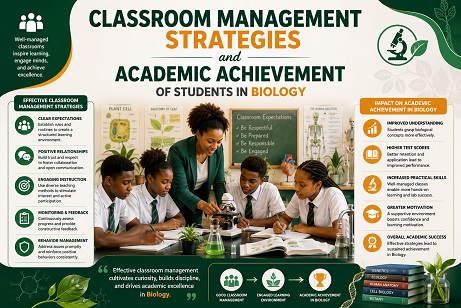
Classroom Management Strategies and Academic Achievement of Students in Biology

Classroom Management Strategies and Academic Achievement of Students in Biology
ABSTRACT
The study investigated classroom management strategies and academic achievement of students in biology in Yakurr Local Government area. The survey research design was employed in the study. Twenty eight (28) Biology teachers in ten (10) secondary schools in Yakurr Local Government area made up the population of the study the twenty eight (28) Biology teachers from ten secondary schools in Yakurr Local Government area selected using purposive sampling technique was the sample size of the study.
The instrument for data collection was a forty itemed questionnaire titled “Classroom management strategies questionnaire’ (CMSQ).” The data collected were analyzed using mean and standard deviation statistical techniques. Findings showed that classroom management strategies such as teacher communication skills, group-based learning and peer teaching classroom management strategies to a very high extent influence academic achievement of students in Biology.
CHAPTER ONE
INTRODUCTION
1.1 Background to the Study
Every classroom has it (formal and informal) social structure with their underlying individual characteristics which provides explanation for failure or succeed of instruction. A good understanding of what relationship exist between the teacher and this instruction on the one hand and the learner on the other hand. Learning takes place in the classroom routinely as an international act through certain degree occur or accidental learning cannot be rule out. Oliver and Reschly (2017) noted that classroom management is a factor that influence academic performance. Classroom management refers to preventing disruptive behaviors so as to improve academic achievement.
Classroom is a physical structure meant and designed to house group of individuals (learners) ready for teaching/ learning process. The teacher manages the activities in the classroom for effectiveness. Classroom management according to Afolabi (2019) is a process concerned with identifying, understanding, stimulating, controlling and unifying human and material resources in the classroom for maximum success in teaching learning situation”. From the above definition, one can infer that classroom management is judiciously harnessing of human, material resources as well as the curriculum within the classroom setting for the successful accomplishment of the school objectives. Classroom management here goes beyond class-discipline, order and control.
It is concerned with the physical setting of the classroom to accommodate instructional materials, chalkboard arrangement, time management, class control, learners’ interest sustaining skills, communication in the classroom and time-tabling. It is only a well -trained, dedicated, duteous and motivated teacher that can deliver the above-mentioned areas of skills. Some of the strategies applied in the management of classroom include chalkboard arrangement, classroom arrangement, time management class control, learners’ interest, communication and timetabling.
The implication of creativity and innovation in the above skills is that schools and teachers should be in various states of reform to adapt their instructional practices to be more effective. To this end the role of the teachers should shift from being subject matter experts who transmit information to acting as facilitators of student learning in the knowledge society. (Young, 2013).
According to Kyriacou (2015) the classroom is the meeting point for both teachers and students where curricular activities are implemented. Educational objectives cannot be fully achieved without the use of conducive classroom environment. The classroom is characterized by a network of interpersonal relationships directed at the attainment of educational goals. Oyina, (2016) refers interpersonal relationship as the reciprocal behavior that occurs between individuals such as exchange of information, exchange of expression and mutual activities. Good classroom environment must be well ventilated, fully supplied with chairs and desks, have adequate spatial arrangement, have sizeable chalkboard, good floors, beautiful walls and lightings (Kolawole, 2014).
Classroom management is a prerequisite for achieving instructional objectives and safeguarding the well-being of students for whom the teaching and learning activities are centered. Classroom management entails planning, supervising, controlling and coordinating the activities of pupils in teaching –learning process. According to Grieser (2017), successful classroom management enhances students questioning and exploration only if the learning environment is conducive. Classroom management techniques as used in this study, refers to tactics adopted by teachers to ensure decorumin the classroom and thus create a healthy and conducive atmosphere for learning.
Classroom Management Strategies and Academic Achievement of Students in Biology
Classroom management strategies according to Everston& Weinstein, (2016) refers to the method or technique which a teacher adopts to ensure that every learner utilizes available resources with the aim of achieving the goal of the school system towards learning. Adeyemi, (2016) described management in education as the process of providing leadership within an educational system by coordinating activities and making decisions that would lead to the attainment of school objectives which are effective teaching and learning.
Classroom management strategy refer to the range of techniques and skills that teachers employ to keep students in organised, orderly, attentive, concentrated and academically fruitful classrooms. This study focused on only four classroom management strategies namely; reinforcement, punishment, antecedent and good relationship. Reinforcement refers to the use of praises, gifts and words of encouragement to promote the occurrence of acceptable classroom behaviours. Group based learning, peer teaching ,Punishment on the other hand is the presentation of painful stimuli to the students in order to prevent them from exhibiting undesired classroom behaviours ( Owusu, Dramanu & Amponsah (2021).
According to Nicholas (2017), this includes creating organized and orderly classroom, establishing expectations, inducing students’ cooperation in learning tasks, and dealing with the procedural demands of the classroom. This view of classroom management contrasts to a more narrow view of classroom management as it deals with just discipline and control. According to Bassey (2012), the wider view of classroom management shows increased engagement, reduction in inappropriate and disruptive behaviors, promotion of student responsibility for academic work, and improved academic achievement of Statement of the Problem Un‐conducive learning environment in the public schools has posed serious problems to students’ academic achievement over many decades ago.
Classroom management requires specific skills such as planning, organizing, as we as an aptitude for team work. It requires a great deal of commitment, initiatives, teacher’s willingness to adjust, creative thinking and action (Abel, 2013). Poorly managed classrooms are usually characterized by disruptive behaviors such as sleeping, late coming, noise making, miscopying of notes, eating, calling of nicknames, verbal or physical threat to fellow students or the teacher (Ekere, 2016).
These disruptive behaviors disorganizing learning processes and hampers academic achievement of students. Effiong, (2017) suggests that teachers can deal with these disruptive behaviors in the classroom and reduce them to the minimum through effective classroom management so that effective learning can take place. Once teachers are able to effectively reduce or eliminate disruptive behaviors in the classroom, there would be increased academic attentiveness and engagement which would pave way for better academic achievement by students.
Group based Learning can be seen as a collection of persons who are emotionally, intellectually, and aesthetically engaged in solving problems, creating products, and making meaning an assemblage in which each person learns autonomously and through the ways of learning of others. Group Based Learning (Collaborative learning) requires learners working together to achieve a learning goal. Collaborative learning is an instructional strategy that establishes a relationship among learners and promotes positive interdependence among the grouped learners (Srinivas, 2015).
FariazKarim, Sheikh, Yu Wang, and Bin Wang, (2013), highlighted group-based classrooms with the following three general characteristics: Sharing knowledge: Teachers have vital knowledge about the course content, skills, and instruction, and provide that information to students. In a collaborative classroom, the teacher also builds upon the knowledge, personal experiences, language, strategies, and culture that students bring to the learning situation. Sharing ability: In group based learning, the teacher encourages students on the use of their own knowledge, ensures that students share their knowledge, expertise and their learning strategies, treat each other respectfully and focus on high levels of understanding with this effective classroom management strategies will be maintained.
Peer to peer teaching is an instructional strategy that consists of pairing students together to learn or practice an academic task. The pairs of students can be of the same or differing ability and/or age range. Peer teaching encompasses a variety of instructional approaches including Cross-Age Tutoring, Peer-Assisted Learning Strategies (PALS), and Reciprocal Peer- peer Teaching (RPT).
According to Maheady (2015), in using peer teaching, student benefits include; development of social and relationship skills, development of self-esteem and responsibility, development of cognitive skills and creativity, practice/reinforcement of skills at an earlier level, gain in learning, insight into the learning process and improvement in attitude towards learning. Recognizing the benefits gained by students from acting as teachers, reciprocal peer tutoring formalizes a process enabling both students in peer tutoring to participate and experience the role of teacher. In this dual role as a teacher and later as a learner, has benefits through the preparation and instruction in which teachers engage, as well as from the instruction that students receive.
Peer teaching consists of recurrent instructional processes applicable to various types of subject matter and usable by more than one teacher. Reciprocal peer tutoring is a systematic, peer-mediated teaching method who has been demonstrated to be successful in promoting the academic and social skills of general education students as well as special education students, including students who were identified as at-risk (Nazzal, 2016).
Peer teaching is an instructional strategy that employs peer interaction for the purpose of teaching and learning (Ginsburg-Block, 2015). Different forms of peer tutoring exist (Lieberman and Houston-Wilson, 2019). These are: Unidirectional peer teaching, Bidirectional or Reciprocal Peer- peer Teaching Class wide peer teaching, Same-age peer teaching and Cross-age peer teaching.
Classroom Management Strategies and Academic Achievement of Students in Biology
The use of verbal instruction is one of the techniques for effective classroom management that can be adopted by teachers. Good (2014) in a study gives clear instruction on what should be done to give the students concrete direction to compliance. In this study teacher should be consistent in enforcing verbal instruction so that it produces the desired results. Corporal punishments were used widely as effective classroom management techniques to curb disruptive behaviors in the classroom.
Instructional supervision is another technique of effective classroom management adopted by teachers in the classroom (Obot, 2014). According to the study, instructional supervision involves moving around the classroom to observe students closely, engaging students in academic activities, asking questions, and employing both verbal and non-verbal teaching methods to ensure that students are paying individual attention lesson than simple facts.
Classroom management strategies are aimed at producing conducive learning environment where students can learn with eased and perform better academically. All these strategies can be adopted in the classroom depending on the nature of the problem at hand. Based on the above back ground, the researcher deemed it necessary to investigate Classroom management strategies and Academic Achievement of students in Biology in Yakurr Local Government area.
1.2 Statement of the Problem
Biology being the core science subject that is offered by science students in senior secondary level of education and at college and university level has been faced with the challenges of poor academic achievement of students as observed by the researcher during her experience during teaching practice and West African certificate examination Councils (WAEC) and National Examination Council (NECO) Chief examiner (2021) report showed that students’ academic achievement in Biology is very poor.
The inappropriate instructional strategies used by Secondary School biology teachers, tend to raise doubts about the possibility of realizing the objectives of Biology education in secondary schools as stated in the National Policy on Education (Federal Ministry of Education, 2014). The teachers have blamed the students for not reading and for displaying lackadaisical attitudes towards learning of the subject. Owing to the fact that no education can rise above the level of its teachers, the researcher was triggered to ask, “Could management strategies which is measured by the group based learning, teachers’ communication skills and peer teaching contribute to this poor academic achievement among biology students?”
It is this existing gap that this present study intended to fill up by undertaking the research on “Classroom management strategies and Academic Achievement of students in Biology in Yakurr Local Government area”.
Classroom Management Strategies and Academic Achievement of Students in Biology
1.3 Purpose of the Study
The purpose of this study is to investigate Classroom management strategies and Academic Achievement of students in Biology in Yakurr Local Government area of Cross River State. Specifically, the study sought to find out:
- determine the relationship between teachers’ communication skills as correlate of students’ academic achievement in Biology.
- determine the relationship between group based learning as correlate of students’ academic achievement in Biology.
- determine the relationship between peer teaching as correlate of students’ academic achievement in Biology.
1.4 Research Questions
The following research questions will be guided the study:
- What is the relationship between teachers’ communication skills as correlate of students’ academic achievement in Biology?
- What is the relationship between group based learning as correlate of students’ academic achievement in Biology?
- What is the relationship between peer teaching as correlate of students’ academic achievement in Biology?
1.5 Significance of the Study
The findings of the study will be of immense benefit to students, science teachers, policy makers, curriculum planners and researchers.
- The study would help boost students’ interaction and seriousness in class because of the management strategies that may lead to positive and meaningful learning in secondary schools.
- The findings would help science teachers in organizing their instructional activities in such a manner that will provide a background that would ensure a stable incorporation of the classroom management strategies.
- The study would also help to educate the policy makers for a suitable classroom management strategies in secondary schools.
- The findings of this study would equally give the planners and developers of curriculum an insight on the kind of classroom management strategies that is effective for the adequate instructional setting.
- The findings of this study would be helpful to other researchers to further investigate on impact of classroom management practices that would improve teachers’ repertoire of technical skills in the teaching of science.
1.6 Scope of the Study
The study is delimited to classroom management strategies as correlate of students’ academic achievement in Biology in Yakurr Local Government area. The study was delimited to academic achievement of students in public secondary two classes in the 2021/2022 academic session in Yakurr Local Government area.
1.7 Definition of Terms
The following are the explanations of some of the terminologies used in this research work.
Academic achievement: It is the extent to which a student has achieved their short or long term educational goals. It is the scores obtained from the administration of Performance test.
Classroom management strategies refer to the range of techniques and skills that teachers employ to keep students in organized, orderly, attentive, concentrated and academically fruitful classrooms.
Group based Learning can be seen as a collection of persons who are emotionally, intellectually, and aesthetically engaged in solving problems, creating products, and making meaning an assemblage in which each person learns autonomously and through the ways of learning of others.
Peer teaching approach is an instructional strategy that employs peer interaction for the purpose of teaching and learning.
Teachers’ communication skills: refer to teachers’ verbal skills, and non-verbal skills
Students: A person who is studying at a school or college. Denoting someone who is studying in order to enter a particular profession.