Feminism and Gender Consciousness in Chimamanda Ngozi Adichie’s We Should All Be Feminists

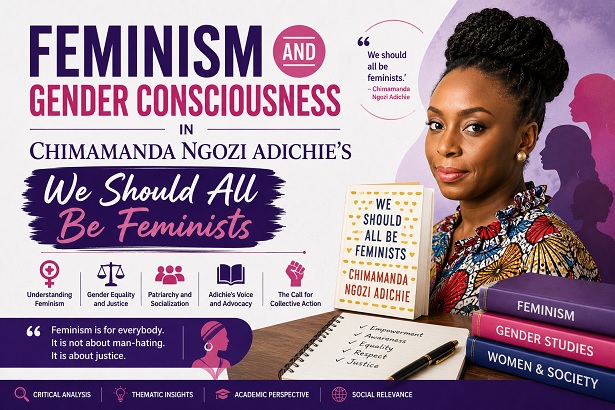
Feminism and Gender Consciousness in Chimamanda Ngozi Adichie’s We Should All Be Feminists
Abstract
This study offers an extensive critical analysis of Chimamanda Ngozi Adichie’s essay We Should All Be Feminists, examining its thematic concerns, ideological foundations, and contemporary relevance. Drawing extensively from the primary text, the work explores Adichie’s articulation of feminism through African lived experiences, cultural critique, and personal narratives. The essay situates Adichie’s arguments within feminist, Black feminist, womanist, motherist, and Africana womanist theoretical frameworks, demonstrating how these perspectives intersect in her discourse.
Through detailed textual analysis and carefully selected quotations, the study highlights Adichie’s challenge to patriarchal norms, gender socialization, and cultural stereotypes. It further examines the social messages embedded in the text and evaluates the significance of the essay in addressing ongoing gender inequalities in today’s world. The study concludes that We Should All Be Feminists is a vital contemporary text that contributes meaningfully to feminist discourse by presenting an inclusive, culturally grounded, and accessible vision of gender equality.
Introduction of the Text
We Should All Be Feminists is a nonfiction essay by Chimamanda Ngozi Adichie, adapted from her 2012 TEDxEuston talk and later published as a book in 2014. The text addresses the concept of feminism, the persistent inequality between men and women, and the cultural misconceptions that surround feminist ideology, particularly within African societies. Adichie’s central argument is that feminism is not a radical or anti-male ideology, but rather a necessary framework for achieving social, political, and economic equality between the sexes.
From the opening pages, Adichie establishes the motivation behind the essay by recounting her early encounters with the word “feminist.” She recalls being called a feminist as an insult and notes that the term often carries negative connotations such as bitterness, anger, and hatred of men. According to Adichie, “My own definition of a feminist is a man or a woman who says, yes, there is a problem with gender as it is today and we must fix it” (Adichie). This definition sets the tone for the essay and frames feminism as a shared human responsibility rather than a gender-specific battle.
The essay is structured around personal anecdotes, cultural observations, and social commentary. Adichie uses everyday experiences to illustrate how deeply gender inequality is embedded in social systems. These experiences range from childhood incidents in Nigeria to adult encounters in professional and social spaces. By grounding her arguments in lived reality, Adichie makes the abstract concept of feminism accessible and relatable to a broad audience.
Feminism and Gender Consciousness in Chimamanda Ngozi Adichie’s We Should All Be Feminists
Importantly, We Should All Be Feminists challenges the notion that feminism is incompatible with African culture. Adichie rejects the claim that feminism is “un-African,” arguing instead that culture is dynamic and subject to change. She asserts, “Culture does not make people. People make culture. If it is true that the full humanity of women is not our culture, then we must make it our culture” (Adichie). This statement encapsulates the essay’s commitment to cultural reform rather than cultural rejection.
Background Study of the Writer
Chimamanda Ngozi Adichie is one of the most influential contemporary African writers and feminist thinkers. She was born in Enugu, Nigeria, and raised in Nsukka, a university town that significantly shaped her intellectual development. Growing up in an academic environment exposed her to literature, critical thinking, and social debates from an early age. Adichie later studied in Nigeria and the United States, experiences that broadened her understanding of gender, race, and identity across cultures.
Adichie’s literary career spans fiction and nonfiction, with works that consistently interrogate power relations, cultural identity, and social injustice. Her feminist stance is informed by her personal experiences as a Nigerian woman navigating patriarchal structures both at home and abroad. In We Should All Be Feminists, she recounts a childhood experience where she scored the highest in her class but was denied the position of class monitor because the role was “reserved for a boy” (Adichie). This incident marks one of her earliest encounters with institutionalized sexism.
As a writer, Adichie is deeply concerned with representation and voice. She often emphasizes the danger of a “single story” and the need for diverse narratives. In the context of feminism, she seeks to redefine the movement in ways that resonate with African realities. Her feminism is inclusive, pragmatic, and culturally conscious, rejecting extremes while insisting on justice and fairness.
Adichie’s authority in feminist discourse stems not only from her literary achievements but also from her role as a public intellectual. Through speeches, essays, and interviews, she has consistently advocated gender equality and challenged societal norms that limit women’s potential. We Should All Be Feminists represents a culmination of these concerns, distilled into a concise yet powerful text.
Context and Purpose of the Essay
The social context of We Should All Be Feminists is one marked by persistent gender inequality despite advances in education, law, and human rights. In many societies, including Nigeria, women continue to face discrimination in leadership, employment, marriage, and social expectations. Adichie situates her essay within this reality, addressing both overt and subtle forms of sexism. One of the key purposes of the essay is to demystify feminism. Adichie recognizes that many people resist the term because of misconceptions. She notes that feminism is often associated with anger, frustration, or failure in personal relationships. By redefining feminism in simple and inclusive terms, she seeks to make it accessible and acceptable.
Another purpose of the essay is to expose how gender roles are socially constructed. Adichie argues that society teaches women to shrink themselves and teaches men to suppress vulnerability. She observes, “We raise girls to see each other as competitors… but we don’t raise boys to have the same” (Adichie). This unequal socialization, she argues, perpetuates inequality and limits human potential.
Ultimately, We Should All Be Feminists aims to inspire change. Adichie does not merely describe the problem; she calls for action, particularly in how children are raised and how cultural norms are questioned. Her insistence that “gender as it functions today is a grave injustice” (Adichie, 2014, p. 34) underscores the urgency of her message.
Detailed Textual Analysis of We Should All Be Feminists
Gender Socialization and the Construction of Inequality
A central concern in We Should All Be Feminists is the process of gender socialization and how it produces inequality between men and women. Adichie argues that gender roles are not natural or biological but socially constructed and reinforced through upbringing, education, and cultural expectations. According to her, society teaches individuals how to behave based on their gender long before they are capable of questioning these norms.
Adichie observes that from childhood, girls are conditioned to be accommodating, modest, and emotionally restrained, while boys are encouraged to be assertive, ambitious, and dominant. She notes that “we teach girls to shrink themselves, to make themselves smaller” (Adichie). This shrinking, she explains, is not physical alone but psychological and emotional. Girls are taught to limit their ambitions and to prioritize acceptance over achievement.
In contrast, boys are socialized to suppress vulnerability and emotional expression. Adichie argues that this expectation harms men as well, stating that “we define masculinity in a very narrow way” (Adichie). By discouraging emotional openness, society creates men who feel pressured to conform to rigid standards of strength and dominance. This imbalance reinforces power hierarchies that privilege men while simultaneously restricting their emotional freedom.
Patriarchy and Cultural Conditioning
Patriarchy, as presented in Adichie’s essay, is not merely a system maintained by men but one reinforced by cultural practices and social expectations. She emphasizes that women themselves often internalize patriarchal values and unconsciously perpetuate them. This internalization is evident in how women are judged more harshly than men for similar behaviors.
One striking example Adichie provides is the cultural emphasis on marriage as the ultimate achievement for women. She notes that women are taught to aspire to marriage above all else, while men are not subjected to the same pressure. According to Adichie, “We teach girls to aspire to marriage but we don’t teach boys the same” (Adichie). As a result, women’s success is often measured by their marital status rather than their personal or professional accomplishments.
This conditioning creates a social environment where unmarried women are viewed with suspicion or pity, while unmarried men are seen as independent or successful. Adichie criticizes this double standard, arguing that it reduces women’s worth to their relationship with men and undermines their individuality.
Feminism and Gender Consciousness in Chimamanda Ngozi Adichie’s We Should All Be Feminists
Economic Power and Gender Inequality
Adichie also addresses the relationship between economic power and gender inequality. She highlights how financial independence is often discouraged in women, particularly in African societies where male dominance is normalized. She recounts instances where women are expected to downplay their success to avoid intimidating men.
One particularly revealing anecdote involves a woman who sold her house because she feared it would discourage potential suitors. Adichie describes this as a tragic illustration of how deeply patriarchy shapes women’s choices, stating that “she sold the house because she did not want to seem intimidating” (Adichie ). This example underscores how women are often forced to sacrifice material success for social acceptance.
Adichie further points out that even when women earn money, society often assumes male ownership or authority over financial resources. She recounts an incident in Lagos where a parking attendant thanked a man for money she had given, assuming the man must have been responsible for the payment (Adichie). This reflects a broader cultural assumption that men are providers and women are dependents.
Feminism and Gender Consciousness in Chimamanda Ngozi Adichie’s We Should All Be Feminists
Language, Labels, and the Stigmatization of Feminism
Another important aspect of Adichie’s analysis is the role of language in shaping attitudes toward feminism. She explains that the word “feminist” is often used as an insult, associated with negative stereotypes such as bitterness, anger, and sexual frustration. This stigmatization discourages many women from identifying as feminists, even when they support gender equality.
Adichie recounts being advised to call herself a “happy feminist” or even a “feminist-lite” to make the term more palatable. She rejects these suggestions, asserting that “I am not a feminist-lite. I am a feminist, full stop” (Adichie). This declaration is significant because it challenges the idea that feminism must be softened or diluted to be acceptable. By reclaiming the term “feminist,” Adichie seeks to normalize it and strip it of its negative connotations. She argues that feminism should be understood simply as a belief in equality, not as an extreme or radical ideology.
Culture, Tradition, and Change
A recurring theme in We Should All Be Feminists is the relationship between culture and gender inequality. Adichie acknowledges the importance of culture in shaping identity but insists that culture should not be used to justify injustice. She argues that cultural practices are created by people and can therefore be changed. Her assertion that “culture does not make people. People make culture” (Adichie) is one of the most significant statements in the essay. This idea challenges the notion that harmful traditions are immutable. Instead, Adichie presents culture as dynamic and adaptable, capable of evolving to reflect changing values.
This perspective is particularly relevant in African contexts, where appeals to tradition are often used to silence women’s voices. Adichie’s argument empowers individuals to question customs that undermine human dignity while still respecting cultural heritage.
Gender and Moral Double Standards
Adichie also highlights the moral double standards imposed on women, particularly in relation to sexuality. She observes that women are often judged harshly for behaviors that are tolerated or even celebrated in men. This imbalance reinforces control over women’s bodies and choices. She discusses how women are expected to preserve their “respectability” at all costs, while men’s sexual freedom is rarely questioned. Such expectations contribute to a culture of shame and silence around women’s desires and experiences. Adichie argues that this moral policing limits women’s autonomy and reinforces inequality.
Feminism as a Human Issue
Throughout the essay, Adichie emphasizes that feminism is not solely a women’s issue but a human issue. She repeatedly calls on men to recognize their role in dismantling gender inequality. According to her, excluding men from feminist conversations only reinforces division. She states clearly that “men and women are different, but that difference should not translate into inequality” (Adichie). This balanced perspective reflects her commitment to inclusivity and cooperation rather than confrontation.
Feminist and Womanist Theories in We Should All Be Feminists
Feminism as a Central Theory
Feminism is the dominant theoretical framework in We Should All Be Feminists. Chimamanda Ngozi Adichie explicitly defines feminism in clear and accessible terms, distancing it from extreme or distorted interpretations. For Adichie, feminism is fundamentally about equality rather than superiority or antagonism. She states unequivocally that “a feminist is a person who believes in the social, political, and economic equality of the sexes” (Adichie).
This definition situates feminism as a human rights ideology rather than a gender-exclusive movement. Adichie’s feminism is reformist rather than revolutionary; it seeks to correct imbalance rather than overthrow social order. She repeatedly emphasizes that feminism should benefit both women and men by dismantling restrictive gender roles. Adichie also challenges the misconception that feminism is rooted in female anger or dissatisfaction. She recounts being told that feminists are women who “cannot find husbands” or who “hate men” (Adichie). By exposing these stereotypes, she reveals how feminism has been deliberately misrepresented to discourage women from embracing it.
Her feminist stance aligns with liberal feminism in its emphasis on equal opportunities, education, and rights. However, it is distinctively African in its cultural sensitivity and reliance on lived experience rather than abstract ideology.
Black Feminism
Black feminism focuses on the intersection of gender, race, and class, particularly as they affect Black women. Although Adichie does not explicitly label her work as Black feminist theory, her experiences as a Black woman inform much of her feminist consciousness. Her narrative reflects an awareness of how gender inequality operates differently across racial and cultural contexts. Adichie discusses wage inequality and gender bias in professional spaces, noting that women are often undervalued economically. She observes that “men are expected to be providers, and women are expected to be grateful” (Adichie). This expectation disproportionately affects Black women, who often face both racial and gender discrimination.
Her experiences in Nigeria and abroad illustrate how Black women navigate multiple systems of oppression. By centering her voice as an African woman, Adichie contributes to Black feminist discourse, which insists that feminism must address racial and cultural specificity rather than assuming a universal female experience.
Womanism
Womanism, a theory closely associated with African and African-American feminist thought, emphasizes family, community, cooperation, and cultural continuity. Adichie’s feminism aligns strongly with womanist principles. She consistently rejects the idea that feminism is anti-family or anti-marriage.
In the essay, Adichie acknowledges that marriage can be meaningful and fulfilling but criticizes the social pressure placed on women to prioritize it above all else. She states that “marriage can be a source of joy and love, but it should not be the defining measure of a woman’s worth” (Adichie). This balanced view reflects womanism’s emphasis on harmony rather than confrontation.
Adichie’s call for mutual respect between men and women further reinforces her womanist orientation. She does not advocate female dominance but rather equitable partnership. Her insistence that feminism includes men aligns with womanism’s inclusive philosophy.
Feminism and Gender Consciousness in Chimamanda Ngozi Adichie’s We Should All Be Feminists
Motherism
Motherism is a theory that emphasizes nurturing, care, responsibility, and social regeneration through motherhood and upbringing. While Adichie does not explicitly identify as a motherist, her emphasis on child socialization reflects core motherist principles.
One of the most significant arguments in We Should All Be Feminists concerns how children are raised. Adichie argues that gender inequality persists because society teaches boys and girls different values. She asserts, “We must raise our daughters differently. We must also raise our sons differently” (Adichie). This statement highlights the importance of parenting and education in shaping future societies.
Adichie’s focus on nurturing equality from childhood aligns with motherism’s belief that social change begins in the home. By advocating gender-neutral upbringing, she emphasizes care, responsibility, and moral development as tools for societal transformation.
Africana Womanism
Africana womanism is a theory rooted in African culture, history, and lived realities. It emphasizes cultural relevance, community survival, and cooperation between genders. Adichie’s rejection of Western feminist universality places her firmly within Africana womanist thought. She challenges the claim that feminism is “un-African” by arguing that culture is not fixed. Her assertion that “culture does not make people. People make culture” (Adichie) is central to Africana womanism, which seeks to reform harmful traditions without rejecting African identity.
Adichie’s emphasis on dignity, respect, and communal responsibility reflects Africana womanism’s focus on collective well-being rather than individual rebellion. Her feminism emerges from African realities and speaks directly to African audiences, making it culturally grounded and socially relevant.
Intersections of Theory in the Text
One of the strengths of We Should All Be Feminists is its ability to integrate multiple theoretical perspectives without becoming abstract or inaccessible. Adichie weaves feminism, Black feminism, womanism, motherism, and Africana womanism into a coherent narrative grounded in lived experience.
Her personal anecdotes serve as case studies that illustrate theoretical principles in practice. By blending theory with storytelling, Adichie makes feminist thought relatable and persuasive. This intersectional approach ensures that her feminism addresses gender inequality in a holistic and culturally sensitive manner.
Case Studies, Life Examples, and Social Messages in We Should All Be Feminists
Case Studies and Life Examples in the Essay
One of the most compelling features of We Should All Be Feminists is Chimamanda Ngozi Adichie’s extensive use of personal and social experiences as case studies to illustrate feminist ideas. Rather than relying on abstract arguments, Adichie presents lived realities that expose how gender inequality operates in everyday life. These examples function as practical demonstrations of feminist, womanist, and Africana womanist theories.
A significant case study occurs in Adichie’s childhood experience in primary school. She recounts how she scored the highest in her class but was denied the position of class monitor because the role was reserved for a boy. Adichie recalls being told that “the monitor had to be a boy” despite her academic excellence (Adichie). This incident illustrates institutional sexism and highlights how gender discrimination begins early in life. The example demonstrates how patriarchal values are embedded within educational systems and normalized through authority figures.
Another powerful case study involves Adichie’s experience in Lagos with a parking attendant. After she gave the attendant money, he thanked a man who was standing nearby instead of her. Adichie notes that the attendant “thanked the man, because he assumed that whatever money I had must belong to the man” (Adichie). This example reveals how economic agency is often denied to women and automatically attributed to men. It reflects the deeply ingrained belief that men are providers while women are dependents.
Adichie also presents examples related to social spaces and morality. She describes how women are often barred from entering certain clubs alone, while men are not subjected to the same restrictions. According to her, this practice is justified as a moral safeguard, yet it reinforces the idea that women’s behavior must be controlled and monitored (Adichie,). This case study highlights gendered moral double standards and the policing of women’s bodies and choices.
Another striking life example concerns women deliberately diminishing their success to protect male ego. Adichie narrates the story of a woman who sold her house because she feared it would intimidate potential husbands. She explains that “she sold the house because she did not want to seem intimidating” (Adichie). This example underscores the psychological and economic sacrifices women are often expected to make for social acceptance and marriage.
Practical Illustration of Feminist and Womanist Theories
These case studies serve as practical illustrations of feminist and womanist theories. Feminism, as articulated by Adichie, is concerned with identifying and challenging systemic inequality. Each example exposes how gender roles are socially constructed and reinforced through everyday interactions.
The school monitor incident demonstrates how patriarchy is institutionalized, while the parking attendant example reveals how economic power is gendered. The club restriction example highlights moral double standards, and the house-selling incident illustrates the internalization of patriarchy by women themselves.
Feminism and Gender Consciousness in Chimamanda Ngozi Adichie’s We Should All Be Feminists
From a womanist perspective, Adichie does not advocate hostility toward men in these examples. Instead, she emphasizes awareness, dialogue, and reform. Her approach seeks to correct imbalance without destroying social relationships. This aligns with womanism’s emphasis on cooperation and communal harmony.
From an Africana womanist perspective, Adichie’s examples are rooted in African social realities. She does not present African culture as uniquely oppressive but shows how specific practices can be reformed. Her critique emerges from within the culture rather than from an external ideological position.
Social and Moral Messages in the Essay
One of the central messages Adichie conveys is that gender inequality is learned and therefore reversible. Through her examples, she demonstrates that sexism is not natural but taught through socialization, language, and cultural norms. This message is reinforced when she states that “gender as it functions today is a grave injustice” (Adichie).
Another important message is that feminism is not anti-men. Adichie repeatedly emphasizes that men are also harmed by rigid gender roles. She argues that society teaches men to suppress vulnerability and equates masculinity with dominance. According to her, “we define masculinity in a very narrow way” (Adichie). This narrow definition limits men’s emotional expression and reinforces unhealthy power dynamics.
Adichie also communicates the message that women should not measure their worth by marriage. She criticizes the cultural obsession with women’s marital status and highlights the unequal standards applied to men and women. By doing so, she challenges a deeply entrenched social value and encourages women to define success on their own terms.
Feminism and Gender Consciousness in Chimamanda Ngozi Adichie’s We Should All Be Feminists
Education and Social Change
A recurring message in the essay is the importance of education as a tool for social change. Adichie argues that the most effective way to dismantle gender inequality is to change how children are raised. She insists, “We must raise our daughters differently. We must also raise our sons differently” (Adichie). This statement underscores her belief that equality must be taught from childhood.
By emphasizing education and upbringing, Adichie aligns with motherist ideology, which views nurturing and moral instruction as central to societal transformation. Her message is forward-looking, focusing on prevention rather than punishment.
Responsibility and Collective Action
Another key message in the essay is collective responsibility. Adichie does not place the burden of change solely on women. Instead, she calls on both men and women to recognize their roles in perpetuating or challenging inequality. She concludes by urging society to “do better” collectively (Adichie).
This emphasis on shared responsibility reinforces her inclusive approach to feminism. It also reflects her belief that sustainable change requires cooperation rather than confrontation.
The Importance of We Should All Be Feminists in Today’s World
We Should All Be Feminists remains profoundly relevant in contemporary society, both globally and within African contexts. Despite advancements in education, legislation, and human rights advocacy, gender inequality continues to manifest in subtle and overt forms. Issues such as unequal pay, gender-based violence, underrepresentation of women in leadership, and restrictive gender norms persist across societies. Adichie’s essay speaks directly to these realities, offering insight into the cultural and psychological foundations of inequality.
One of the essay’s greatest strengths is its accessibility. Adichie deliberately avoids complex academic language, making feminist ideas understandable to a wide audience. This accessibility is crucial in today’s world, where misinformation and stereotypes about feminism continue to discourage engagement. By redefining feminism as a belief in equality rather than hostility, Adichie makes the ideology approachable and relevant to everyday life.
In contemporary African societies, where appeals to tradition are often used to justify gender inequality, Adichie’s insistence that culture is dynamic is particularly significant. Her statement that “culture does not make people. People make culture” (Adichie) challenges the idea that harmful practices must be preserved in the name of tradition. This perspective empowers individuals and communities to reform cultural norms without abandoning their identity.
Relevance to Gender Relations in Africa
The essay is especially important within African contexts, where discussions of feminism are often met with resistance. Feminism is frequently dismissed as a Western import that threatens African values. Adichie confronts this misconception directly by grounding her arguments in African experiences and realities. Her examples are drawn largely from Nigerian society, making her critique relatable and credible to African audiences.
Adichie’s work is relevant to contemporary African gender relations because it addresses everyday sexism rather than abstract ideology. Her discussion of marriage pressure, economic dependency, and moral double standards reflects ongoing social realities. Many African women continue to face expectations to prioritize marriage over education or career, while men are encouraged to pursue ambition and authority. By exposing these norms, Adichie invites critical reflection and dialogue.
Furthermore, her inclusive approach to feminism encourages male participation in gender reform. In societies where male authority is deeply entrenched, this inclusivity is essential for meaningful change. Adichie’s argument that feminism benefits men by freeing them from restrictive masculinity norms resonates strongly in contemporary discussions about mental health and emotional well-being.
Feminism and Gender Consciousness in Chimamanda Ngozi Adichie’s We Should All Be Feminists
Global Significance of the Essay
Beyond Africa, We Should All Be Feminists has achieved global significance. The essay has been translated into multiple languages and incorporated into educational curricula worldwide. Its themes resonate across cultures because gender inequality is a universal issue, even though it manifests differently in different societies.
Adichie’s emphasis on intersectionality though not always explicitly named aligns with contemporary feminist discourse that recognizes the interconnectedness of gender, race, class, and culture. Her position as a Black African woman allows her to contribute a perspective often marginalized in global feminist conversations.
In a world increasingly shaped by social media, globalization, and migration, Adichie’s essay provides a framework for understanding gender relations across cultural boundaries. Her insistence on empathy, dialogue, and shared responsibility offers a constructive alternative to polarized debates.
Educational and Social Impact
The educational value of We Should All Be Feminists cannot be overstated. The essay is widely used in schools and universities as an introduction to feminist thought. Its narrative style encourages critical thinking and self-reflection, making it particularly effective for young readers.
Adichie’s call to “raise our daughters differently” and “raise our sons differently” (Adichie) has significant implications for education policy and parenting practices. By emphasizing early socialization, she identifies education as a powerful tool for long-term social change. This perspective aligns with contemporary research on gender equality, which highlights the importance of early intervention.
The essay also encourages readers to examine their own biases and behaviors. By presenting familiar scenarios, Adichie prompts self-awareness and accountability. This reflective quality contributes to the essay’s enduring relevance.
Feminism and Gender Consciousness in Chimamanda Ngozi Adichie’s We Should All Be Feminists
Critical Evaluation of the Essay
While We Should All Be Feminists has been widely praised, it is important to evaluate it critically. One limitation is its brevity, which restricts the depth with which certain issues can be explored. Topics such as class inequality, rural women’s experiences, and systemic violence are touched upon only briefly.
However, this limitation is also a strength. The essay’s conciseness makes it accessible and impactful. Adichie does not attempt to provide an exhaustive theory of feminism but rather to initiate conversation and awareness. Her goal is not academic completeness but social engagement.
Another point of critique is that some readers may find the essay overly moderate, particularly those who advocate more radical feminist approaches. Adichie’s emphasis on cooperation and balance may appear insufficient to address deeply entrenched power structures. Nevertheless, her approach is consistent with African feminist and womanist traditions that prioritize communal harmony and gradual reform.
The Writer’s Central Message Revisited
At its core, We Should All Be Feminists communicates a simple yet powerful message: gender inequality is unjust, learned, and therefore changeable. Adichie urges society to question norms that limit human potential and to embrace equality as a shared value.
Her concluding appeal for collective improvement “All of us—women and men—must do better” (Adichie) encapsulates the essay’s inclusive and hopeful tone. Rather than assigning blame, she calls for responsibility and action.
Conclusion
This study has examined Chimamanda Ngozi Adichie’s We Should All Be Feminists through detailed textual analysis, theoretical interpretation, and contextual evaluation. Drawing extensively from the primary text, the essay has explored Adichie’s articulation of feminism, her engagement with Black feminism, womanism, motherism, and Africana womanism, and her use of personal experiences as case studies.
The analysis demonstrates that Adichie presents feminism as a culturally grounded, inclusive, and practical ideology aimed at achieving equality and dignity for all. Her rejection of confrontational feminism and her emphasis on education, culture, and shared responsibility reflect an African-centered approach to gender reform.
Ultimately, We Should All Be Feminists is a significant contemporary text that contributes meaningfully to feminist discourse. Its relevance to today’s world lies in its accessibility, cultural sensitivity, and moral clarity. By challenging stereotypes and encouraging dialogue, Adichie’s essay continues to inspire reflection and action toward a more just and equitable society.
Works Cited
Adichie, C. N. We should all be feminists. Vintage Books. 2014