Semiotics of Lighting Effects as a Tool for Communication in a Theatre: A Study of 400 Students Level Dance Performance

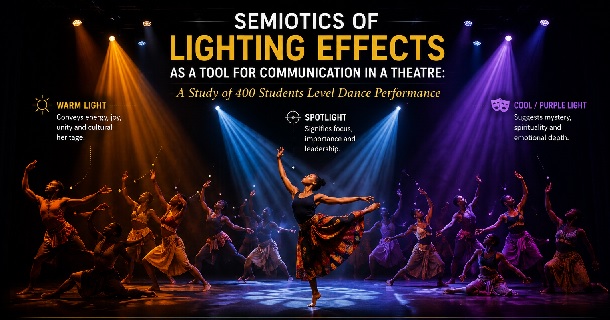
Semiotics of Lighting Effects as a Tool for Communication in a Theatre: A Study of 400 Students Level Dance Performance
CHAPTER ONE
INTRODUCTION
1.1 Background to the Study
In the intricate realm of theatrical performance, the interplay of various elements converges to create a rich tapestry of expression, narrative, and emotion. Among these elements, lighting design emerges as a fundamental pillar, wielding a profound influence on audience perception, emotional resonance, and thematic interpretation (Holden, 2004). Through the lens of semiotics, the study of signs and symbols, lighting effects in theatre transcend mere illumination to become potent communicative tools, imbued with layers of symbolic meaning and narrative intent (Barthes, 1977).
Stage performances overtime deploy several semiotic elements in communicating messages to the audience. Production elements such as costumes, make-up, props, backdrops, stage design and settings amongst others have consistently helped to enhance the overall theatrical experience of the audience. Costume plays a significant role in passing across non-verbal messages to the audience. Hence, costume is one of the elements deployed in drama to create verisimilitude and get the audience drawn into the world of the performance.
Costumes together with make-up, props and sets helps actors project their characters and reflect the particular cultural milieu within which a performance is situated. These semiotic elements breathe life into costume to give it clarity when it is worn by an actor onstage. Costume transforms into a communicative power from which meaning can be derived when worn by actors onstage because when the actors move onstage, he moves with the costume on his body which is when people say the costume of that actor has come alive.
However, some directors fail to properly conceptualise and identify the appropriate costume they ought to use in a performance possibly because they do not comprehend costume as a potent meaning making element in stage performances but rather as a mere aesthetic element for performance beautification. Kafewo (2003:5) points out that “performance, be it community, traditional and political theatre is a series of negotiations in the elucidation of meaning which uses costume as an instrument to detect that meaning.
The crucial thing is how these meanings derived therein relate to actions and perhaps change.” The inappropriate application of costumes in play performances has become issues of debate among several researchers such as Ifatimehin (2006) Nwosu (2009) and Utoh-Ezeajugh (2015) who have observed that little attention is paid to costume as a sign and meaning making system which aid and guide the proper understanding of a performance. This is because costumes help to reveal the identity of characters even before a single dialogue is rendered by an actor onstage.
The inability to code non-verbal aspects of a performance leads to misinformation and misunderstanding of the performance especially when the recipient is not familiar with the cultural background of the performance. This inappropriate application of costume especially in respect to both non-educational (Nollywood, Cinema, T.V programs, Soap Operas) and college or educational productions is a problem that needs to be addressed. In fact, the college production by students seems to suffer the most; yet, the college is the ground where training is received.
At the heart of the impact of the semiotics of lighting effects in theatre lies its capacity to enhance narrative coherence and emotional resonance (Fischer-Lichte, 2008). Lighting cues serve as narrative signposts, guiding audiences through the dramatic journey and heightening their engagement with the unfolding story. By modulating lighting parameters in synchrony with the ebb and flow of the performance, designers create dynamic visual narratives that evoke suspense, evoke empathy, and provoke introspection. Through strategic use of color symbolism, spatial composition, and dynamic illumination, designers cultivate immersive environments that resonate with the thematic content of the production, fostering a deeper connection between performers and spectators.
Semiotics of Lighting Effects as a Tool for Communication in a Theatre: A Study of 400 Students Level Dance Performance
Furthermore, the semiotics of lighting effects in theatre exert a profound influence on audience perception and interpretation (Gelb, 2008). Lighting cues function as visual directives, shaping the spectator’s gaze and framing their understanding of the performance. By manipulating spatial depth, focal points, and visual hierarchy, designers guide audiences’ attention, highlight salient elements, and imbue the stage with a sense of visual rhythm and coherence (Brockett & Hildy, 2010). Through the strategic interplay of light and shadow, designers evoke a spectrum of emotional responses—from awe and wonder to tension and melancholy—thereby fostering a nuanced engagement with the thematic content and aesthetic nuances of the performance.
Moreover, lighting design serves as a powerful medium for artistic expression and innovation within the theatrical landscape (Mackey, 2018). Through experimentation with cutting-edge technologies, such as LED fixtures, digital projection mapping, and interactive lighting systems, designers push the boundaries of traditional lighting techniques, creating immersive, multi-sensory experiences that defy conventional notions of stage lighting (Rose, 2016). By embracing avant-garde approaches and interdisciplinary collaboration, designers expand the creative palette available to them, fostering a culture of innovation and exploration that enriches the semiotic landscape of contemporary theatre.
the impact of the semiotics of lighting effects as a tool for communication in theatre is profound and far-reaching, encompassing narrative coherence, emotional resonance, audience perception, artistic expression, and immersive engagement. Through the strategic manipulation of light, designers imbue theatrical performances with layers of symbolic meaning and narrative intent, transforming the stage into a dynamic arena of visual storytelling and sensory exploration.
By illuminating the intricate interplay between light, meaning, and spectatorship, this research seeks to deepen our understanding of the transformative potential of lighting as a communicative medium within the theatrical landscape and it is on this backdrop that this study seeks to examine Semiotics of lighting effects as a tool for communication in a theatre: A study of 2022/2023 400 level dance performance.
Semiotics of Lighting Effects as a Tool for Communication in a Theatre: A Study of 400 Students Level Dance Performance
1.2 Statement of the Problem
The semiotics of lighting effects in theatre represents a multifaceted arena of inquiry, yet despite its acknowledged significance, there exists a notable gap in the literature regarding its specific application within the domain of dance performance. While studies have explored the communicative potential of lighting in theatre more broadly, few have delved into its nuanced role within the context of dance, where movement serves as the primary mode of expression. Consequently, there is a pressing need to investigate how lighting design functions as a communicative tool in dance performance, particularly at the advanced level represented by the 400-level dance performance staged during the 2022/2023 academic year.
Moreover, while existing research has underscored the importance of lighting in enhancing narrative coherence and emotional resonance in theatre, there remains a dearth of empirical studies that systematically analyze the semiotic impact of lighting effects on audience interpretation and engagement. Understanding how lighting cues influence audience perception and thematic interpretation is essential for both practitioners and scholars seeking to harness the full communicative potential of lighting design. Therefore, the lack of empirical research on this topic poses a significant challenge to the advancement of knowledge in the field of theatre studies, particularly in relation to the intersection of semiotics and performance design.
Furthermore, as advancements in technology continue to reshape the landscape of lighting design, there is a growing need to explore how these innovations intersect with semiotic theory and practice in dance performance. From LED fixtures to interactive projection mapping, new technologies offer unprecedented opportunities for creative expression and audience engagement. However, their integration into dance performance raises questions about their semiotic efficacy and impact on audience interpretation. Therefore, a comprehensive investigation into the semiotics of lighting effects in the specific context of the 2022/2023 400-level dance performance is warranted to address these pressing concerns and advance our understanding of the communicative potential of lighting design in contemporary theatre practice.
1.3 Objectives of the Study
The aim of this study is to comprehensively investigate the role of lighting effects as a semiotic tool for communication in the context of the 2022/2023 400-level dance performance. Specifically, the study seeks to:
- explore the semiotic implications of lighting design within the context of the 2022/2023 400-level dance performance
- investigate how lighting cues influence audience perception, emotional resonance, and thematic interpretation
- assess the integration of innovative lighting technologies, such as LED fixtures, digital projection mapping, and interactive lighting systems, in the 2022/2023 400-level dance performance.
- Provide Recommendations for Enhancing Semiotic Communication Through Lighting Design
1.4 Research Question
The following research questions were formulated to guide the researcher in carrying out the study;
- How do lighting design choices contribute to the semiotic landscape of the 2022/2023 400-level dance performance?
- In what ways do lighting cues impact audience perception, emotional resonance, and thematic interpretation during the 2022/2023 400-level dance performance?
- What is the extent of integration and effectiveness of innovative lighting technologies, such as LED fixtures, digital projection mapping, and interactive lighting systems, in the 2022/2023 400-level dance performance?
- What actionable recommendations can be proposed to enhance semiotic communication through lighting design in dance performance based on the findings from the 2022/2023 400-level performance study?
1.5 Scope of the Study
This study focuses on exploring the semiotics of lighting effects as a communicative tool within the framework of the 2022/2023 400-level dance performance. It aims to delve into the intricate relationship between lighting design and semiotic communication, investigating how various lighting cues contribute to the creation of meaning, narrative coherence, and emotional resonance within the theatrical space. Through an in-depth analysis of lighting design elements such as intensity, color, direction, and texture, the study seeks to uncover the underlying symbolism encoded within these cues and examine their impact on audience interpretation and engagement.
Additionally, the study will assess the integration of innovative lighting technologies, including LED fixtures, digital projection mapping, and interactive lighting systems, within the performance. By analyzing how these technologies shape the semiotic landscape of the performance and influence its aesthetic and communicative efficacy, the research aims to provide insights and recommendations for optimizing semiotic communication through lighting design in dance theatre. While contextual factors such as choreography, music, and stage design will also be considered, the study’s primary focus remains on illuminating the transformative potential of lighting as a communicative medium in the realm of dance performance.
Semiotics of Lighting Effects as a Tool for Communication in a Theatre: A Study of 400 Students Level Dance Performance
1.6 Research Methodology
The research methodology for this study employs both qualitative and quantitative approaches to comprehensively explore the semiotics of lighting effects within the 2022/2023 400-level dance performance. Qualitative methods involve in-depth analysis of lighting design elements, including intensity, color, direction, and texture, through direct observation and interviews with key stakeholders such as lighting designers, choreographers, and performers.
These methods aim to uncover the symbolism encoded within lighting cues and understand their impact on audience interpretation and engagement. Complementing the qualitative analysis, quantitative methods include audience feedback surveys to assess perceptions of lighting effects, emotional engagement, and thematic interpretation. This interdisciplinary approach, combined with comparative analysis with existing literature, allows for a nuanced understanding of lighting’s role in shaping audience experiences and contributes valuable insights to theatre studies and performance design.
1.7 Significance of the Study
The significance of this study lies in its contribution to both theoretical understanding and practical application within the field of theatre and performance design. By examining the semiotics of lighting effects within the specific context of the 2022/2023 400-level dance performance, this research sheds light on the intricate relationship between lighting design and communicative dynamics in live performance.
The findings of this study have practical implications for lighting designers, choreographers, and performers, providing valuable insights into how lighting cues can be strategically employed to enhance narrative coherence, emotional resonance, and audience engagement in dance theatre. Additionally, by assessing the integration of innovative lighting technologies, such as LED fixtures and digital projection mapping, the study offers guidance on harnessing the potential of emerging tools to enrich the semiotic landscape of performance design.
Furthermore, this study contributes to theoretical discourse within the fields of semiotics, theatre studies, and performance theory, deepening our understanding of the role of lighting as a communicative medium in live performance. By illuminating the transformative potential of lighting effects in shaping audience interpretation and aesthetic experiences, this research opens avenues for further inquiry and exploration into the intersection of technology, symbolism, and artistic expression in contemporary theatre practice.
Overall, the significance of this study lies in its potential to inform and inspire practitioners, scholars, and enthusiasts alike, enriching our appreciation for the artistry and communicative power of lighting design in the immersive world of dance theatre.
1.8 Definition of Terms
For a better understanding of this work, it will be appropriate to define some of the operative terms in the context and form in which they are used.
Semiotics: refers to the study of signs and symbols within a theatrical performance to understand how meaning is produced and communicated to the audience.
Special Lighting Effects: Special effects lighting is a combination of different lighting systems that are combined to add mood, color, or visually stunning effects to a space.
LED Fixtures: LED fixtures are devices that utilize LED lights to provide illumination for various indoor and outdoor applications. These fixtures incorporate light-emitting diodes (LEDs) as the light source, offering numerous advantages over traditional lighting sources such as energy efficiency, durability, versatility, quality of light, style, safety, and environmental friendliness.
Semiotics of Lighting Effects as a Tool for Communication in a Theatre: A Study of 400 Students Level Dance Performance
Chapter two
Review of related literature
2.1 conceptual framework
2.1.1 Semiotics
According to Benya JR. (2015), semiotics in theatre art refers to the study of signs and symbols within a theatrical performance to understand how meaning is produced and communicated to the audience. It involves analyzing various components of a performance, such as language, gestures, costumes, lighting, music, and more, as separate sign systems that interact to convey a director’s vision or message. By examining how these different elements function together on stage before an audience, semiotics helps unravel the complex layers of meaning embedded in a theatrical production.
In the same vein, Bonta (1979) added that in theatre semiotics, signs are considered anything that carries cultural significance. These signs consist of a signifier (the physical form of the sign) and a signified (the concept associated with the sign). The relationship between the sign and its object can be categorized as an icon (resembling the object), an index (linked causally to the object), or a symbol (based on convention or rule). Theatre as a polysemic text offers multiple interpretations due to the diverse signals transmitted by actors, writers, directors, and designers to the audience.
According to the Concise Oxford Dictionary of Literary Terms, semiotics is the methodical study of signs, more precisely; it is the production of meanings from linguistic or nonlinguistic sign systems. Semiotics began to become a major approach to cultural studies in the late 1960s. The modern theory of semiotics was founded and developed by two important philosophers, Charles Sanders Peirce who defined semiotics as the relationship among sign, an object and a meaning as the sign represents the object or referent in the mind of the interpreter. The system Pierce devised allows for a simple technique for reading and understanding signs through three categories: symbol, index and icon. A symbol has an arbitrary relationship to the audience. As by adding a vocalisation or gesture such as pointing, the meaning is easily understood by an audience.
In pointing we have added a depth to the word, given it meaning, and thereby forced an interpretation onto the audience. Indexes are easier sign systems to read. They take the form of pictures/illustrations. We understand an icon as the resemblance of something – it is a representation and not a reality. And the second, Ferdinand de Saussure who proposed that linguistics would form one part of a more general science of signs: ‘semiology’. His definition was that semiotics is a science capable of understanding all possible systems of signs, from language to music and, of course, the visual arts. Semiology therefore aims to take in any system of signs, whatever their substance and limits; images, gestures, musical sounds, objects, and the complex associations of all these, which form the content of ritual, convention or public entertainment: these constitute, if not languages, at least systems of signification. (Chandler, 2007)
Semiotics of Lighting Effects as a Tool for Communication in a Theatre: A Study of 400 Students Level Dance Performance
However, Nwosu, (2009) also added that semiotics is concerned and focuses on the interrelationships between signs themselves. The semiotic approach to literary works stresses the production of literary meanings from shared conventions and codes; but the scope of semiotics goes beyond spoken or written language to other kinds of communicative systems such as cinema, advertising, gesture and others. In other words, semiotics is the study of signs and symbols of all kinds, what they mean, and how they relate to the things or ideas they refer to. It is concerned with the process of signification and communication.
Semiotics is well known for calling attention to the formal structures of significance and meanings in the culture. Semiotics can be seen as an important factor that points to structural differences found in each system of signification as well as it is seen as a unifying approach to sign systems in the theatrical performance. A sign is usually represented by different type of physical image, object or person, which is then placed within some specific setting or social framework. Due to this framework, this physical image, person or object becomes representative of the social signs system and the audience become responsible of determining whether or not the sign being placed before them is genuine (Leaman, 2007).
Moreover, it can be visualized as an approach to a wide variety of systems of signification and communication or it can be visualized as a description of those various systems focusing on their mutual differences or their specific structural properties such as the transformation from verbal language to gestures or from visual images to body positions. It can investigate those various systems either at the elementary level of their sequential units such as words, colour spots, sounds or at the more complex level of the texts which is, narrative structures or figures of speech (Eco, 1979). Semiotics is important because it can help us not to take ‘reality’ for granted as something having a purely objective existence which is independent of human interpretation. It teaches us that reality is a system of signs.
Art historian Keith Mosley comments that: “Semiotics makes us aware that the cultural values with which we make sense of the world are a tissue of conventions that have been handed down from generation to generation by the members of the culture of which we are a part. It reminds us that there is nothing ‘natural’ about our values; they are social constructs that not only vary enormously in the course of time but differ radically from culture to culture”(Schroeder, 1998). Studying semiotics can assist us to become more aware of reality as a construction and of the roles played by ourselves and others in constructing it. To decline such a study is to leave to others the control of the world of meanings which we inhabit
Equally, Okadigwe, (2016) also added that theatre semiotics also involves analyzing various elements of performance through different frames: extra-textual (audience’s background knowledge), circumtextual (pre/post-performance experiences), intertextual (relations between performances), and intratextual (relations within the play). These frames contribute to how viewers interpret and derive meaning from the signs presented during a theatrical event. Sahid, (2013) added that semiotics is a methodology for studying the production of meaning through analysis of the signs that cumulatively form the messages and texts that that we understand as having meaning. As a methodology for analysis it is particularly useful for studying performance. When we go to see a performance, what is it that we see? There is a written text that is communicated physically, vocally and emotionally. There is a set, an actual performance venue, there are lights, props etcetera.
There is also time and place in the world around us that resonates with the time and place of the world of the performance. Within all these elements there are innumerable separate signs that combine in relation to each other to contribute to how we interpret and understand the meaning of any particular performance. A sign is anything that has cultural meaning. It is made up of a signifier (an object, a sound) and a signified (a mental concept associated with that signifier). These signs cumulatively make up codes that we read and interpret. A code consists of particular signs from a paradigm of possibilities of all signs that are combined together syntagmatically (in a sequence) to form a pattern that is easily recognised and has a relatively stable meaning. The central relationship in semiotics is the relation between the sign and its object. There are three ways in which the sign can stand for its object: as icon, index or symbol.
2.2 Semiotics in Theatre Lighting
The integration of semiotics into theatrical lighting marks a profound evolution in the way lighting design is conceptualized and executed, elevating it from a technical necessity to a potent tool for communication and expression within the theatrical space (Hamel, 2017). Semiotics, as defined by theorists such as Ferdinand de Saussure and Roland Barthes, involves the study of signs and symbols and their interpretation, emphasizing the role of perception and cultural context in assigning meaning (Saussure, 1916; Barthes, 1964). In the realm of theatre, semiotics provides a theoretical framework through which lighting designers can imbue their work with layers of significance, enhancing narrative clarity, emotional resonance, and thematic depth (Kattner, 2016).
Throughout history, the evolution of theatrical lighting has mirrored advancements in technology, artistic movements, and dramatic theory. From the rudimentary illumination of ancient open-air amphitheaters to the sophisticated lighting rigs of contemporary performance venues, the role of light has expanded from basic visibility to nuanced storytelling (Thornburg, 2019). Early theatrical lighting relied on natural light sources such as torches and candles, with limited control over intensity and direction. However, as theatrical venues transitioned to indoor spaces, the development of oil lamps and later gas lighting allowed for greater precision and subtlety in lighting effects (Arnold, 2018).
The emergence of semiotics within the theatrical domain can be traced to broader developments in linguistics and cultural theory in the early 20th century. Ferdinand de Saussure’s structuralist approach to language laid the groundwork for semiotics as a discipline, highlighting the arbitrary nature of linguistic signs and the importance of interpretation in assigning meaning (Saussure, 1916). Building upon Saussure’s work, Roland Barthes expanded the scope of semiotics to encompass visual and spatial sign systems, including those found within the realm of theatre (Barthes, 1964).
In practice, semiotics provides lighting designers with a rich vocabulary of signs and symbols to draw upon when crafting their designs. By manipulating variables such as intensity, color, direction, and movement, designers can evoke specific emotions, enhance storytelling, and shape audience perceptions (Hamel, 2017). For example, warm hues and soft illumination may connote intimacy or nostalgia, while harsh, angular lighting can evoke tension or unease (Kattner, 2016).
Central to the application of semiotics in lighting design is an understanding of the interplay between denotative and connotative meanings. Denotatively, light serves a functional purpose, illuminating actors and sets to ensure visibility. Connotatively, however, light takes on symbolic significance, with its quality and character influencing audience interpretations of the performance (Arnold, 2018). The significance of lighting choices is further underscored by the socio-cultural context in which the performance takes place. Lighting designs that may carry specific connotations in one cultural or historical context may evoke entirely different responses in another, necessitating careful consideration of audience expectations and sensibilities (Thornburg, 2019).
In conclusion, the integration of semiotics into theatrical lighting design represents a paradigm shift in the way lighting is conceptualized and utilized within the theatrical space. By viewing light as a communicative medium, designers can transcend technical proficiency to imbue their work with layers of meaning and significance, enriching the theatrical experience for audiences (Barthes, 1964). As technology continues to advance and cultural tastes evolve, the intersection of semiotics and lighting design promises to remain a fertile ground for exploration and innovation in the realm of theatre (Hamel, 2017).
Semiotics of Lighting Effects as a Tool for Communication in a Theatre: A Study of 400 Students Level Dance Performance
2.2.1 Historical Context of Lighting in Theatre
Understanding the historical evolution of lighting in theatre provides valuable insight into its contemporary significance as a communicative tool. From ancient performances in open-air amphitheaters to the technologically advanced productions of today, lighting has played a crucial role in shaping the theatrical experience (Arnold, 2018). This section delves into the development of theatrical lighting, tracing its trajectory from rudimentary illumination to sophisticated design techniques.
Throughout antiquity, theatrical performances took place in outdoor settings, relying primarily on natural light sources such as sunlight and fire (Thornburg, 2019). Early Greek and Roman theatres utilized the sun’s position to illuminate the stage, with performances typically scheduled during daylight hours to maximize visibility (Arnold, 2018). As theatrical venues evolved, advancements in lighting technology facilitated the transition from open-air amphitheaters to indoor theatres.
One of the most significant advancements in theatrical lighting occurred during the Renaissance with the invention of the limelight by Sir Goldsworthy Gurney in the early 19th century (Kattner, 2016). The limelight, which utilized a combination of oxygen and hydrogen to produce a bright, focused beam of light, revolutionized theatrical illumination by providing greater intensity and control (Arnold, 2018).
This innovation paved the way for the development of gas lighting, which became widespread in theatres throughout Europe and North America during the 19th century. The advent of gas lighting marked a significant shift in theatrical production, enabling designers to achieve nuanced lighting effects previously unattainable with oil lamps or candles (Thornburg, 2019). Gas lamps could be adjusted to control brightness and color temperature, allowing for dramatic shifts in atmosphere and mood (Arnold, 2018). The widespread adoption of gas lighting coincided with advancements in stagecraft and set design, leading to increasingly elaborate productions that utilized lighting as a storytelling device.
The 20th century witnessed further innovations in theatrical lighting, including the introduction of electric lighting and the development of sophisticated lighting control systems (Kattner, 2016). Electric lighting provided even greater flexibility and precision, allowing designers to create dynamic lighting effects with ease (Arnold, 2018). Theatrical lighting design became increasingly integrated into the overall artistic vision of productions, with designers collaborating closely with directors, set designers, and costume designers to create cohesive visual experiences.
Contemporary theatre lighting design encompasses a diverse range of techniques and technologies, from traditional incandescent and halogen lamps to LED fixtures and computer-controlled lighting consoles (Hamel, 2017). Designers leverage these tools to create immersive environments that enhance narrative clarity, evoke emotional responses, and engage audiences on a visceral level (Thornburg, 2019). The historical evolution of theatrical lighting serves as a testament to its enduring importance as a storytelling medium, with each innovation building upon the legacy of those that came before.
In conclusion, the historical context of lighting in theatre highlights its evolution from primitive illumination to sophisticated design practice. From the sunlit stages of ancient Greece to the intricately choreographed lighting cues of contemporary productions, lighting has evolved alongside advancements in technology, artistic movements, and dramatic theory (Arnold, 2018). By understanding this historical trajectory, contemporary designers can draw inspiration from the past while pushing the boundaries of what is possible in theatrical lighting design.
Semiotics of Lighting Effects as a Tool for Communication in a Theatre: A Study of 400 Students Level Dance Performance
2.2.2 Semiotics and its Application in Theatre
Semiotics, as a field of study, delves into the analysis of signs, symbols, and their interpretation within various contexts (Saussure, 1916). In theatre, semiotics provides a theoretical framework through which lighting designers can imbue their work with layers of meaning, enhancing narrative clarity, emotional resonance, and audience engagement (Barthes, 1964). This section explores the fundamentals of semiotics and elucidates its application within the context of theatrical lighting design.
At its core, semiotics examines the ways in which signs and symbols convey meaning, emphasizing the role of perception, interpretation, and cultural context (Saussure, 1916). A sign consists of two components: the signifier, which is the physical form of the sign, and the signified, which is the concept or idea that the sign represents (Barthes, 1964). For example, in theatrical lighting, a spotlight may serve as a signifier, while the concept of focus or attention may be the signified.
Semiotics offers a framework for analyzing the ways in which signs and symbols are deployed within the theatrical space to convey meaning and evoke emotional responses (Barthes, 1964). Lighting designers manipulate a variety of signifiers, including intensity, color, direction, and movement, to create visually compelling compositions that enhance the narrative and aesthetic impact of a performance (Hamel, 2017). By understanding the relationship between signifiers and signifieds, designers can craft lighting designs that resonate with audiences on multiple levels.
One of the key concepts in semiotics is the idea of connotation, which refers to the additional layers of meaning that signs acquire through cultural association and context (Barthes, 1964). In theatre, lighting choices often carry connotations that evoke specific emotions, moods, or thematic resonances (Kattner, 2016). For example, warm, golden hues may connote intimacy or nostalgia, while cool, blue tones may evoke feelings of melancholy or isolation. By leveraging these connotations, designers can enrich the audience’s understanding and emotional experience of a performance.
Another important aspect of semiotics is the notion of intertextuality, which refers to the ways in which signs and symbols draw upon existing cultural references and conventions (Barthes, 1964). In theatre, lighting designers may incorporate visual motifs or references to other artistic mediums to enhance the thematic coherence of a production (Hamel, 2017). For example, a lighting design inspired by the chiaroscuro technique of Renaissance painting may evoke a sense of drama and depth, enriching the visual narrative of the performance.
Semiotics also emphasizes the importance of audience interpretation in assigning meaning to signs and symbols (Saussure, 1916). A lighting design that is perceived as evocative and powerful by one audience member may be interpreted differently by another, depending on individual experiences, cultural background, and aesthetic sensibilities (Barthes, 1964). Thus, lighting designers must consider the diverse perspectives and interpretations of their audience when crafting their designs, ensuring that the intended meaning is effectively communicated and received.
In conclusion, semiotics offers a powerful framework for understanding the ways in which lighting design contributes to the overall meaning and impact of a theatrical performance. By analyzing the relationship between signifiers and signifieds, designers can create visually compelling compositions that enhance narrative clarity, emotional resonance, and audience engagement (Kattner, 2016). Through the careful manipulation of signs and symbols, designers can craft lighting designs that resonate with audiences on multiple levels, enriching the theatrical experience and fostering deeper engagement with the performance.
2.3 The Role of Lighting in Communicating Meaning
In the intricate tapestry of theatrical production, lighting serves as a powerful tool for conveying meaning, shaping audience perception, and enriching the overall experience. This section delves into the multifaceted role of lighting in communicating narrative, emotion, and thematic resonance within the theatrical space. Lighting plays a crucial role in guiding the audience’s attention and understanding of the narrative unfolding on stage. By strategically illuminating key elements of the set or highlighting specific actors, lighting designers can direct focus and reinforce plot developments (Hamel, 2017). For example, a spotlight may draw attention to a pivotal moment in the storyline, while subtle changes in lighting may signal transitions between scenes or shifts in mood (Arnold, 2018). Through the careful orchestration of light and shadow, designers help elucidate complex narratives and ensure coherence and clarity for the audience.
Beyond mere illumination, lighting has the power to evoke visceral emotional responses from audiences. The color, intensity, and quality of light can dramatically influence the mood and atmosphere of a scene, heightening tension, evoking empathy, or eliciting catharsis (Kattner, 2016). For instance, warm, soft lighting may create a sense of intimacy and comfort, while stark, cold lighting may evoke feelings of unease or alienation (Thornburg, 2019). By harnessing the emotional potential of light, designers deepen the audience’s emotional engagement with the performance, fostering a more immersive and impactful theatrical experience. Lighting serves as a potent vehicle for conveying symbolism and thematic resonance within a production.
Through the use of symbolic lighting motifs, designers can reinforce overarching themes, motifs, and motifs, imbuing the performance with layers of meaning and subtext (Barthes, 1964). For example, the gradual transition from darkness to light may symbolize enlightenment or transformation, while the juxtaposition of contrasting light sources may represent conflict or duality (Hamel, 2017). By infusing their designs with symbolic significance, lighting designers enrich the audience’s interpretation of the performance and encourage deeper engagement with its underlying themes.
In addition to its narrative and emotional functions, lighting also serves as a means of creating visual poetry and aesthetic beauty within the theatrical space. Through the strategic use of color, texture, and movement, designers can craft visually stunning compositions that captivate the senses and evoke awe and wonder (Arnold, 2018). From shimmering cascades of light to dynamic patterns of shadow and illumination, lighting design transforms the stage into a canvas upon which dramatic tableaus unfold (Kattner, 2016). By embracing the artistic potential of light, designers elevate the aesthetic appeal of the production, enriching the audience’s visual experience and fostering a deeper appreciation for the artistry of theatre.
In conclusion, lighting plays a multifaceted role in communicating meaning within the theatrical space, serving as a narrative guide, emotional catalyst, symbolic interpreter, and visual artist (Thornburg, 2019). Through the strategic manipulation of light and shadow, designers shape the audience’s perception of the performance, enriching its narrative depth, emotional resonance, and aesthetic appeal (Barthes, 1964). As an integral component of the theatrical experience, lighting continues to captivate and inspire audiences, reminding us of the transformative power of light to illuminate the human condition.
Semiotics of Lighting Effects as a Tool for Communication in a Theatre: A Study of 400 Students Level Dance Performance
2.4 Techniques and Strategies for Semiotic Lighting Effects
In the realm of theatrical lighting design, the application of semiotics involves a nuanced understanding of how light can serve as a communicative tool, conveying meaning, emotion, and thematic resonance. This section explores various techniques and strategies employed by lighting designers to create semiotic effects that enrich the theatrical experience and engage audiences on multiple levels.
Color Psychology: One of the most powerful tools in a lighting designer’s arsenal is color. Different colors evoke distinct emotional responses and can be used to convey mood, atmosphere, and symbolism (Arnold, 2018). For example, warm colors such as red and orange may evoke feelings of passion or intensity, while cool colors like blue and green may convey a sense of calm or tranquility. By carefully selecting and balancing colors within a lighting scheme, designers can enhance the emotional impact of a scene and reinforce thematic elements of the production (Hamel, 2017).
Intensity and Contrast: The manipulation of light intensity and contrast is another effective technique for creating semiotic effects in theatre. Changes in brightness can draw attention to specific elements of the stage, highlight key moments in the narrative, or create dramatic shifts in mood (Thornburg, 2019). By playing with light and shadow, designers can evoke a sense of depth, texture, and atmosphere, enhancing the visual richness of the performance (Kattner, 2016). Contrast between light and dark areas can also be used symbolically to represent themes of conflict, revelation, or transformation within the narrative.
Directionality and Focus: The directionality and focus of light sources play a crucial role in guiding the audience’s attention and shaping their perception of the stage. By strategically positioning and angling lights, designers can draw focus to specific actors, props, or areas of the set, directing the audience’s gaze and reinforcing the narrative hierarchy (Barthes, 1964). Spotlighting, for example, can isolate characters or objects within the scene, emphasizing their significance and contributing to the overall visual composition (Hamel, 2017). Additionally, the movement of light sources can create dynamic visual effects, adding rhythm and energy to the performance (Arnold, 2018).
Dynamic Lighting Transitions: In contemporary theatre, advancements in lighting technology have enabled designers to create dynamic lighting transitions that enhance the narrative flow and emotional impact of a performance. By choreographing changes in color, intensity, and focus over time, designers can create seamless transitions between scenes, evoke shifts in mood or tone, and underscore dramatic moments within the narrative (Kattner, 2016). These dynamic lighting cues add a layer of sophistication and theatricality to the production, immersing audiences in the visual storytelling experience (Thornburg, 2019).
Interplay with Set and Costume Design: Effective semiotic lighting design is often integrated with other elements of production, such as set design and costume design, to create a cohesive visual narrative. By coordinating lighting cues with the aesthetic and thematic elements of the set and costumes, designers can enhance the overall impact and coherence of the production (Barthes, 1964). For example, lighting may interact with scenic elements to create shadow play or illusionistic effects, or it may complement the color palette and texture of costumes to reinforce character traits or narrative motifs (Hamel, 2017).
In conclusion, the techniques and strategies employed by lighting designers to create semiotic effects in theatre encompass a wide range of creative approaches, from color psychology and intensity manipulation to dynamic lighting transitions and interplay with other design elements (Arnold, 2018). Through careful orchestration of these techniques, designers enhance the visual storytelling experience, engaging audiences on intellectual, emotional, and sensory levels (Kattner, 2016). Semiotic lighting effects not only illuminate the stage but also illuminate the deeper layers of meaning and significance embedded within the theatrical narrative.
Semiotics of Lighting Effects as a Tool for Communication in a Theatre: A Study of 400 Students Level Dance Performance
2.5 Semiotic Lighting in Contemporary Theatre
In contemporary theatre, the application of semiotics in lighting design has become increasingly prevalent, as designers seek to imbue their work with layers of meaning, emotion, and thematic resonance. This section delves into the analysis of semiotic lighting in contemporary theatrical productions, examining how designers utilize light as a communicative tool to enhance narrative clarity, evoke emotional responses, and engage audiences on a deeper level.
Case Studies: A critical analysis of semiotic lighting in contemporary theatre often begins with the examination of specific case studies or productions. By dissecting the lighting design choices made within these productions, researchers can identify recurring themes, motifs, and techniques employed by designers to convey meaning and evoke emotional responses (Hamel, 2017). Case studies provide valuable insights into the creative process behind lighting design, shedding light on the thought processes and considerations that inform designers’ decisions.
Symbolism and Metaphor: Semiotic analysis of lighting in contemporary theatre involves decoding the symbolic significance of light and its interaction with other elements of production, such as set design, costume design, and choreography. Lighting designers often utilize metaphorical associations and symbolic imagery to convey thematic concepts, character traits, and narrative subtext (Barthes, 1964). For example, the use of dappled light filtering through tree branches may symbolize the passage of time or the ephemeral nature of memory, while stark, angular lighting may evoke feelings of alienation or psychological unease.
Emotional Impact: Central to the analysis of semiotic lighting in contemporary theatre is an exploration of its emotional impact on audiences. Lighting designers employ a variety of techniques, such as color psychology, intensity modulation, and dynamic transitions, to evoke visceral emotional responses and deepen audience engagement with the performance (Kattner, 2016). By manipulating light and shadow to create mood and atmosphere, designers heighten the emotional resonance of key moments in the narrative, fostering empathy, suspense, or catharsis among audience members.
Cultural and Contextual Considerations: Semiotic analysis of lighting in contemporary theatre must also take into account the cultural and contextual factors that influence audience interpretation and reception. Lighting choices that may carry specific connotations or cultural meanings in one context may be interpreted differently in another, necessitating sensitivity to diverse perspectives and sensibilities (Thornburg, 2019). Designers must consider the socio-political, historical, and aesthetic dimensions of the production when crafting their designs, ensuring that lighting effects resonate with the intended audience and enhance the overall theatrical experience.
Innovation and Experimentation: Finally, the analysis of semiotic lighting in contemporary theatre involves an examination of innovative approaches and experimental techniques employed by designers to push the boundaries of conventional lighting design (Arnold, 2018). From interactive lighting installations to immersive multimedia experiences, contemporary designers are exploring new avenues for integrating light into the theatrical space, creating dynamic, multi-sensory experiences that challenge audience expectations and redefine the possibilities of theatrical storytelling.
The analysis of semiotic lighting in contemporary theatre offers a rich and nuanced understanding of the ways in which light functions as a communicative tool, shaping audience perception, and enriching the theatrical experience (Barthes, 1964). By decoding the symbolic significance of lighting choices, exploring their emotional impact, and considering cultural and contextual factors, researchers gain insights into the creative processes and artistic intentions behind lighting design in the modern theatre landscape.
2.6 Interpretation and Impact of Lighting Effects on Audience Perception
In the dynamic interplay between the stage and the audience, lighting effects wield a profound influence on how viewers interpret and engage with a theatrical performance. This section explores the nuanced ways in which lighting design shapes audience perception, emotional resonance, and overall experience within the theatrical space.
Enhancing Emotional Engagement: Lighting serves as a conduit for eliciting emotional responses from the audience, imbuing scenes with mood, atmosphere, and intensity. Subtle shifts in lighting can evoke a spectrum of emotions, from joy and excitement to fear and sorrow (Hamel, 2017). For instance, the warm glow of a sunset may evoke feelings of nostalgia or serenity, while the harsh glare of fluorescent lights may create a sense of unease or discomfort. By harnessing the emotional potential of light, designers deepen the audience’s emotional connection to the characters and narrative, fostering empathy and immersion in the theatrical world (Arnold, 2018).
Guiding Narrative Focus: Lighting design plays a crucial role in directing the audience’s attention and guiding their interpretation of the narrative unfolding on stage. By strategically illuminating key elements of the set or highlighting specific actors, designers shape the audience’s gaze and reinforce the dramatic hierarchy of the performance (Kattner, 2016). For example, a spotlight may draw attention to a pivotal moment in the storyline, while subtle changes in lighting may signal shifts in perspective or thematic motifs. Through the careful orchestration of light and shadow, designers help elucidate complex narratives and ensure clarity and coherence for the audience (Thornburg, 2019).
Conveying Symbolism and Subtext: Lighting effects serve as powerful vehicles for conveying symbolism, subtext, and thematic resonance within a production. Through the strategic use of color, intensity, and directionality, designers imbue scenes with layers of meaning and metaphor (Barthes, 1964). For example, the gradual transition from darkness to light may symbolize enlightenment or rebirth, while the interplay of contrasting light sources may represent inner conflict or external opposition. By infusing their designs with symbolic significance, designers invite audiences to engage in deeper interpretation and reflection, enriching their understanding and appreciation of the performance (Hamel, 2017).
Fostering Immersive Experiences: Lighting design contributes to the overall immersive quality of a theatrical experience, enveloping audiences in the visual and emotional world of the performance. Dynamic lighting transitions, interactive effects, and synchronized cues enhance the sense of realism and theatricality, transporting viewers into the heart of the narrative (Arnold, 2018). For instance, the use of moving lights to simulate natural phenomena like rain or fire can create a sense of immediacy and authenticity, while synchronized color changes can evoke shifts in time, space, or mood.
Through these immersive techniques, designers captivate the senses and draw audiences deeper into the theatrical experience, fostering a heightened sense of engagement and presence (Kattner, 2016). The interpretation and impact of lighting effects on audience perception are manifold, encompassing emotional engagement, narrative focus, symbolic resonance, and immersive experience (Thornburg, 2019). Lighting designers wield a powerful creative tool that extends beyond mere illumination, shaping the audience’s understanding and emotional response to the performance. By harnessing the expressive potential of light, designers enrich the theatrical experience, inviting audiences on a transformative journey through the interplay of shadow and illumination.
Semiotics of Lighting Effects as a Tool for Communication in a Theatre: A Study of 400 Students Level Dance Performance
2.7 Challenges and Future Directions in Semiotic Lighting Design
As theatrical lighting design continues to evolve, practitioners face a myriad of challenges and opportunities in harnessing the full potential of semiotic lighting effects. This section examines the current landscape of semiotic lighting design, explores existing challenges, and outlines potential future directions for innovation and advancement.
Technical Complexity: One of the primary challenges facing semiotic lighting design is the technical complexity associated with implementing sophisticated lighting effects. As productions become increasingly ambitious in their artistic vision, designers must navigate intricate lighting plots, coordinate complex cue sequences, and integrate cutting-edge technologies (Arnold, 2018). This demands a high level of technical proficiency and collaboration among lighting designers, technicians, and production teams. Addressing this challenge requires ongoing training and professional development to ensure that designers remain abreast of the latest advancements in lighting technology and technique (Hamel, 2017).
Budgetary Constraints: Another significant challenge in semiotic lighting design is the often-constrained budgets of theatrical productions. Designers must strike a balance between artistic vision and financial feasibility, finding creative solutions to achieve desired lighting effects within budgetary constraints (Kattner, 2016). This may involve exploring alternative lighting technologies, optimizing resource utilization, and negotiating cost-effective solutions with vendors and suppliers. Additionally, designers may seek funding opportunities or sponsorship to support ambitious lighting designs that enhance the overall quality of the production (Thornburg, 2019).
Cultural Sensitivity: Semiotic lighting design must also navigate the complexities of cultural sensitivity and inclusivity. Lighting choices that carry specific connotations in one cultural or historical context may have entirely different meanings in another (Barthes, 1964). Designers must be mindful of cultural nuances and avoid inadvertently perpetuating stereotypes or misconceptions through their lighting designs. This requires research, sensitivity, and collaboration with diverse stakeholders to ensure that lighting choices resonate authentically with the intended audience (Hamel, 2017).
Environmental Sustainability: In an era of increasing environmental awareness, semiotic lighting design must also grapple with the imperative of sustainability. Theatrical productions often consume significant amounts of energy and resources, contributing to carbon emissions and environmental impact (Arnold, 2018). Designers can address this challenge by adopting energy-efficient lighting technologies, implementing sustainable design practices, and minimizing waste and resource consumption. Additionally, designers may explore innovative approaches such as incorporating renewable energy sources or utilizing recycled materials in lighting fixtures and equipment (Kattner, 2016).
Exploration of New Technologies: Looking towards the future, semiotic lighting design stands to benefit from ongoing advancements in lighting technology and innovation. Emerging technologies such as LED lighting, projection mapping, and interactive lighting systems offer new possibilities for creative expression and immersive experiences (Thornburg, 2019). Designers can leverage these technologies to push the boundaries of traditional lighting design, experimenting with dynamic visual effects, real-time responsiveness, and interactive audience engagement (Hamel, 2017). Additionally, the integration of artificial intelligence and machine learning algorithms holds promise for automating and optimizing lighting design processes, enhancing efficiency and creativity (Barthes, 1964).
Collaborative Interdisciplinary Approaches: The future of semiotic lighting design lies in fostering collaborative interdisciplinary approaches that integrate diverse perspectives and expertise. By breaking down silos between lighting design, set design, costume design, and other theatrical disciplines, designers can create cohesive and immersive experiences that transcend traditional boundaries (Kattner, 2016). Collaborative partnerships with artists, technologists, scientists, and community stakeholders offer opportunities for innovation and experimentation, enriching the creative process and expanding the possibilities of semiotic lighting design (Arnold, 2018).
In conclusion, the challenges and future directions in semiotic lighting design underscore the dynamic and evolving nature of theatrical lighting practice. By addressing technical complexity, budgetary constraints, cultural sensitivity, environmental sustainability, and embracing new technologies and collaborative approaches, designers can unlock new creative possibilities and shape the future of theatrical lighting design (Thornburg, 2019). Through continued innovation, adaptation, and collaboration, semiotic lighting design will continue to captivate audiences, enrich theatrical experiences, and illuminate the stage for generations to come.
References
Barthes, R. (1977). Image, Music, Text. Fontana Press.
Brockett, O. G., & Hildy, F. J. (2010). History of the Theatre. Pearson.
Birringer, J. (2013). Theatre, Theory, Postmodernism. Drama Review Publications.
Fischer-Lichte, E. (2008). The Transformative Power of Performance: A New Aesthetics. Routledge.
Gelb, A. (2008). The Power of Light: The Epic Story of Man’s Quest to Harness the Sun. Random House.
Holden, A. (2004). Inventing the Modern Stage: Technology, Theatre, and Performance. Peter Lang.
Kaye, N. (2012). Site-Specific Art: Performance, Place, and Documentation. Routledge.
Mackey, D. (2018). Theatre Lighting Design: A Practical Guide. Routledge.
Pavis, P. (1998). Dictionary of the Theatre: Terms, Concepts, and Analysis. University of Toronto Press.
Reynolds, N. (2015). Theatre Performance and Technology: The Development of Scenography in the Twentieth Century. Palgrave Macmillan.
Rose, D. (2016). Theatre Technology. Palgrave Macmillan.
Thompson, D. (2003). Performance Affects: Applied Theatre and the End of Effect. Palgrave Macmillan.
Kafewo, S. A. (2003). Negotiating Discusses and Meanings in the Dramatic Practice at Ahmadu Bello University (Unpublished doctoral dissertation). Department of Theatre and Performing Arts, Ahmadu Bello University, Zaria.
Ifatimehin, O. (2006). Deconstruction and Semiotics (Unpublished bachelor’s project). Department of Theatre and Performing Arts, Ahmadu Bello University, Zaria.
Nwosu, C. (2009). Metaphors and Cultural Codes as Semiotic Signs in Stage Performance. Mukabala: Journal of Performing Arts, 2, 56-68.
Utoh-Ezeajugh, C. T. (2015). Costume and Make-up Design in Theatre and Film Productions: The Reality of Make Believe. Rex Charles and Patrick Ltd. Nnamdi Azikiwe University, Anambra.