Representation of Culture and Identity in Michael Afenfia’s Leave My Bones in Saskatoon and Chimamanda Adichie’s Americanah

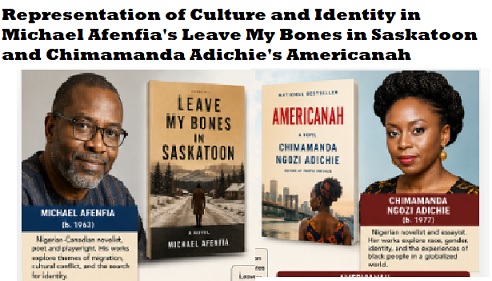
Representation of Culture and Identity in Michael Afenfia’s Leave My Bones in Saskatoon and Chimamanda Adichie’s Americanah
CHAPTER ONE
INTRODUCTION
1.1 Background to the Study
The representation of culture and identity in contemporary Nigerian literature is a dynamic field that encapsulates the tensions and negotiations inherent in a postcolonial and increasingly globalized world. Nigerian literature, historically rooted in the oral traditions and colonial experiences of the nation, has evolved to become a medium through which the complexities of Nigerian identity are explored and articulated. This evolution is particularly evident in the works of contemporary writers like Michael Afenfia and Chimamanda Ngozi Adichie, whose novels engage deeply with the themes of culture, identity, migration, and the challenges of navigating multiple cultural landscapes. Their works are emblematic of a broader literary movement that seeks to address the multifaceted nature of identity in a globalized world, where traditional cultural boundaries are constantly being challenged and redefined. (Dada, 207)
According to Atte, Culture is learned behaviour which each person acquires as a member of a group or society. Therefore, each character is a product of its unique history. Culture is an extensive feature of a group or society, also, it is a mark of identification and something that the individuals or groups could easily get sentimental about. (11) Though the Encarta English Dictionary (2229) has different definition of culture varying from “arts collectively”, “knowledge and sophistication”, “share beliefs and practices” and so on, but the definition that best suits our course of study is that of Amadi which states that:
Cultures are beliefs, customs, practices and social behaviour of a particular nation or people. Also, it can be a group of people whose shared beliefs and practices identify the particular place, class, or time to which they belong. (209)
In the same vein, Awolalu and Dopamu also added that Culture is a human characteristic in which man expresses the totality of his ways of life in a collection setting. It can also be referred to as some total human activities shared by the member of the group, being a sentimental phenomenon which an individual not only cherishes, but also protects dearly. Thus, literature becomes the medium through which cultural and traditional sentiments are expressed and projected (103).
In the like manner, Dennis, and Cosmos also added that Africans in particular have, for a long time, been subjected to cultural imposition and displacement of foreign culture. This was due to the invasion by Europeans in the African regions. This does not mean that Africans received this foreign culture whole-heartedly. There was resistance and there has continued to be resistance through African arts, ethnic and culture. As a result of this resistance, the conflict between the Western World and Africans began to manifest. Today, plays that are protestant in nature are being written to this effect. (56-60)
African literary writers are victims of cultural imperialism as a result of colonial rule of the European, therefore, at the same time, they try to force themselves out from colonial cultural imposition while projecting and glorify traditional cultures. In the words of Adeyemi (1993) citing Olurunmoye (15) “culture supplies us our habits of life…” Harrison opine that with the advent of civil rule, new Nigerian writers are quick to dispense with literature imbued with serious socio-political messages.
The high hope associated with civilian dispensation unequivocally influences their thematic thrusts which now centre on individuality, promiscuity, sex, women are wine. Since their works are meant for audiences who care no hoot about cultural revitalisation, they flood the literary arena with themes which negate the core African values cherished by their predecessors. (73) While also evaluating recent Nigerian fiction, Nnolim (201) argues that where the first generation of African writers had a general thematic focus, Africa’s cultural encounter with Europe and the fight against apartheid and colonialism, the second-generation writers fought ideological battles for social equality, for feminism, contemporary African writers lack a clearly defined thematic focus. (207)
He stresses that instead, what we have in recent Nigerian fiction, are disinherited people who have abandoned “home” and converged in Lagos (no man’s land) searching for quintessential pleasure, through sluice-gates of debauchery, drinking, motoring as doubtful palliatives and suspect compensations in bars and brothels. This is why he concludes: “…in recent Nigerian fiction, … there is a corruption of the Nigerian dream, there is an absence of a national ethos, there is a sense of estrangement, of cultural disinheritance….” and observes that “…recent Nigerian writing is no more cheering.” (217) On the contrary, submissions by some other scholars and critics point to the obvious fact that recent Nigerian writers, novelists, in particular, have been depicting the rich cultural values and other important issues of their society in their works. According to Ojaide:
The third generation of African writers…learned from their literary elders the power of culture in a people’s literary tradition. That is why they took that aspect their writing but shed the use of what has come to be described a la Chinweizu as “euro-modernist Hopskins disease.” I think the third generation took over from where the second generation stopped…In fact, what makes the third generation to flourish is folktales and use Ibo moralistic proverbs among others, to boost the aesthetic zest of their narratives and show the world that Africans and the Igbo particularly, have a great pride in their culture, people and country. Therefore, the writers have gallantly converted their bilingual challenge to literary gifts, which they have exploited to reveal to the world at large the culture, traditions and heritage of the African people. (136)
The above submissions are good proof that recent Nigerian writers are concerned with the cultural experiences of their society and thematise them in their works.
Despite the recent influences on recent Nigerian fiction, there are still many recent Nigerian writers who are conscious of and are concerned with the preservation and promotion of their cultural experiences and therefore project them through their works copiously. These writers have demonstrated that they are aware, as Nnolim (25) stresses that the survival of our cultures and folkways depends on artists. They, like their predecessors, have therefore continued to respect, copy from, make use of, and owe allegiance to our folk literature, folk tale, local myths, et cetera, in giving expression to our national culture in line with the definition of the Nigerian tradition in the novel given by Nnolim (25). Just as Abubakar, points out in the case of the early African novel in general, folklore motifs equally abound in the contemporary Nigerian novel. This is evident in the profuse use of Nigerian imagery, proverbs, local customs and practices; beliefs, mystery, magic, witchcraft, axioms, adages, social habits, modes of thoughts and actions, and traditional heroic songs.
Representation of Culture and Identity in Michael Afenfia’s Leave My Bones in Saskatoon and Chimamanda Adichie’s Americanah
The movement and evolution of African literature are largely influenced by factors such as migration, globalization, and related concepts like exile, transnationality, and multilocality, all of which impact the cultural identity, aesthetics, content, and forms of literary works by Africans living abroad (Ojaide, 43). Since many 21st-century African writers are migrants themselves, they are uniquely positioned to explore issues of mobility that they personally experience. Themes such as identity crisis, mothering, dis/order, exilic consciousness, homesickness, non-belonging, racial discrimination, the quest for identity, multiple homelands, homelessness, and unhomeliness are central to the works of contemporary African migrant writers. The motif of mobility in African literature represents a significant and enduring transformation.
Identity crisis, discrimination, humiliation, and trauma of displacement have been the unforgettable experience of most African migrants. Okpeyemi comments that “homelessness and … unhomeliness of home constitute a traumatising reality for migrants …” (67). Therefore, the African man who is on the ‘path of becoming’ is left to suffer the harsh realities of displacement, and punctuated and polluted socio-cultural identity which equally affect their thought patterns and relationships. Many of them do not suffer the spatio-temporal loss of home and relations alone; they equally suffer from disillusionment, and frustrated realities. Maxwell states that migrants assume the West to be centre of possibilities, fulfilment of dreams, and where identity and destinies could be transformed (251).
However, they are oblivious of the fact that the West is equally the centre of brutality and subjugation, disappointment and frustration. In Chimamanda Adichie’s The Thing Around Your Neck , Akunna expresses her fantasies of getting a better life as soon as she arrives at the United States. But her hope is upset by diasporic conditions that dawn on her in the hostland. Like other African migrants, she regrets ever leaving home, gets disillusioned, and feels alienated from her root. Maxwell avers that “a valid and active sense of self may have been eroded by dislocation resulting from migration, the experience of enslavement, transportation or voluntary removal for indentured labour” (252).
It is this lack of original self-identity (which is caused by the voluntary and involuntary continuous movement) that actually brings a double identity or hybridity. The dynamics of defining ‘self’ and finding a space for ‘self’ by African migrants have open up chats on diasporic identity codes. Lubkemann opines that “diaspericity” should be understood in terms of identity discourse in which the socially determined ‘self’ of the migrants lives within the periphery of imagination and “publicly presented through particular types of claim about group origins” (78). Lubkemann seems to state that all diasporic identities are just ordinary claims for social reckoning. Invariably, hybrid identities are false identities, a cover-up of the extreme brutal experience of the African migrants
Michael Afenfia’s Leave My Bones in Saskatoon provides a profound exploration of the immigrant experience, focusing on the protagonist’s struggle to preserve his Nigerian cultural identity while adapting to life in Canada. The novel portrays the immigrant experience as one of constant negotiation and compromise, where the protagonist is torn between the desire to assimilate into Canadian society and the need to retain a connection to his Nigerian roots.
Afenfia delves into the psychological and emotional challenges that accompany this process, highlighting the sense of dislocation and alienation that often characterizes the immigrant experience. The protagonist’s struggle is not merely a personal one; it is reflective of a broader cultural dilemma faced by many immigrants, who must navigate the often conflicting demands of their adopted country and their homeland. The novel’s depiction of cultural nostalgia, where the protagonist yearns for the familiarity of Nigerian customs and traditions, underscores the deep emotional ties that bind individuals to their cultural heritage, even when they are physically distant from it.
In contrast, Chimamanda Ngozi Adichie’s Americanah offers a broader exploration of identity, focusing not only on the immigrant experience but also on the intersectionality of race, gender, and culture in a globalized world. The novel follows Ifemelu, a young Nigerian woman who moves to the United States for her education, and who must navigate the complexities of race and identity in a society that views her primarily through the lens of her race. Adichie uses Ifemelu’s experiences to critique the racial dynamics in American society, particularly the ways in which African identity is often homogenized and misunderstood by Western perceptions. Ifemelu’s journey is one of self-discovery, where she grapples with the tension between her Nigerian identity and the cultural norms of her new environment. Through her blog, “The Non-American Black,” Adichie provides a platform for candid discussions on race and identity, challenging the reader to confront the often uncomfortable realities of racism, privilege, and the immigrant experience in America.
Adichie’s narrative structure, which moves between different time periods and locations, reflects the fluid and evolving nature of identity, suggesting that identity is not a fixed or static concept but one that is constantly being shaped and reshaped by personal experiences and social contexts (Adichie 190). The novel’s exploration of hair as a symbol of identity further illustrates this point. Ifemelu’s decision to stop straightening her hair and embrace her natural texture becomes a powerful statement of self-acceptance and resistance against societal expectations (Adichie 298). This act of reclaiming her natural hair is symbolic of her broader journey towards self-affirmation, where she rejects the pressure to conform to Western standards of beauty and instead embraces her Nigerian heritage.
The comparative study of Leave My Bones in Saskatoon and Americanah reveals the diverse ways in which contemporary Nigerian literature addresses the themes of culture and identity. While Afenfia’s novel focuses on the immigrant experience and the challenges of cultural preservation in a diaspora context, Adichie’s work expands the discussion to include the intersectionality of race and identity in a globalized world. Both novels, however, underscore the fluid and dynamic nature of identity, illustrating how it is continually shaped and reshaped by personal experiences, cultural influences, and societal expectations. It is against this backdrop that this study seeks to examine representation of culture and identity in contemporary Nigerian literature in Michael Afenfia’s Leave My Bones in Saskatoon and Chimamanda Adichie’s Americanah.
Representation of Culture and Identity in Michael Afenfia’s Leave My Bones in Saskatoon and Chimamanda Adichie’s Americanah
1.2 Statement of the Problem
The exploration of culture and identity in contemporary Nigerian literature has become increasingly significant as globalization, migration, and transnationalism continue to reshape the lives of Nigerians both within and outside the country. Nigerian authors such as Chimamanda Ngozi Adichie and Michael Afenfia have produced works that delve into the complexities of cultural identity, examining how characters navigate the tensions between their Nigerian heritage and the demands of life in the diaspora. Despite the growing body of literature that addresses these themes, there remains a need for a more nuanced comparative analysis that situates these narratives within the broader discourse on identity in a globalized world. Existing studies tend to focus on individual works in isolation, often neglecting the potential insights that can be gained from a comparative approach that examines how different authors address similar themes in diverse contexts.
Past research has explored various aspects of identity and culture in Nigerian literature. For example, scholars have examined how Adichie’s Americanah addresses the intersection of race, gender, and cultural identity in the context of migration, focusing on the protagonist’s experiences in the United States and the challenges she faces in reconciling her Nigerian identity with her new environment (Okuyade 2015).
Similarly, Afenfia’s Leave My Bones in Saskatoon has been analyzed in terms of its portrayal of the immigrant experience, particularly the protagonist’s struggle to maintain cultural ties while adapting to life in Canada (Irele 2021). However, these studies have primarily been conducted separately, with little attention paid to how these works might be compared to provide a more comprehensive understanding of how contemporary Nigerian literature engages with the themes of culture and identity.
The gap that this study seeks to fill lies in the lack of a comparative framework that brings together the works of Adichie and Afenfia to explore the representation of cultural identity in Nigerian literature. By comparing Leave My Bones in Saskatoon and Americanah, this research aims to uncover the ways in which these authors approach the negotiation of identity in different socio-political contexts, and how their narratives reflect the broader experiences of Nigerians in the diaspora. This study will contribute to the existing scholarship by offering a deeper understanding of the complexities of cultural identity in contemporary Nigerian literature, providing insights into how Nigerian authors engage with the challenges of globalization, migration, and identity formation in a diverse and rapidly changing world.
1.3 Aims and Objectives
The primary aim of this study is to conduct a comparative analysis of the representation of culture and identity in contemporary Nigerian literature, specifically through the examination of Michael Afenfia’s Leave My Bones in Saskatoon and Chimamanda Ngozi Adichie’s Americanah. The study seeks to explore how these novels portray the complexities of cultural identity in the context of migration and globalization, and to understand the broader implications of these representations for the discourse on identity in Nigerian literature. However, the specific objectives are to:
- to analyze the portrayal of cultural identity in Leave My Bones in Saskatoon and Americanah
- to compare the narrative strategies used by Afenfia and Adichie to explore identity and culture
- to investigate the role of migration in the shaping of cultural identity as depicted in the novels
- to examine the influence of socio-political contexts on identity formation in the novels
1.4 Scope of the Study
This study focuses on the comparative analysis of cultural identity and its representation in contemporary Nigerian literature, specifically through the examination of Michael Afenfia’s Leave My Bones in Saskatoon and Chimamanda Ngozi Adichie’s Americanah. The scope is limited to these two novels, as they provide rich, contrasting perspectives on the themes of identity, culture, migration, and the diasporic experience. The study will explore how each author addresses the challenges and complexities of identity formation in the context of migration, examining the narrative techniques, character development, and thematic concerns within both works. It will also consider the influence of socio-political contexts in Canada and the United States on the characters’ cultural identities, as portrayed in the novels.
The analysis will be confined to the textual content of the novels, drawing on relevant secondary literature to support the examination of the themes and narrative strategies employed by the authors. While the study may touch on broader concepts of postcolonialism, globalization, and identity politics, it will not extend into an exhaustive analysis of these theories beyond their relevance to the selected texts. The study will primarily engage with the experiences and perspectives of the protagonists in the novels, rather than attempting to generalize the findings to all Nigerian literature or diaspora literature at large.
Representation of Culture and Identity in Michael Afenfia’s Leave My Bones in Saskatoon and Chimamanda Adichie’s Americanah
1.5 Methodology and theoretical framework (abstract)
This study employs a qualitative research methodology, focusing on textual analysis as the primary method for exploring the representation of culture and identity in Michael Afenfia’s Leave My Bones in Saskatoon and Chimamanda Ngozi Adichie’s Americanah. The research involves a close reading of the selected novels to identify and analyze key themes, narrative structures, character development, and the portrayal of cultural identity in the context of migration and globalization.
The study will conduct an in-depth analysis of the novels, examining how the authors depict the complexities of cultural identity through their characters, narrative techniques, and thematic concerns. Specific passages from the texts will be analyzed to uncover how each author represents the challenges of identity formation, cultural dislocation, and the negotiation of cultural differences in the diaspora. The analysis will be guided by relevant literary theories and concepts, ensuring a systematic approach to understanding the texts.
A comparative approach will be used to highlight the similarities and differences in the representation of cultural identity between the two novels. This will involve comparing the narrative strategies employed by Afenfia and Adichie, as well as examining how each author’s portrayal of migration and identity is shaped by the different socio-political contexts of Canada and the United States. The study will also include a review of existing scholarly literature on both novels, as well as relevant research on identity, culture, migration, and postcolonial theory in Nigerian literature. This will provide a contextual framework for the analysis, situating the study within the broader discourse on identity in contemporary Nigerian literature.
The theoretical framework for this study is grounded in postcolonial theory, which provides a lens through which the complexities of cultural identity, migration, and globalization can be examined. Additionally, the study will draw on the concepts of hybridity and diaspora, as articulated by scholars such as Homi K. Bhabha, Stuart Hall, and Paul Gilroy. Postcolonial theory is central to understanding how the legacies of colonialism continue to shape cultural identities in contemporary literature.
This framework will be used to analyze how Afenfia and Adichie address issues of cultural dislocation, identity crisis, and the tension between tradition and modernity in their novels. Homi Bhabha’s concept of the “third space” will be particularly useful in exploring the hybrid identities that emerge in the diaspora, where characters are caught between their native culture and the dominant culture of their new environment (Bhabha 56).
1.6 Justification for the Study
This study is justified by the growing need to understand how contemporary Nigerian literature engages with the complexities of cultural identity in the context of globalization, migration, and the postcolonial experience. As Nigerian authors like Chimamanda Ngozi Adichie and Michael Afenfia gain increasing recognition on the global stage, their works provide valuable insights into the ways in which Nigerian culture and identity are negotiated in diverse and often challenging environments. However, despite the rich narratives and themes explored in their literature, there remains a significant gap in the scholarly analysis of these works, particularly from a comparative perspective.
First, the comparative analysis of Leave My Bones in Saskatoon and Americanah addresses a gap in the literature by exploring how different authors portray similar themes of cultural identity, migration, and diaspora in distinct socio-political contexts. While both novels examine the experiences of Nigerians in the diaspora, they offer unique perspectives shaped by the specific settings of Canada and the United States. This study provides a deeper understanding of how these authors approach the negotiation of identity in different cultural and political environments, contributing to the broader discourse on identity formation in a globalized world.
Second, this study is significant because it brings attention to Michael Afenfia’s work, which, despite its relevance, has not received the same level of critical attention as Adichie’s Americanah. By including Leave My Bones in Saskatoon in this comparative analysis, the study broadens the scope of Nigerian literature being considered in scholarly discussions, highlighting the diversity of voices and perspectives within contemporary Nigerian writing. This is particularly important in ensuring that the literary contributions of lesser-known but equally important authors are recognized and analyzed within the context of postcolonial and diaspora studies.
Moreover, the study’s focus on the themes of cultural dislocation, hybridity, and identity negotiation is timely and relevant in today’s increasingly interconnected world. As issues of migration, cultural exchange, and identity become more prominent globally, literature serves as a crucial medium through which these experiences are articulated and understood. By examining how Nigerian authors depict these themes, the study not only contributes to literary scholarship but also offers insights into the broader societal and cultural challenges faced by migrants and diaspora communities.
Finally, this study contributes to the theoretical development of postcolonial and diaspora studies by applying these frameworks to a comparative analysis of Nigerian literature. It challenges and expands existing interpretations of identity and culture in postcolonial contexts, offering new perspectives on how Nigerian writers engage with the legacies of colonialism and the realities of a globalized world. This contribution is particularly valuable in advancing scholarly debates on the intersection of culture, identity, and literature in postcolonial and diasporic settings.
Representation of Culture and Identity in Michael Afenfia’s Leave My Bones in Saskatoon and Chimamanda Adichie’s Americanah
1.7 Organisation of the Study.
This study is structured into five chapters, each designed to systematically address the research objectives and provide a comprehensive analysis of the representation of culture and identity in Michael Afenfia’s Leave My Bones in Saskatoon and Chimamanda Ngozi Adichie’s Americanah. The organization is as follows:
Chapter One: This chapter introduces the study, providing the background to the research, the statement of the problem, the aims and objectives, and the justification of the study. It also outlines the scope of the research and provides a brief overview of the methodology and theoretical framework employed. The chapter concludes with a summary of the organization of the study.
Chapter Two: Literature Review: This chapter presents an Introduction, a comprehensive review of existing literature related to the study’s themes of culture, identity, migration, and diaspora in Nigerian literature. Theoretical framework (in-depth analysis). It examines previous research on both Leave My Bones in Saskatoon and Americanah, as well as broader scholarly discussions on postcolonial theory, hybridity, and the negotiation of identity in diaspora literature. The chapter identifies gaps in the existing scholarship that the current study seeks to address and situates the research within the broader context of Nigerian and postcolonial literary studies.
Chapter Three: This chapter outlines the chapter also details the research methodology, including the qualitative approach, textual analysis, and comparative analysis employed in the study. Additionally, the chapter discusses the selection criteria for the texts and the process of data collection and analysis and the synopsis of the two texts.
Chapter Four: This chapter provides the core analysis of the study, comparing the representation of culture and identity in the two novels. It examines how Afenfia and Adichie portray the experiences of their protagonists in the diaspora, focusing on themes such as cultural dislocation, identity negotiation, and the impact of socio-political contexts on identity formation. The chapter also analyzes the narrative strategies and literary techniques used by both authors to convey the complexities of cultural identity and migration.
Chapter Five: The final chapter summarizes the key findings of the study, highlighting the similarities and differences in the representation of culture and identity in the two novels. It discusses the implications of these findings for the understanding of contemporary Nigerian literature and the broader discourse on identity in postcolonial and diasporic contexts.
The chapter also provides recommendations for future research, suggesting areas where further comparative studies could enhance the understanding of identity and culture in Nigerian and global literature. The study concludes with reflections on the contributions of the research to literary scholarship and its relevance to ongoing discussions on migration, identity, and cultural exchange. Each chapter is designed to build on the previous one, creating a coherent and comprehensive analysis of the research topic.