Leadership Challenges in Contemporary Nigeria: An Analysis of Selected Poems of Niyi Osundare

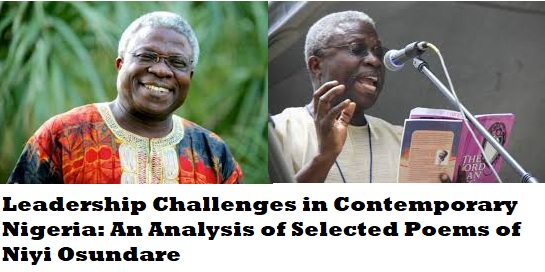
Leadership Challenges in Contemporary Nigeria: An Analysis of Selected Poems of Niyi Osundare
CHAPTER ONE
INTRODUCTION
1.1 Background to the Study
As the day goes by, Nigeria plunges deeper into corruption and almost all her institutions have been infested by this disease which is seemingly becoming incurable. Corruption a phenomenon identified as one of the several societal disorders destroying Africa (Igwe, 2010. p 88), has become so pervasive that Babatope, (1981) one of the country’s social critics, was forced to conclude that Nigeria had become another name for corruption (p.7). A literary artist serves as the public’s eyes, ears, mouthpiece, crusader, and moral conscience (Ozoh, 2020. P. 43-44) and consequently, writers have continuously portrayed the level of moral decadence exhibited by political leaders.
The essence of depicting these social ills in literary works is not just as a tool for exposing such vices, but curtailing and perhaps eradicating them from the society. There must be more than simply political will, determination, and courage required to carry out reformative action in a corrupt institution. These characteristics are crucial, but the reformer also needs to be intellectually and strategically prepared for any darts that the small Kleptocratic governing elite may hurl (Chinaka, 2022, p. 81).
Leadership is widely recognized as a key determinant of a nation’s development, particularly in emerging economies like Nigeria, where governance structures remain fragile and often unstable. Over the years, Nigeria has faced significant leadership challenges, from the colonial era through the post-independence period to contemporary times. These challenges are deeply entrenched in issues such as corruption, nepotism, mismanagement of resources, and a lack of accountability, all of which have hindered the nation’s progress. Despite Nigeria’s vast natural resources and strategic position as the largest economy in Africa, the country continues to grapple with poverty, unemployment, insecurity, and underdevelopment, much of which can be traced to failed leadership (Ake 1981, p. 45).
Sharma and Jain (2013) view leadership as a process in which an individual encourages others to achieve a goal and manages the organisation in a way that makes it stronger and functional (p.310). To Shanum, the growth of every nation is determined by the standard of its leadership and how it can apply this to the welfare of the people. By his definition, every nation is defined by its quality of leadership. However, the populace has been reduced to poverty despite the country’s vast natural and human resources because Nigeria’s government has prioritised selfish desires over human and social well-being (Kure, 20220, p. 4). This level of decay in the general wellbeing of Nigerians is a result of corruption.
According to Abu corruption is deeply ingrained in practically every sector of the economy, including the various branches of government executive, legislative, and judicial sectors (33). In a study by Ogbonnaya,(2018) he stated that corruption in Nigeria has become an increasingly common term- an epidemic that has sprouted its ugly head in almost every society and institution (p.128). Ukase and Audu, (2015) defined it as the bane of Nigeria’s democratic state (p.175). Kure went ahead and listed poor leadership and misappropriation as major contributors to corruption in Nigeria. He further stated that what we face in Nigeria today is a result of two major factors- indecisiveness of leadership and the irresponsible lifestyle adopted by Nigerian politicians (p.6). Anikpe, (2022) further stated that the corruption and executive abuse of power have continued to grow in Nigeria simply because the Nigerian citizens have allowed it to remain so (p.995).
The failure of leadership in Nigeria has been a recurring theme in Nigerian literature, especially in the works of poets and writers who serve as the voice of the marginalized and the oppressed. Literature, in this regard, is more than just an art form; it becomes a tool for social change, offering critiques of the political and social status quo. Niyi Osundare, one of Nigeria’s most celebrated poets, has established himself as a leading figure in this tradition, using his poetry to confront the failures of leadership in Nigeria. His works are not only reflections of the socio-political realities of his time but also calls for accountability and responsible governance.
Osundare’s poetry is marked by his use of simple yet profound language, drawing heavily on African oral traditions, proverbs, and folktales to communicate his messages. His poems are accessible to a wide audience, particularly the masses, whom he considers the victims of poor leadership. His critiques of leadership are often scathing, with a focus on the corruption, greed, and self-serving nature of Nigerian politicians. In his view, the disconnection between the leaders and the people is one of the fundamental reasons for the country’s persistent challenges. As Osundare asserts, leadership should be rooted in the service of the people, yet in Nigeria, it has become a tool for personal enrichment and exploitation (Osundare 1993, p. 10).
The leadership crisis in Nigeria is intricately linked to issues of corruption, which Osundare frequently highlights in his poetry. In many of his works, he paints a vivid picture of a nation where leaders prioritize their interests over the needs of the people. For instance, in his poem “The Leader and the Led,” Osundare metaphorically illustrates the dysfunctional relationship between leaders and followers, symbolizing the former as predators who devour the latter (Osundare 2002, p. 13). The poet uses animal imagery to expose the parasitic nature of leadership in Nigeria, where those in power are likened to predators that prey on the weak and vulnerable.
Another key theme in Osundare’s critique of leadership is the theme of oppression. The masses are portrayed as victims of an oppressive system in which the ruling elite remain disconnected from the struggles of ordinary Nigerians. Osundare’s poetry reflects the frustrations of the common man, echoing the disillusionment with leaders who promise change but deliver nothing. His works, such as Songs of the Marketplace (1983), emphasize the erosion of public trust in political leadership. In these poems, the marketplace serves as a metaphor for the public arena, where broken promises and shattered dreams are sold to the masses, leaving them trapped in a cycle of poverty and deprivation (Osundare 1983, p. 28).
Leadership Challenges in Contemporary Nigeria: An Analysis of Selected Poems of Niyi Osundare
Additionally, Osundare’s poetry examines the economic consequences of poor leadership. His works often detail the squandering of national resources, with oil, a significant contributor to Nigeria’s economy, symbolizing the greed and mismanagement by those in power. In poems like “Dying in Petrol Queue,” he provides a stark portrayal of the hardships faced by Nigerians due to the failure of governance in managing the country’s wealth (Osundare 2015, p. 5). The poet uses powerful imagery to depict the suffering caused by leaders who prioritize personal wealth over national prosperity, thereby reinforcing the idea that Nigeria’s leadership crisis is at the heart of its economic instability.
Osundare’s focus on leadership is not limited to the present; he often draws on historical and cultural references to demonstrate that the current crisis is part of a larger pattern of misrule in postcolonial African societies. His poems often call for a re-evaluation of African leadership models, suggesting that a return to traditional African values of communalism, accountability, and justice could offer a solution to the current malaise. His critique is thus not only political but also cultural, as he believes that the erosion of values has contributed to the leadership problems Nigeria faces today (Osundare 1999, p. 32).
The urgency of addressing leadership challenges in Nigeria is emphasized throughout Osundare’s body of work. He views poetry as a vehicle for social reform, using his craft to inspire change and awaken the consciousness of his readers. As Osundare himself asserts, “Poetry is not the dance of the elite, but the voice of the common man” (Osundare 1996, p. 19). Through his poems, he demands accountability from those in power and calls on the people to hold their leaders responsible for their actions. His vision of leadership is one rooted in integrity, service, and a commitment to the collective good.
This study, therefore, seeks to provide an in-depth analysis of selected poems of Niyi Osundare, focusing on the leadership challenges they address in contemporary Nigeria. By examining the thematic concerns, imagery, and stylistic choices in Osundare’s poetry, this research will shed light on the poet’s critique of leadership and governance. The study will explore how Osundare’s poetic voice reflects the larger socio-political context of Nigeria, offering insights into the potential pathways for reform. Ultimately, this analysis will contribute to the broader discourse on leadership in Nigeria, highlighting the role of literature in shaping public opinion and advocating for positive change.
1.2 Statement of the Problem
Despite Nigeria’s abundant natural resources and its position as a key player in Africa, the country continues to face persistent socio-political and economic challenges. At the heart of these issues lies the problem of ineffective and corrupt leadership, which has led to widespread poverty, unemployment, insecurity, and the stagnation of national development. The failure of Nigerian leaders to address the pressing needs of the population has created a disillusioned citizenry and has contributed to the erosion of trust in governance. This leadership crisis manifests in mismanagement of resources, lack of accountability, nepotism, and widespread corruption, factors that have prevented Nigeria from achieving its full potential.
The gap between Nigeria’s leaders and the people they serve has been a subject of critique in various forms of literature, particularly poetry. Niyi Osundare, a prominent Nigerian poet, has used his works to provide sharp criticisms of the nation’s leadership, exposing the failures of governance and the impact these failures have had on ordinary Nigerians. His poems present vivid portrayals of a nation plagued by greed, oppression, and the exploitation of the masses by a self-serving elite.
However, while Osundare’s poetry offers a powerful critique of leadership, there remains limited scholarly exploration into how his poetic works specifically address the contemporary leadership challenges facing Nigeria. Although his poems clearly reflect the socio-political climate of the nation, there is a need for a detailed analysis of how he uses language, imagery, and symbolism to depict these leadership crises. More importantly, it is essential to explore how his works resonate with the ongoing discourse on leadership in Nigeria and how they might offer solutions or reflections that can guide future reforms.
This study, therefore, seeks to bridge this gap by providing a comprehensive analysis of selected poems of Niyi Osundare in relation to the leadership challenges in contemporary Nigeria. It will critically examine the themes of corruption, misrule, oppression, and economic mismanagement, as depicted in his poetry, and evaluate how these themes mirror the reality of Nigeria’s leadership problems. The research aims to demonstrate how Osundare’s poetry serves as both a reflection of Nigeria’s leadership crisis and a call for accountability, justice, and reform.
1.3 Aim and Objectives
The primary aim of this study is to critically analyze the leadership challenges in contemporary Nigeria through the lens of selected poems by Niyi Osundare. The study seeks to explore how Osundare’s poetry critiques the failures of leadership, exposes the socio-political realities of Nigeria, and advocates for reform. Specifically, the objectives of the study are:
- to examine the thematic representation of leadership failures in Niyi Osundare’s selected poems, focusing on issues such as corruption, mismanagement, and oppression.
- to explore how Osundare’s poetry reflects the socio-political and economic conditions in Nigeria, particularly the impact of poor leadership on the masses.
- to investigate Osundare’s vision of leadership and governance, as portrayed in his poetry, and assess how these ideas contribute to the ongoing discourse on leadership reform in Nigeria.
- to analyze how Osundare uses literary devices such as imagery, symbolism, and metaphor to convey his critique of Nigerian leadership
1.4 Research Questions
The following research questions were formulated to guide the study:
- How does Niyi Osundare’s poetry depict the leadership failures in contemporary Nigeria?
- In what ways do Osundare’s poems reflect the socio-political and economic realities of Nigeria, particularly the consequences of poor leadership on the masses?
- What is Osundare’s vision of effective leadership, and how does he propose solutions to Nigeria’s leadership crisis in his poetry?
- What literary devices (such as imagery, symbolism, and metaphor) does Osundare employ to critique Nigerian leadership?
1.5 Scope of the study
This study focuses on a critical analysis of selected poems by Niyi Osundare (“The Leader and the Led”, “The Oil Thieves of thief Country”, “Incompetence Weds Corruption”, “The Politician’s Two Mouths”, “Remember Rwanda”, “Dancing Politician”, “The House of Hunger 2”, “Dying in the Petrol Queue”, “Snapsong 220” and “Random Snaps 219”) that address leadership challenges in contemporary Nigeria. The scope is limited to the 10 selected poems that explicitly critique political governance, corruption, social injustice, and the socio-economic consequences of poor leadership in Nigeria. The study will explore the thematic concerns and literary techniques employed by Osundare to convey his critique of Nigerian leadership.
1.6 Significance of the Study
This study holds significant importance for various academic, socio-political, and cultural spheres. It contributes to the existing body of literature on Nigerian poetry by offering a detailed analysis of Niyi Osundare’s works, specifically focusing on his critique of leadership in Nigeria. By examining the intersection between poetry and governance, this research highlights how literature serves as a platform for socio-political engagement, offering insights into the failures and potential reform of leadership in Nigeria.
- Contribution to Literary Scholarship: This study adds to the critical discourse on African literature, particularly Nigerian poetry, by analyzing how Osundare uses his art to engage with the political realities of his society. It provides an in-depth exploration of the themes, literary devices, and imagery in Osundare’s poetry, offering scholars new perspectives on his contributions to contemporary African literature.
- Insight into Nigerian Leadership: The study provides a critical reflection on the leadership challenges facing Nigeria, focusing on issues like corruption, misrule, and oppression. Through Osundare’s poetry, it offers an alternative lens to understand how the failures of governance have affected the socio-economic development of the country and its people. This analysis can contribute to ongoing debates on governance reform and leadership accountability.
- Social and Political Relevance: By analyzing Osundare’s poetry as a tool for social change, the study underscores the role of literature in raising awareness about pressing issues. It demonstrates how poetry can serve as a form of resistance and advocacy, empowering citizens to hold leaders accountable and demand good governance. This is particularly relevant in the Nigerian context, where literature has historically played a role in challenging oppressive systems.
- Cultural and Educational Value: This study will serve as a valuable resource for students, educators, and researchers interested in the relationship between literature and politics. It encourages a deeper understanding of how literary texts can reflect and influence real-world events, particularly in postcolonial societies like Nigeria.
Leadership Challenges in Contemporary Nigeria: An Analysis of Selected Poems of Niyi Osundare
CHAPTER FIVE
SUMMARY AND CONCLUSION
5.1 Summary
This study was to examine “Leadership Challenges in Contemporary Nigeria: An Analysis of Selected Poems of Niyi Osundare,” the study explore the intricate and often fraught relationship between leadership and societal wellbeing in Nigeria, as reflected in the literary works of Niyi Osundare. Through a close reading of the poems provided in the uploaded document, this study aims to uncover the layers of critique embedded in Osundare’s poetic expression, focusing on how he addresses the multifaceted challenges of leadership in contemporary Nigeria. This research aims was to unpack the multifaceted challenges that Nigerian leadership faces, as captured in Osundare’s selected poems. These poems are not merely artistic expressions but serve as powerful critiques of the socio-political landscape in Nigeria, offering a reflective and often critical examination of the country’s leadership since independence.
Osundare’s poetry is deeply rooted in the Nigerian experience, and his work reflects a profound understanding of the country’s history, culture, and politics. His poems address various themes, including corruption, incompetence, moral decay, and the failure of leadership to meet the needs of the people. Through his masterful use of literary devices such as symbolism, irony, and vivid imagery, Osundare paints a compelling picture of the leadership crisis that has plagued Nigeria for decades. One of the central aspects of this research is the exploration of how Osundare uses allegory and symbolism to represent different types of leaders and leadership styles.
For instance, in “The Leader and the Led,” he employs animals as symbols to depict various leadership qualities, ranging from the authoritarian lion to the passive lamb. This poem is a profound commentary on the dangers of extreme leadership styles and the need for balance and wisdom in governance. The allegorical representation invites readers to reflect on the qualities that are essential for effective leadership, emphasizing that the success of a nation depends on the character and actions of its leaders.
Another critical focus of the research is Osundare’s critique of corruption and its pervasive influence on Nigerian society. In poems like “The Oil Thieves of Thief Country,” Osundare vividly depicts the moral and ethical decay that corruption breeds within the political class. His language is sharp and direct, using phrases like “Prince prophet by day, A plundering pirate by night” to expose the hypocrisy and duplicity of those in power. This poem, along with others, highlights how the exploitation of resources by corrupt leaders not only impoverishes the nation but also erodes the social and moral fabric of society. Osundare’s critique extends beyond the actions of individual leaders to the systemic corruption that has become entrenched in the Nigerian political system.
In poems like “Incompetent Leaders,” Osundare takes a more direct approach, using blunt and accusatory language to express his frustration with the lack of capable leadership in Nigeria. The rhetorical questions posed throughout the poem challenge the reader to consider the consequences of poor leadership, emphasizing the need for more competent and visionary leaders. This poem, like many others in Osundare’s oeuvre, reflects a deep sense of disillusionment with the current state of Nigerian leadership, while also serving as a call to action for change.
“The Politician’s Dance” is another poem that uses metaphor and irony to critique the erratic and self-serving behavior of Nigerian politicians. The metaphor of dance, described as chaotic and deceptive, symbolizes the dissonance between the public image of politicians and their true intentions. Osundare’s use of irony in describing this dance as a “national pastime” critiques the normalization of political corruption and the apathy of the citizenry. This poem underscores the idea that the failures of leadership are not just the fault of those in power but also reflect a broader societal acceptance of corruption and incompetence.
The research also explores Osundare’s use of emotionally charged language and imagery to convey the impact of leadership failures on Nigerian society. In ” Dying in the Petrol Queue” for example, Osundare mourns the loss of children due to the government’s inability to protect its citizens. The poem’s elegiac tone and the use of phrases like “blood diamonds from the belly of our land” convey the tragic irony of a nation rich in resources yet plagued by violence and suffering. This poem, like many others, serves as a powerful indictment of a leadership that has failed to fulfill its most basic responsibilities.
In poems like “Snapsong 220 and Random Snaps 219,” Osundare shifts focus to the theme of liberation and the ongoing struggle for freedom in Nigeria. Using biblical allusions and rhythmic repetition, he creates a sense of urgency and moral authority, drawing parallels between the biblical Exodus and contemporary struggles for justice. These poems serve as rallying cries for change, urging Nigerians to rise against oppression and demand better leadership.
The use of repetition and rhythmic flow in “Freedom Song” adds to its uplifting message, making it a powerful anthem for those fighting for freedom and justice. This research highlights the power of Niyi Osundare’s poetry as a tool for social and political critique. Through his masterful use of literary devices, Osundare not only exposes the failures of Nigerian leadership but also challenges his readers to engage critically with the issues of governance and leadership. His poems reflect a deep concern for the future of Nigeria, calling for a transformation in leadership that is essential for the country’s progress. This study contributes to the broader understanding of how literature can serve as a powerful vehicle for social and political change, particularly in the context of Nigeria’s ongoing struggles with leadership and governance.
5.2 Conclusion
In conclusion, the analysis of Niyi Osundare’s selected poems through the lens of “Leadership Challenges in Contemporary Nigeria” offers a comprehensive exploration of the intricate and deeply rooted issues within Nigeria’s political and leadership structures. Osundare’s poetry, with its rich use of literary devices, serves as a powerful vehicle for critiquing the socio-political conditions that have stunted the nation’s growth and development. His work provides not just a reflection of Nigeria’s past and present struggles but also an urgent call to action for the future.
Osundare’s poems vividly capture the myriad ways in which leadership failures have permeated every aspect of Nigerian life. From the stark allegories in “The Leader and the Led” to the scathing critique of corruption in “The Oil Thieves of Thief Country,” his poetry exposes the deep-seated issues of power, authority, and governance that have long plagued the country. These poems highlight the consequences of poor leadership—ranging from economic deprivation to social unrest—and illustrate how the actions, or inactions, of leaders directly impact the lives of ordinary citizens.
However, one of the most compelling aspects of Osundare’s work is his ability to blend cultural, historical, and political commentary with artistic expression. His use of traditional African symbols and metaphors, alongside modern political critique, creates a body of work that is both deeply rooted in Nigerian culture and sharply relevant to contemporary issues.
For instance, in “The Politician’s Two Mouths,” the symbolism of the python, a creature often associated with deceit and danger, becomes a metaphor for the treacherous nature of Nigerian leadership. This blend of cultural and political critique allows Osundare to speak to a wide audience, making his work accessible and resonant with both the educated elite and the general populace.
Leadership Challenges in Contemporary Nigeria: An Analysis of Selected Poems of Niyi Osundare
Furthermore, Osundare’s poetry is characterized by its strong moral and ethical stance. His work consistently calls for accountability, integrity, and justice in leadership—qualities that he suggests are sorely lacking in the Nigerian context. Through poems like “Incompetent Leaders” and ” Remember Rwanda,” Osundare not only critiques the current state of leadership but also envisions a better future where leaders are guided by principles of fairness, wisdom, and a genuine commitment to the people they serve.
His poetic voice acts as a moral compass, urging Nigerian society to demand more from its leaders and to reject the corruption and incompetence that have become all too common. The research also highlights the role of literature as a potent tool for social and political change. Osundare’s poetry does more than just document Nigeria’s challenges; it actively participates in the discourse on how to overcome them. By bringing attention to the leadership crisis in Nigeria, Osundare’s work encourages critical reflection and dialogue, both within Nigeria and beyond. His poems resonate with universal themes of justice, freedom, and human dignity, making them relevant to broader discussions on leadership and governance in other parts of the world as well.
Moreover, the emotional depth of Osundare’s poetry cannot be overlooked. His work often conveys a profound sense of sorrow, anger, and frustration—emotions that are shared by many Nigerians who have suffered under poor leadership. Yet, alongside this emotional intensity, there is also a sense of hope and resilience. In poems like ” Dying in the Petrol Queue,” Osundare captures the spirit of resistance and the enduring desire for liberation that continues to drive the Nigerian people.
This duality of despair and hope adds a rich layer of complexity to his work, making it not only a critique but also a celebration of the human spirit’s capacity to endure and overcome adversity. In expanding on Osundare’s critique, this research underscores the need for a transformative approach to leadership in Nigeria. The poems analyzed suggest that the path forward lies in embracing leadership that is ethical, visionary, and committed to the common good. Such leadership would require a fundamental shift in how power is perceived and exercised in Nigeria, moving away from the self-serving and corrupt practices that have become entrenched and toward a model of governance that is transparent, accountable, and responsive to the needs of the people.
Ultimately, Niyi Osundare’s poetry serves as both a mirror reflecting the stark realities of Nigerian life and a beacon guiding the way toward a more just and equitable society. His work is a testament to the power of literature to not only document and critique but also inspire and provoke change. As Nigeria continues to navigate its complex journey toward progress, the insights and lessons embedded in Osundare’s poetry remain invaluable.
They provide a critical lens through which to examine the past, understand the present, and envision a future where leadership is truly in service of the people. This research contributes to a deeper understanding of how literature can influence and shape the discourse on leadership and governance, offering new perspectives on the challenges and opportunities that lie ahead for Nigeria.
5.3 Contributions to Knowledge
This research on “Leadership Challenges in Contemporary Nigeria: An Analysis of Selected Poems of Niyi Osundare” contributes significantly to the understanding of leadership, governance, and societal dynamics in Nigeria, offering several valuable insights to the fields of literature, political studies, and socio-economic discourse. Niyi Osundare’s poetry provides a unique lens through which the socio-political realities of Nigeria are critically examined, particularly in relation to leadership failure, corruption, and the impact of governance on ordinary citizens. The research adds to the ongoing scholarly conversation in several key ways:
1. Bridging Literature and Political Analysis
This study contributes to knowledge by bridging the gap between literary analysis and political discourse. Osundare’s poetry is analyzed not just as art but as a tool of political and social engagement. By highlighting how Osundare’s works critique leadership and governance, this research expands the scope of literary studies to include a nuanced understanding of political commentary in African poetry. It reinforces the idea that literature can serve as a medium for political resistance, social awareness, and advocacy for reform. This interdisciplinary approach strengthens the understanding of how literary works like Osundare’s function as a commentary on real-world governance issues.
2. New Perspectives on Leadership in Postcolonial Nigeria
The research provides fresh perspectives on the leadership crisis in postcolonial Nigeria by analyzing how Osundare critiques the remnants of colonial legacies and the failures of post-independence leadership. It deepens the conversation about how Nigeria’s political structures, heavily influenced by both colonial history and postcolonial developments, continue to affect governance. By drawing on postcolonial theory, this study enriches the discourse on how historical legacies shape current political challenges, offering insights into the role of leadership in shaping the trajectory of postcolonial states like Nigeria.
3. Literary Exploration of Corruption and Accountability
Through a detailed analysis of Osundare’s poems, the research sheds light on how literature can effectively critique political corruption and call for accountability in governance. By focusing on poems such as The Oil Thieves of Thief Country and Incompetence Weds Corruption, the study provides an in-depth examination of how corruption undermines socio-economic development and contributes to the leadership crisis in Nigeria. This literary exploration of corruption adds a new dimension to political studies by demonstrating how metaphors, allegory, and satire can expose the complexities of corruption in ways that traditional political analysis might overlook.
4. Socio-Economic Impact of Leadership Failures
This research contributes to a deeper understanding of the socio-economic impact of leadership failures on ordinary Nigerians. By analyzing poems such as Dying in the Petrol Queue and The House of Hunger 2, the study explores how mismanagement of resources, incompetence, and corruption affect the daily lives of Nigerian citizens. It adds to the body of knowledge on how leadership influences not only political outcomes but also the economic realities faced by the masses. This socio-economic perspective is crucial for developing a more holistic understanding of leadership’s role in shaping national well-being.
5. Advocacy for Ethical and Compassionate Leadership
Through its analysis of Osundare’s vision for leadership reform, the research highlights the poet’s advocacy for ethical, compassionate, and accountable leadership. This contribution to knowledge is important in advancing the discourse on leadership reform in Nigeria. Osundare’s poetry not only critiques current leaders but also offers a vision of what leadership should be: transparent, ethical, and focused on the needs of the people. This vision, grounded in justice and empathy, enriches the ongoing debate on how leadership reform can be achieved in Nigeria and other developing nations. It provides a valuable resource for scholars, activists, and policymakers who are working towards creating better governance structures.
6. Contributions to African Literary Scholarship
This research contributes to African literary scholarship by deepening the understanding of Osundare’s body of work, particularly in relation to socio-political issues. The study positions Osundare’s poetry as a vital part of African resistance literature, highlighting his role as a poet-activist. The focus on Osundare’s use of satire, allegory, and oral traditions in critiquing leadership adds to the scholarly conversation about the role of African literature in political and social movements. It underscores the importance of poetry as a medium for political commentary in African societies, thus enriching the study of African literature and its intersections with governance and activism.
5.4 Recommendations for Future Studies
The following recommendations were made for further studies:
- A Dialogic Analysis should be carried out on Selected Poems of Niyi Osundare and other contemporary Nigerian Poet.
- Investigating how emerging Nigerian poets address leadership challenges could provide a fresh perspective and highlight evolving trends in the literary response to contemporary issues
- Carry out a deconstructive reading of two or more other popular Nigerian poet