Critical Analysis of Political Films in Nollywood: Using 4th Republic as a Case Study

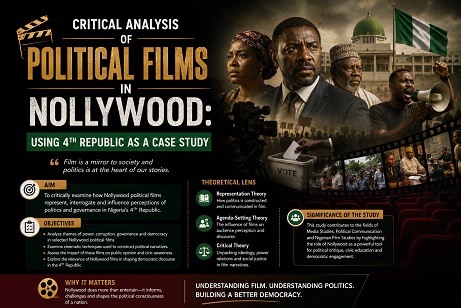
Critical Analysis of Political Films in Nollywood: Using 4th Republic as a Case Study
Abstract
“4th Republic” stands as a testament to the power of Nollywood in addressing and critiquing the socio-political issues that define Nigeria’s contemporary landscape. Through its compelling narrative, the film exposes the pervasive corruption and electoral malpractices that undermine democratic processes in the country. The character of Mabel King serves as a powerful symbol of integrity and resilience, inspiring viewers to demand greater transparency and accountability in their political system. By highlighting the critical roles of the judiciary and media, “4th Republic” underscores the importance of these institutions in safeguarding democracy and promoting justice.
Moreover, the film’s focus on gender equality through Mabel King’s journey challenges the patriarchal norms that pervade Nigerian politics. Her character’s struggle and determination to break through systemic barriers provide a poignant commentary on the need for greater female representation and empowerment in leadership roles. “4th Republic” not only reflects the aspirations and challenges of women in politics but also advocates for a more inclusive and equitable political landscape. This aspect of the film adds a significant dimension to its narrative, making it a nuanced exploration of the intersectional issues faced by Nigerian society.
Ultimately, “4th Republic” exemplifies the potential of political films in Nollywood to serve as catalysts for societal change. By combining powerful storytelling with critical thematic exploration, the film engages its audience in meaningful reflections on the state of democracy in Nigeria. It encourages viewers to question and challenge the status quo, fostering a culture of political awareness and activism. As a case study, “4th Republic” demonstrates how Nollywood can leverage its influence to not only entertain but also educate and inspire, making a substantial impact on public perceptions and encouraging a collective pursuit of justice and integrity in the political sphere.
Critical Analysis of Political Films in Nollywood: Using 4th Republic as a Case Study
CHAPTER ONE
INTRODUCTION
1.1 Background to the Study
The Nigerian film industry, popularly known as Nollywood, has emerged as a powerful medium for storytelling and cultural expression. Over the past few decades, Nollywood has grown into a global phenomenon, ranking among the largest film industries in the world by volume.( Olukotun,& Seteolu, 2001) This burgeoning industry has not only provided entertainment but has also become a significant platform for discussing social, economic, and political issues. Omoera, (2010) added that political films, in particular, have become an important genre within Nollywood, providing critical commentary on the political landscape of Nigeria. One such film, 4th Republic, serves as a pertinent case study for examining the intersection of film and politics in Nollywood.
In the like manner, Samson & Ogwu (2014) also added that since the return of the country to democratic rule in 1999, Nigerian politicians have evolved a political culture that is characterized by several ills such as the politics of godfatherism, corruption and misappropriation of public funds and electoral malpractices to control state power against the popular will of the masses among several other ill practices. This political culture has given rise to a very chaotic political order, occasioned by tension and wide scale violence at the political front, the resultant effect of which is gross underdevelopment, lack of good governance and the enthronement of a political class that lacks the ability to drive home to the masses, the dividends of democracy.
As one could rightly expect, the media are supposed to breathe sanity into the system. This expectation isn’t far fetch from the surveillance role of the mass media. Surveillance as a function of mass communication ascribes to the mass media, the responsibility of watch dogs of the society, i.e. holding the key actors in the society accountable to the people. Here, the media situate the behavior of stakeholders in the society within the framework of acceptable standard, hence those who are found wanting are exposed for a better society, (Nwabueze, 2014).
Nigerian political history has been marked by colonial rule, military coups, and the eventual establishment of a democratic system. This tumultuous history provides a rich backdrop for political narratives in film. Political films in Nollywood often explore themes such as corruption, electoral fraud, governance, and the struggle for democracy. These films not only reflect societal issues but also influence public opinion and political discourse (Jedlowski, 2013). The depiction of political themes in Nollywood is not merely for entertainment; it serves an educational purpose, helping viewers understand the complexities of their political environment and inspiring civic engagement.
According to Falola & Heaton, 2008, Nigerian politics is crucial for appreciating the narratives depicted in Nollywood’s political films. Nigeria gained independence from British colonial rule in 1960, followed by a series of military coups and brief periods of civilian rule. The country transitioned to a stable democratic government with the establishment of the Fourth Republic in 1999. However, this period has been marked by persistent issues such as electoral violence, corruption, and political instability.
Critical Analysis of Political Films in Nollywood: Using 4th Republic as a Case Study
The Fourth Republic, while representing a democratic milestone, has also been fraught with challenges that filmmakers like Ishaya Bako seek to address through their works. 4th Republic, directed by Ishaya Bako and released in 2019, is a political thriller that delves into the intricacies of Nigeria’s electoral process. The film follows the story of Mabel King, a gubernatorial candidate who challenges the outcome of an election marred by violence and irregularities. Through its narrative, 4th Republic highlights issues such as electoral malpractice, the quest for justice, and the resilience of democratic institutions in Nigeria.
The film’s release came at a crucial time, coinciding with Nigeria’s general elections in 2019. It served as a mirror to the political climate of the period, providing a fictional yet resonant depiction of the challenges faced in the pursuit of free and fair elections. 4th Republic is not merely a piece of entertainment; it is a form of political expression and activism, prompting viewers to reflect on the state of democracy in Nigeria (Adesokan, 2011). The film’s critical reception and its impact on public discourse underline its significance as a cultural artifact and a tool for political engagement.
Political films in Nollywood play a significant role in shaping political consciousness and encouraging civic engagement. By dramatizing real-life issues, these films make political concepts more accessible to the general public. They also provide a platform for marginalized voices and contribute to the national dialogue on governance and accountability. Moreover, political films serve as historical documents, preserving and interpreting significant events in Nigeria’s political history.
They offer insights into the socio-political dynamics of different eras, helping future generations understand the complexities of their nations past (Okome, 2010). Films like 4th Republic are particularly impactful because they tackle contemporary issues directly, creating a bridge between current events and cinematic representation. Political films in Nollywood, exemplified by 4th Republic, serve as vital instruments for political commentary and social change. It offers a unique blend of entertainment and education, prompting audiences to critically engage with the political realities of their society. This study seeks to deepen our understanding on the relationship between film and politics, highlighting the power of Nollywood as a cultural force for democracy.
1.2 Statement of the Problem
Over the years, the Nigerian film industry, Nollywood, has become an influential platform for addressing critical social, economic, and political issues. Despite its significant role in shaping public discourse, there remains a gap in scholarly analysis of how political films within Nollywood impact viewers’ perceptions of political processes and governance. Specifically, while films like 4th Republic have brought attention to electoral malpractice and democratic challenges, there is limited research on their effectiveness in fostering political awareness and encouraging civic engagement among the Nigerian populace. This lack of comprehensive analysis hinders our understanding of the full potential of Nollywood films as tools for political education and activism.
Moreover, the representation of women in political roles within Nollywood films is an area that requires deeper exploration. 4th Republic, with its focus on a female gubernatorial candidate, offers a unique opportunity to examine the portrayal of gender dynamics in Nigerian politics. However, there is insufficient research on how such portrayals influence public attitudes towards women’s participation in politics. Addressing this gap is essential for understanding the broader implications of Nollywood’s political narratives on gender equality and empowerment in the Nigerian political sphere.
In the same vein, while Nollywood’s political films are known to reflect contemporary issues, there is a need to assess their accuracy and the extent to which they resonate with the actual political experiences of Nigerian citizens. Films like 4th Republic depict critical themes such as electoral fraud and justice, yet the connection between these cinematic representations and real-life political outcomes remains underexplored. This study aims to bridge this gap by critically analyzing 4th Republic and evaluating its impact on public perception of electoral integrity and democratic governance, thereby contributing to the broader discourse on the role of Nollywood in political activism and cultural production.
Critical Analysis of Political Films in Nollywood: Using 4th Republic as a Case Study
1.3 Research Question
The following research questions were formulated to guide the researcher;
- What role does Nollywood play in political activism and cultural production, as evidenced by 4th Republic?
- How do the narrative and thematic elements of 4th Republic reflect Nigeria’s political climate?
- What impact does 4th Republic have on public perceptions of electoral integrity and democratic processes in Nigeria?
- In what ways do political films in Nollywood shape political discourse and promote civic engagement?
1.4 Objectives of the Study
The main objective of the study was to carry out a critical analysis of political films in Nollywood: using 4th Republic as a case study. Specifically, the objectives of this study are;
- to analyze the role of Nollywood in political activism and cultural production through the case study of 4th Republic.
- to examine how the narrative and thematic elements of 4th Republic reflect Nigeria’s political climate.
- to assess the impact of 4th Republic on public perceptions of electoral integrity and democratic processes in Nigeria.
- to investigate the ways in which political films in Nollywood shape political discourse and promote civic engagement.
1.5 Research Methodology
This study will employ a qualitative research design, utilizing both content analysis and audience reception analysis to explore the objectives. The qualitative approach is appropriate given the focus on understanding the nuanced representations and impacts of the film 4th Republic. A detailed content analysis of 4th Republic will be conducted. This involves examining the film’s narrative structure, character development, themes, dialogues, and visual style to identify how it reflects and critiques Nigeria’s political climate. Specific scenes and sequences will be analyzed to understand their portrayal of electoral processes, gender dynamics, and political activism.
- Definition of Terms
Film: also called movie or motion picture, is a visual art used to simulate experiences that communicate ideas, stories, perceptions, feelings, beauty or atmosphere by means of recorded or programmed moving images along with other sensory stimulations.
Nollywood: is the colloquial name given to the Nigerian film industry. Alex Eyengho defined Nollywood as ‘the totality of activities taking place in the Nigerian film industry, be it in English, Yoruba, Hausa, Igbo, Itsekiri, Edo, Efik, Ijaw, Urhobo or any other of the over 300 Nigerian languages.
Themes: is a subject of discourse, discussion, meditation, or composition; topic. It is the idea, premise, or purpose of a movie. It is the whole reason why movies are made. The theme is the heart of the movie. The theme regulates the movie. The theme is why people go to the movies.