Full Project-The influence of Teaching Methods and Academic Performance of Pupils in Preprimary Schools

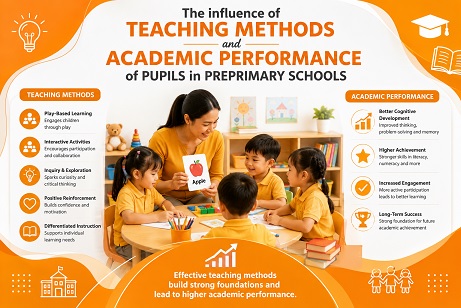
Full Project-The influence of Teaching Methods and Academic Performance of Pupils in Preprimary Schools
Abstract
This study examined Teaching Methods and Academic Performance of Pupils In Pre-Primary Schools Mathematics In Ibiono Ibom Local Government Area.. Two null hypotheses were formulated to guide the study in line with the specific objectives. The quasi-experimental research design was adopted for the study. The population of the study consisted of all Pre-Primary two (2) pupils with a total of 2,340 pupils in the study area. A sample size of 240 pupils was used for the study. The major instrument for data collection was Pupils Achievement Test (PAT). The data collected were analyzed using t-test statistics.
The results revealed that pupils taught using demonstration method of teaching performed significantly better than their counterparts taught using lecture method of teaching. It was also found that pupils taught using activity method performed significantly better than their counterparts taught using discussion method. It was concluded that teaching methods significantly influenced pupils learning of social skills development. It was recommended among others that Teachers should adopt demonstration and activity methods of teaching in teaching the subject in order to facilitate pupils’ understanding of instruction and improve their academic performance.
CHAPTER ONE
INTRODUCTION
1.1 Background to the Study
Teaching involves the passage or transfers of Knowledge or ideas by the teachers to the learners. It is an activity exercise that takes a sequential processes Etim (2009). This processes according to NTI (2000) have the following principles; the dynamics principles and the perceptual variability.
However, the rapid changes and increased complexity of today world have presented a new challenge thereby introducing new demands on our educational system. Most developing countries, as a result of visible roles of science and technology now make frantic efforts to improve on the study of science and often allied subjects (mathematics) in their schools. Mathematics is one of the science subject which according to Orok(2009) mathematic education is a course that prepares a child for a useful living which this case is self reliance. Therefore a sound method of teaching this subject should be adopted.
Okpala (2009) stressed that mathematics is the language of orderliness, as seen in things like traveling, times-table, identification of pages of books, house numbering on the streets, and often methodological records that makes use of numbers, measurement and shapes in everyday life. It is increasingly becoming more difficult to be an effective teacher today than ever before, this is because the demands of the learners are more complex and varied than before, early. A teacher was expected to be vast in book, knowledge and impact same to students. Knowledge, but must also know his pupils capability, be conversant with the complexity of the teaching-learning environment and a good knowledge of the application of methods and techniques. Effective teaching depends to a large extent on the selection of efficient methods, teaching approaches and techniques.
Essentially, the goal of all teachers is to enhance their effectiveness in the classroom. Effectiveness in teaching will be an illusion if appropriate methods and strategies are not adopted by the teachers. Therefore, any teaching–learning encounter is often geared at changing the behaviour of the learners through the selection of appropriate instructional approaches, methods and techniques, here the role of the teacher goes beyond a person talking and writing on the chalkboard but an organizer and planner, less preoccupied with what he will teach but more concerned with how he will teach what he has to teach to the learners (Ekanem, 2006). At this point, the question he will ask himself is “how can I bring about the mass efficient and effective learning in a given situation?”
“How can I ensure full understanding of instruction by the pupils in order to improve their academic performance?” As an educational planner and monitor of the total teaching-learning process, the teacher makes decision about each learner based on his learning history and know ways of presenting content which seem best suited to his individual attitude, interest and background. Thus, the end product of this activity is change in the behaviour of the learners and improvement in the level of their academic achievement.
To be able to achieve the desire goals of mathematics education due consideration must therefore be given to the extent to which the method of teaching mathematics in our school is subject is align with the group of pupils/students to which the subject is taught.
The question now is, what is the method use by pre-primary school teachers in teaching mathematics in order to achieve the aim of mathematics education which one of the science and important subject in getting admission into the nation tertiary institution and Art related courses respectively. NPE (2004). This study is therefore investigate Teaching Methods And Academic Performance Of Pupils In Preprimary School Mathematics In Ibiono Ibom Local Government Area.
Full Project-The influence of Teaching Methods and Academic Performance of Pupils in Preprimary Schools
1.2 Statement of the Problem
The major problem that attract the attention of the researcher is the poor performance of pupils in mathematics in pre-primary schools in Ibiono Ibom Local Government Area. The poor performance of pupils in mathematics has persist for a number of years now. The problem is attributed to factors such as gender difference, socio-economic status, school types, parenting style, teaching strategies and other variables.
The interest of the researcher has been activated by the fact that the effort made by Akwa Ibom State Government, teachers, and parents to improve the academic performance of preprimary school pupils has not yielded any result. The researcher behoove that researching into the teaching method adopted by the teachers in teaching the subject in pre-primary schools will help improve the situation of poor academic performance in Mathematics among pre-primary school pupils in Ibono Ibom Local Government Area.
1.3 Purpose of the study
The main purpose of this study is to examine Teaching Methods and Academic Performance of Pupils in pre-primary schools mathematics in Ibiono Ibom Local Government Area. Specifically, the study sought the:
- To examine the academic performance of pupils taught mathematics using demonstration method of teaching and those using lecture method in Pre-primary school pupils in Ibiono Ibom local Government Area.
- To examine the academic performance of pupils taught mathematics using the activity Method and those using the Discussion method in Pre-primary school pupils in Ibiono Ibom local Government Area.
1.4 Significance of the study
It is anticipated that the findings of this study would be of immense benefits to all and sundry in the educational sector. Particularly, teachers, school administrators, educational planners and policy makers, pupils, parents and the government at large in the following ways:
- It would make known the instructional methods adopted by Social Studies teachers in the study area.
- It would bring into focus the instructional methods that best guarantee improvement in pupils’ understanding of instructional and their academic performance.
- It would add to the body of existing literature on instructional methods in relation to pupils’ academic performance.
- Finally, the findings of this study would serve as a reference material for further research on teaching methods in relation to pupils’ academic performance.
1.5 Research hypotheses
The following null hypotheses were formulated to guide the study in line with the specific objectives.
- There is no significant difference in academic performance of pupils in mathematics taught using demonstration method of teaching and those using lecture method in Pre-primary school in Ibiono Ibom local Government Area .
- There is no difference in academic performance of pupils taught mathematics using the activity Method and those using the Discussion method in Pre-primary school in Ibiono Ibom local Government Area.
1.6 Delimitation of the study
The study was delimited to Teaching Methods and academic performance of pupils in Pre-primary schools in Ibiono Ibom Local Government Area of Akwa Ibom State. Analysis was on primary (2) pupils in the study area.
1.7 Limitation of the study
The major factors that limit the scope of this study to Ibiono Ibom Local Government Area were insufficient fund, time frame for the completion of the study and the researcher’s academic work-load among others.
Full Project-The influence of Teaching Methods and Academic Performance of Pupils in Preprimary Schools
1.8 Definition of the terms
The following terms used in this study were operationally defined by the researcher:
Teaching methods: The Instructional approaches adopted by teachers in lesson delivery.
Academic performance: The performance of pupils in tests and examinations given on lessons taught to them.
Demonstration method: A method of teaching which involves the act of showing or explaining how something works or is done.
Activity method: A method of teaching where the teacher provides an avenue for the pupils to carry out some activities under the supervision and guidance of the teacher.
Discussion method: A method of teaching which involves interaction between the teacher and the pupils.
CHAPTER FIVE
SUMMARY, RECOMMENDATIONS AND CONCLUSION
This chapter present the summary, recommendations and conclusion of the study.
5.1 Summary
The study examined Teaching Methods and Academic Performance of Pupils in pre-primary schools mathematics in Ibiono Ibom Local Government area. The analysis of the data collected for the study revealed that pupils taught using demonstration method of teaching performed significantly better than their counterparts taught using the lecture method of teaching. It was also found that pupils taught using activity method of teaching performed significantly better than their counterparts taught using discussion method of teaching. Consequently, the null hypotheses were rejected in favour of the alternatives.
5.2 Recommendations
Based on the findings of the study, the following recommendations were made:
- Teachers should adopt demonstration and activity methods of teaching in teaching the subject in order to facilitate both pupils’/students’ understanding of instruction and improve their academic performance.
- Teachers should endeavour to adopt teaching methods that are best suitable for selected topics to facilitate pupils’ understanding and boost their performance.
- Curriculum developers should incorporate suggested teaching methods that are best suitable for a particular topic to enable teachers know exactly which method to adopt in a particular lesson.
- Teacher’s awareness of the methods of teaching should be broadened through workshops and seminars on teaching methodology and strategies. This will help to reposition teachers for effective teaching vis-a-viz improvement in pupils’ social skills development.
Full Project-The influence of Teaching Methods and Academic Performance of Pupils in Preprimary Schools
5.3 Conclusion
Based on the findings of the study, it was concluded that teaching methods significantly influenced pupils’ social skills development in the study area.
REFERENCES
Abdulhamid, A. T. (2002). Effects of Two Teaching Methods on Secondary School Students’ Agricultural Science Performance in Bauchi metropolis, Nigeria. Journal of Research in Education, 1(1): 3-10.
Abdul-Raheem, U. N. (2010). Effects of Teaching Methods on Students’ Academic performance in Physics. International Journal of Research Education, 3(2): 44-52.
Adekunle, A. A. (2004). Perception of Teacher’s knowledge, Attitude and Teaching Skills as predictor of Academic Performance in Nigeria Secondary Schools. Journal of Research in Education, 2(3): 84-88.
Adewuya, G. A. (2007). Effects of Discovery and Expository Methods on achievement of students in O-Level Biology. Journal of Research in Education, 3(1): 66-71.
Aina, D. O. (2009). Teachers’ Questioning Techniques and classroom interaction pattern in Nigeria. Humanity and social Science Journal, 2 (1): 35-42.
Akinboye, S. C. (2008). Educational Psychology and Effective Teaching-Learning Strategies. London McClean Press.
Akpan, S. T. (2004). Science Teaching in Nigeria. Illorin: Aluta press.
Ayodele, S. S. (2009). The Acts of Discovery. Harvard Educational Review, 1 (31): 21-32.
Briges, A. S. (2008). Teaching Methods and Students’ Academic Achievement in Mathematics. International Journal of Research in Education, 2(3): 77-81.
Dyer, C. O. (2005). Effects of Teaching Methods on Students’ Academic Achievement in Biology. A Multidisciplinary journal of Educational Research, 3(2): 40-41.
Ekanem, T. F. (2006). Principles and Methods of Teaching: An Introduction. Uyo: MacGrace Academic Resources Publishers.
Ekong, N. U. (2003). Comparative Analysis of the Effects of Lecture and Demonstration Methods of Teaching on Students’ Academic Performance in Biology in Calabar Metropolis. Journal of Educational Research and Development, 4(2): 102-110.
Federal Republic of Nigeria (2009). National Policy on Education. Lagos: NERDC Press.
Foster, R. M. (2008). Self-perception of Gender Bias among Agricultural Education Students. London: Los Angeles Academic Press.
Nzewi, U.N. (2002). A Meta Analysis of Research report in alternation Strategies of science teaching. A paper Presented at the national conference on effective teaching. Nnamdi Azikiwe University Awka. 24th-26th October.
Obanya, C. T. (2006). The Relative Efficacy of Scientific Literacy. Science Teachers Association of Nigeria, 36 (1&2): 43-51.
Ochonogor, E. C. (2009). Teaching Methods: A Multi-disciplinary Approach. Lagos: Oludare Obielum printing Nig. Enterprise.
Full Project-The influence of Teaching Methods and Academic Performance of Pupils in Preprimary Schools
Obot, N. E. (2006). Akwa Ibom Renaissance. Uyo; Abaam Publishers.
Oghenevwede, E. C. (2010). Effects of Discovery and Inquiry Approaches in Teaching and Learning of Biology in Secondary Schools Journal of Research in Education, 4(2): 168-174.
Ogundele, A. S. (2000). The Effects of two Methods of Teaching on Achievement in the Foreign language beginners’ class. Ibadan. University of Ibadan Press.
Okon, E. J. (2008). Effects of Teaching Methods on Reading Development of Primary School Pupils. Owerri: Barloz Publishers Inc.
Okoye, N. T. (2008). Teaching Methods and Students’ Academic Performance in English Language. Journal of Educational Research and Development, 3(2): 31-37.
Okwilagwe, S. O. (2002). Teaching Methods and Teachers’ Teaching Effectiveness. International Journal of Research in Education, 2(4): 108-115.
Okwuri, N. S. (2008). Teaching Methods and Students’ Academic Performance in Mathematics. International Journal of Educational Research and Development, 5(2): 119-126.
Olatoke, R. D. (2004). Effects of Inquiry and Discovery Methods of Teaching on Students’ Achievement in Mathematics. Journal of Research in Education, 2(3): 133-147.
Oyedyi, G. B. (2006). Effects of Demonstration Method of Teaching on Students’ Academic Performance in Science Subjects. International Journal of Educational Research in Education, 4(3): 86-93.
Oyegwe, P.O. (2008). Special Methodology: A Modern Approach to the Teaching of Technical Education. Jos: Academic Trust Fund.
Oyer, T. S. (2005). Peer Tutoring Techniques and Students’ Academic Performance in Economics. Journal of Educational Research and Development, 3(2): 144-156.
Russon, N. E. & Adeloye, T. N. (2003). Peer Effects on Learning outcomes. Journal of Research in Education, 2(3): 171-178.
Tawari, O. C. (2006). The Relative Effectiveness of two Methods of Teaching Science on Junior Secondary School Students Achievement in English Language. International Journal of Research in Education, 4(2): 206-217.
Zadra, E.T. (2005). Learning as a gate way to the 21st century. International Institute for Educational Planning Newsletter, 18(2):1-144