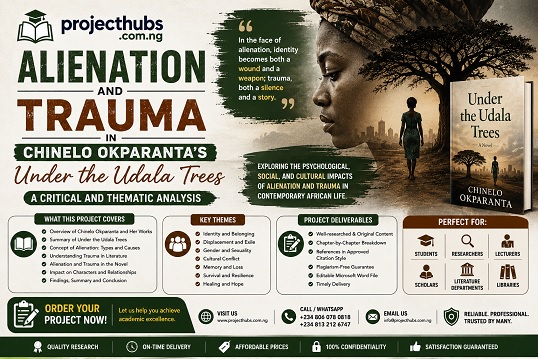
Alienation and Trauma in Chinelo Okparanta’s Under the Udala Trees
CHAPTER ONE
INTRODUCTION
1.1 Background to the Study
Alienation and trauma are pervasive themes in African literature, intricately woven into the continent’s rich tapestry of historical, social, and political narratives. Across various literary works, authors explore the profound psychological and emotional toll of colonization, post-colonial dictatorships, civil conflicts, displacement, and other forms of societal upheaval. According to Reena Mittal, alienation manifests as a natural outcome of the existential predicament, involving both intrinsic and extrinsic dimensions for exploration and scrutiny (2). The concept of alienation is explored in numerous studies across psychology, sociology, literature, and philosophy.
Alienation simply put refers to a sense of detachment or estrangement, often from oneself, others, or society, resulting in feelings of isolation or disconnection. Encyclopedia Britannica defines alienation as “the state of feeling estranged or separated from ones milieu, work, and products of work or self”. The English word ‘Alienation’ is derived from the Latin word ‘Alienato’. Alianato is a noun which receives meaning from the verb ‘alienare’ which means to make a thing for others, to snatch, to avoid, to remove, etc. In French language Alienate and alienation, are used in the same sense as the English words ‘Alienate and Alienation. Anomie and Anomia are used as synonyms of Alienation.
The use of these words is considered modern. These words are Greek in origin the meaning of ‘Anomia’ is self-alienation and ‘Anomie’ is alienation from society. ‘Anomia’ is an indicator of Personal disintegration of man from the society.
According to G.H.Nettler: “…… anomia is personal disorganization, alienation is psychological state of an individual and ….. alienated in the person who has been estranged from, made unfriendly toward his society and the culture it carries”(2). Generally, Anomie, Anomia or Alienation are interchangeable. In English there are other words other than Alienation. They are Estrangement Isolation and Separation. Different interpreters of alienation have given different definitions. According to Arnold Kaufman, “To claim that a person is alienated is to claim that his relation to something else has certain features which result in avoidable discontent or loss of satisfaction”(3).
According to Breuer and Freud, (40) trauma is thus defined in relation to the process of remembering and as an event harbored within the unconscious that causes a splitting of the ego or dissociation. The authors, citing Janet’s work on dissociation, write: “the splitting of consciousness which is so striking in the well‐known classical cases under the form of ‘double conscience’ is present to a rudimentary degree in every hysteria, and that a tendency to such dissociation, and with it the emergence of abnormal states of consciousness … is the basic phenomenon of this neurosis”.
However, Olaniyan, Solomon (12-14) opine that trauma in literature refers to the portrayal and exploration of psychological, emotional, and physical distress experienced by characters as a result of deeply disturbing events. Trauma is a prevalent theme in literature as it allows authors to delve into the complexities of human experience, resilience, and the impact of adversity on individuals. Through the depiction of trauma, authors can shed light on the lasting effects of distressing events, such as war, abuse, loss, and other forms of suffering. This literary exploration often serves to increase awareness and empathy for those who have experienced trauma in real life.
Amandeep, N. (250) further added that in literature, trauma is often depicted through various narrative techniques and literary devices. Authors may employ fragmented storytelling, nonlinear narratives, and stream-of-consciousness writing to convey the fragmented nature of traumatic memories and experiences. Additionally, characters grappling with trauma may exhibit symptoms of post-traumatic stress disorder (PTSD), anxiety, depression, and other psychological conditions. The portrayal of trauma in literature can serve as a means for readers to gain insight into the complexities of human suffering and the resilience of the human spirit.
Furthermore, Winkler, Johanna added that the representation of trauma in literature has been a subject of scholarly analysis and critical examination. Scholars have explored how authors depict trauma, the ethical considerations surrounding the portrayal of distressing events, and the potential for literature to serve as a medium for healing and understanding. Through literary criticism and academic discourse, the concept of trauma in literature has been examined from various theoretical perspectives, including psychoanalytic theory, feminist theory, postcolonial theory, and trauma studies. Overall, the concept of trauma in literature provides a platform for authors to address profound human experiences while offering readers an opportunity to engage with themes of resilience, empathy, and the enduring impact of traumatic events.
Akem, Maformba, also added that the legacy of colonialism casts a long shadow over African literature, with writers often depicting the cultural dislocation and estrangement experienced by indigenous populations under colonial rule. The imposition of foreign systems of governance, language, and religion ruptured traditional African societies, leaving individuals grappling with the collision of old and new worldviews.
Alienation and Trauma in Chinelo Okparanta’s Under the Udala Trees
Chinua Achebe’s “Things Fall Apart” and Ngũgĩ wa Thiong’o’s Decolonising the Mind illuminate this cultural rupture. Post-colonial realities further exacerbate feelings of alienation and disenfranchisement among African populations. Authoritarian regimes, rampant corruption, and socioeconomic inequality perpetuate a sense of marginalization and betrayal among citizens. Ayi Kwei Armah’s The Beautyful Ones Are Not Yet Born and Chimamanda Ngozi Adichie’s Purple Hibiscus delve into the psychological toll of living under oppressive regimes.
In the same vein, Maxwell, Ugwanyi (250) also added that the civil conflicts and wars have ravaged many African nations, resulting in widespread displacement, loss of life, and psychological trauma. Ishmael Beah’s memoir A Long Way Gone vividly portrays the trauma of child soldiers, while Warsan Shire’s poetry captures the liminal existence of refugees. Gender dynamics intersect with themes of alienation and trauma, particularly for African women who often face intersecting forms of oppression.
Tsitsi Dangarembga’s Nervous Conditions and Mariama Bâ’s So Long a Letter illuminate the complexities of gender-based violence, patriarchy, and the quest for self-empowerment. Despite the pervasive themes of alienation and trauma, African literature also celebrates resilience, solidarity, and the human capacity for healing and renewal. Through narratives of reconciliation and communal solidarity, authors offer hope for a future where the wounds of the past can be healed, and where individuals and societies can forge new paths towards collective empowerment and liberation.
Chinelo Okparanta’s groundbreaking debut novel, Under the Udala Trees, published in 2015, stands as a literary testament to the intricate interplay of alienation and trauma within the framework of Nigerian society, particularly during the tumultuous period of the Nigerian Civil War (1967-1970) and its aftermath. Through the lens of the protagonist, Ijeoma, Okparanta intricately weaves a narrative that explores the profound impact of societal expectations, personal identity, and the enduring scars of conflict on individual lives. The Nigerian Civil War, also known as the Biafran War, remains a pivotal moment in Nigeria’s history, characterized by widespread devastation, loss of life, and deep-rooted political and ethnic tensions.
Against this backdrop of turmoil and upheaval, “Under the Udala Trees” unfolds, offering readers a glimpse into the lives of ordinary people grappling with extraordinary circumstances. It delves into the complexities of Ijeoma’s personal journey as she navigates her feelings and relationships against the backdrop of historical and cultural challenges. Hence, the background to this study shall be the need to analyse the alienation and trauma in Chinelo Okparanta’s Under the Udala Trees.
1.2 Statement of the Problem
After decades of the Nigerian civil war which is also known as the Biafra war, several scars, bruises etc. has been left on the citizens as a result of the wanton destructions of lives and properties which took place in almost all part of the nation as a result of the civil war. In a bit to provide healings, literary writers such as Chinelo Okparanta in her work Under the Udala Trees tries to reflect on incidents that happened during the civil war. Her reasons is not to rekindle hates but to provide healings as the story is told in her works.
Various scholars have carried out several studies on Chinelo Okparanta’s work. For example, Eze, carried out a study on existential feminism in Chinelo Okparanta’s under The Udala Tree. The researcher through investigation of the primary text discovered that Marriage is intended to avoid women from the freedom of men, but because there is no love or individuality without freedom, he must let go of love for special individuals to convince him to get life’s protection from men and live on their own terms, this Chinelo Okparanta portray using the character of Ijeoma. Again, in Under the Udala Tree, Okparanta showcases the loving and caring nature of her queer characters who are dismissed as nonentity in the midst of their haters.
In another study by Josephine Delali Ofei and Daniel Oppong-Adjei on Sexual Identities in Africa: A queer reading of Chinelo Okparanta’s Under the Udala Trees. The researcher discovered that due to the brutality of men on women couple with social status which has placed women as a second class citizens, they only way for them to break free from men superiority is same sex affairs even though African culture is against it.
From the two studies cited so far, there is still a cap which needs to be filled because so many authors are looking at action of Ijeoma and Annies as a taboo not even caring to find out level of alienation and trauma that the female gender went through in the text that resulted them to seek same sex love. At the heart of the problem lies the need for a nuanced analysis of the ways in which alienation and trauma shape Ijeoma’s sense of self and her interactions with the world around her. While existing research acknowledges the presence of these themes in Under the Udala Trees, there is a dearth of in-depth examination into the intricate dynamics at play.
Furthermore, there is a lack of exploration into how Ijeoma’s experiences of alienation and trauma are influenced by broader societal attitudes towards sexuality, gender, and the legacy of conflict in Nigeria. Understanding these nuances is essential for unpacking the complexities of Ijeoma’s narrative and shedding light on the broader socio-cultural implications embedded within the novel.
Alienation and Trauma in Chinelo Okparanta’s Under the Udala Trees
Addressing this gap in research is vital for advancing scholarly discourse on Chinelo Okparanta’s work and for deepening our understanding of the intersections between identity, trauma, and societal norms. By delving into the nuanced layers of Ijeoma’s narrative, scholars can offer insights into the broader implications of alienation and trauma within the context of post-colonial Nigeria. This is the gap which the study intends to cover by studying Trauma and alienation in Chinelo Okparanta’s Under the Udala Trees.
1.3 Purpose of the Study
The purpose of the study is to analyse alienation and trauma in Chinelo Okparanta’s Under the Udala Trees. The specific objectives are to;
- analyze the theme of alienation in Chinelo Okparanta’s novel Under the Udala Trees
- explore the theme of trauma in the novel, focusing on how traumatic events impact the protagonist’s psyche and relationships.
- examine how cultural factors contribute to feelings of alienation and trauma in the novel, considering the protagonist’s Nigerian background and the societal norms that influence her experiences.
- discuss the coping mechanisms employed by the protagonist in response to alienation and trauma.
1.4 Significance of the Study
The study of this nature will be significance in the following ways;
- Firstly, this study will contribute to the broader field of literary scholarship by offering a nuanced analysis of Chinelo Okparanta’s “Under the Udala Trees.” By exploring themes of alienation and trauma within the novel, the research expands our understanding of the intricate layers of the narrative and sheds light on Okparanta’s portrayal of the human experience amidst socio-political upheaval.
- Secondly, the study’s examination of societal attitudes towards sexuality and gender within the context of post-colonial Nigeria provides valuable insights into the challenges faced by LGBTQ+ individuals in conservative cultural settings. By elucidating the ways in which these attitudes contribute to feelings of alienation and trauma, the research contributes to ongoing conversations surrounding LGBTQ+ rights, cultural acceptance, and social change.
- Thirdly, through its analysis of trauma and resilience in the novel, the study offers insights into the psychological effects of conflict and displacement on individuals. By examining how the protagonist navigates trauma and asserts agency in the face of adversity, the research highlights the potential for resilience and empowerment even in the most challenging circumstances. These insights contribute to our understanding of trauma recovery and coping mechanisms in contexts of social and political turmoil.
- Fourthly, the study’s exploration of themes such as alienation, trauma, and identity has relevance beyond the confines of literature, resonating with contemporary social and political issues. By delving into the complex interplay of personal and collective experiences within the novel, the research offers a lens through which to examine broader socio-cultural dynamics, including the legacies of colonialism, the impact of conflict on communities, and the pursuit of individual freedom and self-expression. As such, the study’s findings have implications for discussions surrounding human rights, social justice, and cultural diversity in today’s globalized world.
Alienation and Trauma in Chinelo Okparanta’s Under the Udala Trees
1.5 Research Methodology
This research is a qualitative research, and relies on textual analysis of the selected text Chinelo Okparanta’s novel Under the Udala Trees which serve as primary sources of data for the study. While other relevant internet and library materials forms the secondary sources of data. The text are purposively selected based on their relevant contents.
1.6 Scope of the Study
The scope of this study involves a thorough examination of the themes of alienation and trauma within Chinelo Okparanta’s novel Under the Udala Trees. It encompasses an in-depth analysis of how these themes are portrayed in the narrative, particularly focusing on the protagonist, Ijeoma, and her experiences of alienation and trauma, and their impact on her relationships and self-perception. Additionally, the study will contextualize the novel within the socio-historical and cultural framework of post-colonial Nigeria, specifically during the Nigerian Civil War, to explore the societal norms, cultural values, and historical events that shape the depiction of alienation and trauma.
Moreover, the research will consider opportunities for comparative analysis with other literary works or cultural texts addressing similar themes, aiming to provide insights into the broader implications of Okparanta’s portrayal. Furthermore, it will discuss the implications of the findings for literary scholarship and their relevance to broader discussions surrounding identity, social justice, and trauma recovery, identifying potential applications in academic, social, or cultural contexts, while also suggesting avenues for future research and exploration.
1.7 Definitions of Terms
Alienation: Alienation is a feeling of separation or estrangement from one’s work, milieu, or self. It can also refer to the feeling of being an outsider or isolated, especially from society. People who are alienated may reject loved ones or society, and may feel distant and estranged, including from their own emotions.
Trauma: Trauma is an emotional response to a stressful event that is difficult to cope with. It can be caused by a single incident, or an ongoing event that happens over a long period of time.
LGBTQ: LGBTQ is an acronym that stands for lesbian, gay, bisexual, transgender, and queer or questioning. It’s used to describe people who are non-heterosexual or non-cisgender, or who don’t identify with the sex they were assigned at birth.