Religion and Conflict Resolution in Chimamanda Ngozi Adichie’s Half of a Yellow Sun and The Thing Around Your Neck

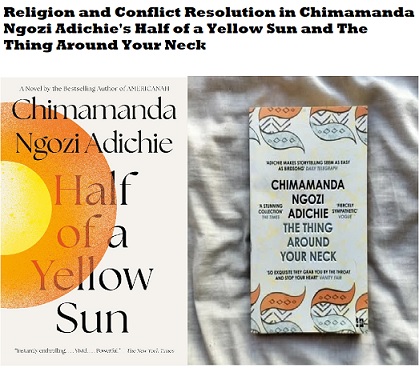
Religion and Conflict Resolution in Chimamanda Ngozi Adichie’s Half of a Yellow Sun and The Thing Around Your Neck
INTRODUCTION
Religion and Conflict Resolution are two concepts that have enjoyed wide critical attention from scholars, both on a linguistic and nonlinguistic trajectory, in recent years. Given the heterogeneous nature of the Nigerian state where multiple cultures, ethnic groupings and even religion exists, there is a high tendency for seeds of conflicts to sprout up among the people, thereby leading to violence such as the destruction of lives and properties, especially when the stakeholders and leaders fold their arms and keep mum over such sensitive matters. Nonetheless, unlike these lackadaisical leaders, writers have shown social commitment to exposing the issues marauding the growth of their society, with the view of resolving them as well.
To this end, writers like Chimamanda Adichie among others have be-fittingly captured the notions of religion and conflict in literary texts, projecting the ills consequent upon the radical or extreme beliefs in them and how contained therein are the solutions to such religious conflicts. Two suitable texts of the said author have been chosen for to buttress this truth: Half of a Yellow Sun and The Thing Around Your Neck.
To begin with, there are many schools of thought on the concept of religion. A few definitions are mentioned here. According to Durkheim in his book, The Elementary Forms of Religious Life (42), defines religion is a “unified system of believes and practices relative to sacred things, that is to say, things set apart and forbidden.” Frazer further (22) considered religion as a belief in “powers superior to man which are believes to direct and control the course of nature and of human life”. Hence, man’s belief in a being beyond the human world is considered religion
Malinowski (1948) further argues that, “Religion is a mode of action as well as system of belief and a sociological phenomenon as well as a personal experience”. Hence, religion is integral to the supernatural experiences man has. It is from this perspective that Edward Sapir, an American Anthropologist, “Religion is man’s never-ceasing attempt to discover a road to spiritual serenity across the perplexities and dangers.” Thus, religion is considered an antidote to the pressing present conflicts in the nation.
Conflict is an everyday part of life. Even in fictional narratives, conflict is deployed to drive the plot forward. However, in life, conflict also exists. Paying attention to the Nigerian state, a lot of conflict abounds. From Boko Haram through Fulani Herdsmen attack to killings, there are a lot of ethnic and religious conflict present in today’s Nigeria. From historical viewpoint, there is the common Nigerian civil war that occurred between 1967-1970 that caused a friction between Christians and Muslims as well as the north and the east. This led to a lot of violence and bloodshed due to the extreme beliefs in religion. However, religion still became the uniting force of both extremes, as shall be discussed using the two chosen texts.
Therefore, this present study delves into the intricate relationship between religion and conflict resolution as portrayed in Chimamanda Adichie’s novel, Half of a Yellow Sun and short story collection The Thing Around Your Neck. Exploring the contextual backdrop of Nigeria’s Biafran War in both texts, the analysis seeks to unravel the role of religion in shaping characters’ responses to conflict and the impact on resolution. Additionally, examining “The Thing Around Your Neck” allows for a broader exploration of Adichie’s portrayal of religious dynamics in various contexts, shedding light on the nuanced ways faith intersects with conflict resolution in her literary works.
Aim and Objectives
The aim of this study is to explore the issues of religion and its role in conflict resolution using Adichie’s Half of a Yellow Sun and The Thing Around Your Neck. To achieve this aim, the following objectives are proposed:
- To examine the presence of religion in Adichie’s Half of a Yellow Sun and The Thing Around Your Neck.
- To investigate the role of religion in creating conflict in the society.
- To justify the effectiveness of religion in resolving conflict in both texts.
Research Problem
In mainstream literary discourse, scholars have examined themes cutting across corruption and moral decadence, military dictatorship, gender roles, female subjugation and objectification, class stratification. However, there are little or no available studies on the concept of religion and conflict resolution in literary text. Thus, this study becomes relevant in filling this gap. Therefore, this project work is aimed at exploring the intricate relationship between religion and conflict resolution in Chimamanda Adichie’s novels, specifically “Half of a Yellow Sun” and “The Thing Around Your Neck.” Through a comprehensive analysis, the study seeks to unravel the role of religious beliefs, practices, and institutions in shaping characters’ responses to conflict, as well as their potential impact on fostering or mitigating tensions within the narratives.
Religion and Conflict Resolution in Chimamanda Ngozi Adichie’s Half of a Yellow Sun and The Thing Around Your Neck
Literature Review
There have been many critical studies on Chimamanda Adichie and her works, each producing a new relevant knowledge critical to understanding the author’s literary repertoire as well as advancing the course of literary criticism. For instance, Roshan investigated the representation of history in Adichie’s Half of a Yellow Sun with the view of answering the causes of the war as well as the role of conflict in Nigerian history (24). The study which adopted a postcolonialism as its theoretical framework studied conflict in the novel on five trajectories: war, ethnic, class, military and eco-political conflict respectively (26).
The study conclusively argues that Adichie’s novel is resplendent with issues of marginality, history and conflict. Muhammad further argues that based on conflict during the Nigerian civil war, the characters in Adichie’s Half of a Yellow Sun struggle with identity loss and value drain much to the chagrin of the nation’s growth and pride (52). This study also reveals that the novel is a good representation of history especially as our historical data is nearly wiped off and replaced with eurocentric thoughts.
Deviating from the thoughts of Roshan and Muhammad, Eyeh examined the presence of social optimism, however making a comparative analysis with Helon Habila’s Measuring Time. The study which employed both the liberal feminist and postcolonial theories discovered that social optimism is a much needed vehicle used to transport humane values in such a way that they advance the community at large (17). Other critical studies on Half of a Yellow Sun are revolved around resolving or balancing the gender question or on the issue of sex (Nwokocha 124). However, none of these studies border on exploring the issue of religion as a catalyst to resolving conflict in the Nigerian society; our study seeks to fill this gap.
In the same vein, Mami in a study examining Adichie’s The Thing Around Your Neck, argues that although the short story collection depicts the union of dictatorship and underdevelopment as a causative agent for the sporadic increase in Nigerian immigrants, inaccurate and often scandalizing media portrayal also has nonetheless an important share in the sad drama (3). While Mami focuses on the media-centric influence on immigration in The Thing Around Your Neck, Ifeoluwa studies the multiple impacts of globalization and colonization on the displaced colonial populations often displaced around the globe. Consequently, this leads to cultural loss and cultural assimilation (25).
Ramesh further lends credence to Ifeoluwa’s study asserting that western colonialism has badly exploited the country and her citizens, with particular reference to the female gender (42). Feminism and postcolonialism theories were utilised to aid a comprehensive understanding of the role colonialism played on suppressing gender using The Thing Around Your Neck as a case study. Olorunfemi further uses a Feminist Critical Discourse Theory to argue on the gender trajectory that male patriarchy and dominance are twins mothering the subjugation and oppression of females in the society (9). While all these studies are relevant, there are little or no studies availably discussing the issue of religion and conflict resolution in the novel, thus, this present study becomes important in settling that research gap.
Religion and Conflict Resolution in Chimamanda Ngozi Adichie’s Half of a Yellow Sun and The Thing Around Your Neck
Research Methodology/Theoretical Framework
This study proposes to adopt Postcolonialism Theory as its theoretical framework. Post-colonial theory or post-colonialism can be said to have originated with the publication of Edward Said’s Orientalism in 1978 and continued through the scholarly works of individuals such as Homi Bhabha and Gayatri Chakravorty Spivak. As a theory, it is seen as a critical framework which can be used in analysing the impact of colonialism on societies and individuals (Nicole 632).
Rooted in the aftermath of decolonization, this theoretical approach seeks to deconstruct and challenge the power structures, cultural hierarchies, and dominant narratives that colonialism imposed. Postcolonial critics believe that religion is a problematic category which oftentimes when linked to the modern West depicts issues of racism and the construction of the Other. Thus, this theory is well suited for this study in that it aids a proper examination of issues of religion especially as an offspring of colonial relics in the nation.
Moreover, the study will also utilise two suitable novels by Chimamanda Adichie: Half of a Yellow Sun and The Thing Around Your Neck. These two texts are suitably selected because of its richness in exploring the thematic preoccupations of religion, conflict as well as conflict resolution, using Nigeria as a case study. Journal articles have also been consulted in the discussion of the findings from the research.
Findings and Discussions
This study is geared towards examining the presence of religion and its role in conflict resolution as portrayed in Chimamanda Adichie’s Half of a Yellow Sun and The Thing Around Your Neck. Adichie as an African-American writer has in previous years occupied herself with exposing the societal ills of the nation as well as professing solutions to them. One of such issues is the religious cum ethnic crises or conflict in Nigeria. For example, in most of her works such as Purple Hibiscus, For the Love of Biafra, etc., she explores this issue intricately, suggesting subtle solutions to this issue. It is at the core of this that this project seeks to unwrap this issue of religion and conflict resolution in the two aforesaid texts
The Thing Around Your Neck is a short story collection which depicts the consequences of the Nigerian civil war and the ethnic conflict also known as the Biafran War, that took place from 1967 to 1970, as well as with the brutal regime of Sani Abacha who ruled Nigeria from 1993 to 1998.) The loss of African traditions, exposure to Western lifestyles and values, immigration and globalism present many challenges for Adichie’s main characters who are often unable to define and articulate their anxieties and the “thing” around their neck(s).
Through this short story collection, Adichie criticises the missionaries and the Nigerians who devalue African culture and praise/prioritise Western lifestyles, views and attitudes. This leads to a lack of pride among Nigerians. Adichie suggests that if there is hope for the Nigerians, they must embrace their own roots and celebrate their culture. They must reject the exclusive values of the Christian missionaries and take pride in their own African roots and religious practices.
In the “American Assembly,” we see that as a consequence of the corruption, the brutality and the ethnic violence (between Christians/the Igbo tribe and Muslims (the Hausa), Adichie shows how life can change so coincidentally at any moment. Fortuitously, Chika (an Igbo woman) finds refuge and a place to hide in the small shop. She knows that she will never find her sister, Nnedi. She is aware that she will “comb the hospital mortuaries looking for Nnedi”.
Nnedi’s and Chika’s lives are transformed just because they were in the wrong place (the market) at the wrong time (the gang assault) (47) Life and death are often reduced to luck on the day. There is no security; nothing is certain in the lives of the Nigerians. The narrator in the American Embassy relays the sudden transformation of her life owing to the sudden death of her son, Ugonna. She reflects on the fact that two days prior, her life had been “normal”; “She had taken Ugonna to school, had bought him a sausage role at Mr Biggs, had sung along with Majek Fashek on the radio” (131).
Also, Adichie shows that the ethnic violence, unnecessarily, destroys communities and people’s lives. In the cleverly crafted story, A Private Experience, the Muslim (Hausa) and the Christian women (Igbo) poignantly share refuge in a very small market-store and identify their troubles with each other, whilst mob violence rages. Each is reeling from the senseless and sudden loss of a loved one, and yet Adachi depicts this as not inevitable. The two women sympathise with and console each other.
Religion and Conflict Resolution in Chimamanda Ngozi Adichie’s Half of a Yellow Sun and The Thing Around Your Neck
The strangers share intimate secrets: “Nnedi, the woman repeats, and her Hausa accent sheaths the Igbo name in a feathery gentleness” (47). These two women somehow find some fulfilment in shared conversations and shared experiences. There is no sense of sarcasm in the woman’s voice as she recounts the suffering endured by the stall holders. It seems that whether the victims be Hausa Muslim or Igbo Christian they are all suffering. Adichie recounts in italics the thoughts of this woman: “Hold me and comfort me because I cannot deal with this alone”.
Chika realises that the media focuses on the brutal and dangerous actions and consequences of this religious and ethnic conflict but overlook the sense of shared grief and suffering. Chika will read in the Guardian that “the reactionary Hausa-speaking Muslims have a history of violence against non-Muslims” and yet in this deeply personal and poignant relationship both women come to share their universal experience of womanhood. Chika examined the “nipples and experienced the gentleness of a woman who is Hausa and Muslim”.
Also, in the story entitled The Shivering, Adiche parallels the stories of Chinedu and Ukamaka which provide each other with a degree of comfort. Chinedu reveals her secret: that she is overwhelmed by an almost supernatural “shivering” when Ukamaka prays (164-166). This friendship also seeks to overcome differences: Chinedu encourages Ukamaka to come to her Catholic Church. She assures him that she will accompany him to his Pentecostal church on another occasion. (165-166). These assurances reflect the Igbo and the Hausa women’s experiences as they take refugee in the store. This reflects an instance of religion resolving conflict in our society.
Likewise, in Half of a Yellow Sun, a novel which explores the issue of religious and ethnic violence or conflict, we see how religion plays a big role in legitimizing the thoughtless violence that characterized the 1966 massacres. To convey her point, Adichie portrays an uneducated Hausa, Abdulmalik, as a willing participant in the horrendous crimes perpetrated to allegedly obey “Allah’s will” (148), but she counterbalances the man’s brutal act with Mohammed’s horrifed observation that “Allah does not allow this…Allah will never forgive this” (148).
Abdulmalik’s and Mohammed’s radically divergent invocations of Allah in the same circumstances have the double effect, on the one hand, of acknowledging that crimes have been committed in the name of Islam in Nigeria and, on the other, of vigorously rejecting the intolerant views that present the entire Muslim community as bloodthirsty and irrational. It is unclear whether Mohammed’s evocative (but very common).
Religion and Conflict Resolution in Chimamanda Ngozi Adichie’s Half of a Yellow Sun and The Thing Around Your Neck
We see the massive killings of people, especially those in authority, due to religious conflict. A scene which acts as contextual evidence presents itself when Olanna is on her way from the airport in Kano to her relatives’ compound and discusses the event with a Muslim (presumably Hausa) taxi driver, who tells her:
“But the Sardauna was not killed, madam,” he whispered. “He escaped with Allah’s help and is now in Mecca.” Olanna smiled gently and said nothing because she k new that this man, with his prayer beads dangling from his rear-view mirror, needed to believe that. The Sardauna, after all, had not only been premier of the North, he had also been the spiritual leader for this man and so many Muslims like him. (128)
The taxi driver has a deluded hope that a godly intervention has saved his “spiritual leader”; this shows a deep portrayal of how religion is believed to rescue a person from religious conflict. Thus, prayers and what have you are employed as a means of sorting one out of conflicts and likewise, resolving them.
Admittedly, in Half of a Yellow Sun, when Richard, Kainene’s English boyfriend, visits a refugee camp during the war, he meets two “selfess Holy Ghost priests” who enthusiastically tell him about “the good work God is doing here” (319). Although the character expresses some doubts which he then quickly brushes away, he asked: “Richard wanted to ask why God had allowed the war to happen in the first place. Yet their faith moved him. If God could make them care so genuinely, God was a worthy concept” (319). Here, religion is seen as an escape tool from the consequences of the war or conflict that had a religious undertone.
From the excerpts of both texts above, it is evident that Adichie explores the issue of religion and conflict resolution in most of her texts. This study therefore will fill the literature gap by examining the different aspects of religion and conflict resolution evident the two texts proposed for this study: Half of a Yellow Sun and The Thing Around Your Neck. It is believed that the knowledge discovered from this research will help leaders and national stakeholders to formulate principles necessary for the proper practice of religion without its extremity; it will also be adding to the body of knowledge in Literature.
Summary/Conclusion
At the end of this study, it can be concluded that religion plays a major role in sparking conflicts among the different ethnic groups of Nigeria. However, religion also has potentials of resolving the multiple conflicts evident in the country, such as religious or tribal wars. It was evident in the selected texts that religion is a major catalyst of conflict in Nigeria, especially when one calls the Nigerian civil war to mind. Thus, this study recommends leaders’ use of religion effectively to solve the conflicts marauding the society, instead of amplifying it.
WORKS CITED
Aisha Mustapha Muhammad. “Divergent Struggles for Identity and Safeguarding Human Values: A Postcolonial Analysis of Chimamanda Ngozi Adichie’s Half of a Yellow Sun.” Management and Social Sciences 11.2 (2018): 52-58. https://doi.org./10.21013/jmss.v11.n2.p1
Durkheim, Émile, 1858-1917. The Elementary Forms of Religious Life. New York: Free Press, 1995.
Eyeh, Abiola. “Social Optimism in Chimamanda Ngozi Adichie’s Half of a Yellow Sun and Helon Habila’s Measuring Time.” (2012): 24-30.
Frazer, James G. The Golden Bough: A Study in Magic and Religion, 1922 – Springer
Ifeoluwa Mary, Amusan. “Adapting to Life in America: Cultural Loss in the Thing Around your Neck by Chimamanda Ngozi Adichie.” 2022: 25-30.
Malinowski, Bronislaw. Magic, Science and Religion and Other Essays. Glencoe, IL: The Free Press, 1948.
Mami, Fouad. “Circumventing Cultural Reification: A Study of Chimamanda Ngozi Adichie’S the Thing Around Your Neck.” Romanian Journal of English Studies 2014: 11. https://doi.org.10.2478/rjes-2014-0025.
Nicole, Goulet. “Postcolonialism and the Study of Religion: Dissecting Orientalism, Nationalism, and Gender Using Postcolonial Theory.” Religion Compass 5.10 (2011): 631-637. https://doi.org/10.1111/j.1749-8171.2011.00306.x
Nwokocha, Sandra. “Rethinking female sexuality in Adichie’s Half of a Yellow Sun.” The Journal of Commonwealth Literature, 57.1 (2019): 125-130.
https://doi.org/10.1177/0021989419842630
Olorunfemi, Christy A. “An examination of women’s voices in Chimamanda Ngozi Adichie’s “The thing around your neck”. Masters Degree. University of KwaZulu-Natal, Durban, 2018 https://researchspace.ukzn.ac.za/handle/10413/17357
Ramesh, Prasad A. “Adichie’s ‘The Thing Around Your Neck’: A Postcolonial Feminist Reading. European Journal of Multilingualism and Translation Studies 1.1 (2020): 42-48.
Roshan K, Morve. “Representation of History in Chimamanda Ngozi Adichie’s Half of a Yellow Sun.” Asian Journal of Humanity, Art and Literature 2 (2015): 23-28. https://doi.org.10.18034/ajhal.v2i1.291.