A Depiction of the Nigerian Civil War in Chinua Achebe’s There Was a Country and Alfred Obiora Uzokwe’s Surviving In Biafra: The Story of the Nigerian Civil War

A Depiction of the Nigerian Civil War in Chinua Achebe’s There Was a Country and Alfred Obiora Uzokwe’s Surviving In Biafra: The Story of the Nigerian Civil War
CHAPTER ONE
INTRODUCTION
1.1 Background to the Study
War is a state of hostility, conflict, or antagonism; a struggle or competition between opposing forces, people, or nations for a particular end. This research is predicated on war, with particular reference to the Nigerian Civil War also known as Nigeria-Biafra Civil War. There is no other experience or dreadful event which depicted violence and pains in Nigeria than the Nigerian Civil war. The Nigerian Civil War which took place between1967-1970 left several indelible marks on the annals of the nation and raised several questions on our viability as one sovereign entity.
The events of the period of the Nigerian Civil War have been copiously documented by Nigerian and non- Nigerian writers employing the modes of fiction and non-fiction. According to Chinyere Nwahunanya, “at some point in Nigeria’s literary history, the Nigerian civil war was the subject matter of popular choice…” (13). For Kole Omotoso, “The Nigerian civil war is the most important theme in post-independence Nigerian writing” (12).
In the writings of George Simmel (57) a German sociologist, he viewed conflict as an inevitable result of social interaction stating that there probably exists no social unit in which convergent and divergent currents among its members are not inseparably interwoven. To say or think that there is an absolutely centripetal and harmonious group, a pure ‘unification’, is not only unreal but also has no real life process.
Therefore, society, too, in order to attain a determinate shape, needs some not only quantitative but in relative measure qualitative ratio of harmony and disharmony, of association and competition, of favourable and unfavourable tendencies. In the same vain, Puja Mondal (79) in simple words describe social conflict as always present phenomenon in social life. It is a fundamental feature of human society rooted in social differences of class and status, of wealth and opportunity, of material interests, where scarce resources are unequally shared.
Conflict can happen on small scale between individuals and within individuals to a larger scale between groups of people, between and within nations and states. Conflict performs functional and dysfunctional effects on a society. Therefore, escalation of conflict not properly managed to achieve functional result can degenerate into interstate wars between states and civil wars within a state between the state and a group usually with devasting consequences.
The Dominance of the civil war theme in post-war Nigerian literature perhaps finds an explanation in Lucien Goldman’s assertion that: “periods of crises are particularly favourable to the birth of great works of art and of literature, because of the multiplicity of problems and experiences that they bring to men and of the widening of affective and intellectual horizons that they provoke” (50). The history of civil wars dates back into the early years of human formation of societies.
The earliest recorded civil wars took place in ancient Rome, known as the Roman Civil War (49-45 BCE). It was a conflict between Julius Caesar and his forces against the Senate and the supporters of Pompey the Great. This civil war ultimately led to the end of the Roman Republic and the establishment of the Roman Empire. According to Errol Henderson (221), he observed that civil wars have become increasingly common and destructive in the post-World War II era with greater death toll raising to millions in death and casualties.
A Depiction of the Nigerian Civil War in Chinua Achebe’s There Was a Country and Alfred Obiora Uzokwe’s Surviving In Biafra: The Story of the Nigerian Civil War
War is a contest between nations, states or parties. It is often an action that emerges from a perceived wrong. War in postcolonial Africa cuts across geographical boundaries and it is often triggered by myriads of personal and social experiences. It is a well-known fact that the African continent has a peculiar history and experience. War in several nations of post independent Africa is also as a result of the competition among the various ethnic groups and the rude manner Africa’s political leaders have completely disregarded the sacredness that traditional African societies have for their institutions.
Adedeji (89) has pointed out that at the beginning of the 21st century, there were 18 countries facing armed rebellion while 11 were facing severe political crisis. He added that 19 countries were enjoying more or less various states of stable political condition. During the four decades between the 1960s and the 1990s, there were about 80 violent changes in government in the then 48 sub-Saharan African countries. During the same period, he also notes most of these countries had experienced different types of civil strife, conflicts and wars.
The Federation of Nigeria has never really been one homogeneous country, with its widely differing peoples and tribes. This obvious fact notwithstanding, Aguh assets that “Britain decided to keep the country one in order to effectively control her vital resources for their economic interests. Thus, for administrative convenience the Northern and Southern Nigeria were amalgamated in 1914” (12). Thereafter the only thing the people had in common was the name of their country since each side had different administrative set-up. This alone was an insufficient basis for true unity. Under normal circumstances the amalgamation ought to have brought the various peoples together providing a firm basis for the arduous task of establishing closer cultural, social, religious, and linguistic ties vital for true unity among the people.
There was division, hatred, unhealthy rivalry, and pronounced disparity in development. The immediate background to the war was a complex situation of tensions and violence between Nigeria’s regions and ethnic groups, especially between those from the east and the north. Achebe in his work, There Was a Country writes that In January 1966 Army officers had attempted to seize power and the conspirators, most of whom were Ibos (from the East) assassinated several leading political figures as well as officers of northern origin. Army commander Major General Ironsi, also an Igbo, intervened to restore discipline in the army, suspended the constitution, banned political parties, formed a Federal Military Government (FMG) and appointed military governors to each of Nigeria’s regions. (54).
However, according to Inynag, (102) at independence, Nigeria became a federation and remained one country. Soon afterwards, the battle to consolidate the legacy of political and military dominance of a section of Nigerian over the rest of the federation began with increased intensity. It is this struggle that eventually degenerated into coup, counter coup and a bloody civil war. The Nigerian Civil War broke out on 6th July, 1967. The war was the culmination of an uneasy peace and instability that had plagued the Nation, from independence in 1960. This situation had its genesis in the geography, history, culture and demography of Nigeria. The immediate cause of the civil war itself may be identified as the coup and counter coup of 1966, which altered the political equation and destroyed the fragile trust existing among the major ethnic groups.
Since literature mirrors the past and present activities of societies, reputable authors such as Festus Iyayi’s Heroes and Isidore Okpewho’s The Last Duty engage in a constructive reenactment of the experiences and ordeals of the men and women of Mid-Western Nigeria during the Nigeria civil war couched in distinct and consciousness. The novels Last Duty and Heroes, set in parts of the defunct Mid-Western area (presently part of the Niger-Delta region) of Nigeria, a location which witnessed intimate encounters of the civil war, narrates significant first-hand accounts of the trauma and calamities of the war, showing how war situations subject human beings to intensely agonising degrees of violence and bestiality, and consequently affect the way men and women interact amidst the pervading situation of insecurity and suffering of war.
Equally, Laura Sjoberg asserts that “war has gendered causes, gendered practices and’ gendered consequences. It is also lived and experienced in gendered ways” (252). This stance is affirmed by Chimamamda Adiche in an interview with Kimber where she said that she wanted to write the story of war and love in Half of a Yellow Sun because she grew up in the shadow of Biafra. She declares that she wanted to engage history so as to animate the discourse of Biafra which is hardly a public epic in Nigeria. However, prolific writers such Chinua Achebe in his book There was a Country and Alfred Obiora Uzokwe in his book Surviving in Biafra are two notable works that shed more light on the Nigeria civil war.
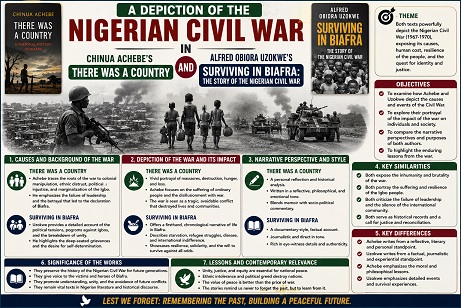
These authors offer different perspectives on the war, presenting personal accounts, historical analysis, and reflections on the consequences of the war. This research work therefore will examine the depiction of the war in these two works examining the authors’ narratives, themes and the impact of the war on the people of Biafra. Chinua Achebe’s work is a memoir that provides a deep personal account on the Nigerian civil war sharing his experiences and reflection while Uzokwe’s book focuses on individual stories of survival during the Nigerian Civil War. He presented first-hand accounts of civilians who endured the hardships and atrocities of the conflict. Through which he captured the resilience, courage and the spirit of the Biafran people in his narrative.
Therefore, this research work seek to bring to life the connecting point of history to gain concrete knowledge from the two scholars in literature to build a historical analysis of the subject matter of the Nigerian Civil War to bridge the gap in history and examine the accounts of these notable individuals who had the chance to be directed impacted by the war. By examining their accounts on the war and analyzing their thoughts, we can have more light and clarity shed into the event that marred the history of the development of Nigeria and the consequent effects on the Nigerian society as a whole. It is however on this background that this research seeks to examine the depiction of the Nigerian civil war in Chinua Achebe’s There Was a Country and Alfred Obiora Uzokwe’s Surviving in Biafra: The Story of the Nigerian Civil War
A Depiction of the Nigerian Civil War in Chinua Achebe’s There Was a Country and Alfred Obiora Uzokwe’s Surviving In Biafra: The Story of the Nigerian Civil War
1.2 Statement of the Problem:
The Nigerian Civil war, also known as the Nigeria-Biafra War, was a three-year bloody conflict with a death toll numbering more than one million people. Having commenced seven years after Nigeria gained independence from Britain, the war began with the secession of the southeastern region of the nation on May 30th, 1967, when it declared itself the independent Republic of Biafra. The ensuing battles and well-publicized human suffering prompted international outrage and intervention.
Carved out of the West of Africa by Britain without regard for pre-existing ethnic, cultural and linguistic divisions, Nigeria has often experienced an uncertain peace. Following decades of ethnic tension in colonial Nigeria, political instability reached a critical mass among independent Nigeria’s three dominant ethnic groups: the Hausa-Fulani in the North, Yoruba in the Southwest and Igbo in the Southeast. On January 15th, 1966, the Igbo launched a coup –d’état under the command of major – General Johnson Thomas Umunnakwe Aguiyi Ironsi, in an attempt to save the country from what Igbo leaders feared would be political disintegration.
Shortly after the successful coup, widespread suspicion of Igbo domination was aroused in the north among the Hausa-Fulani Muslims, many of whom opposed independence from Britain. Similar suspicion of the Igbo Junta grew in the Yoruba west, prompting a joint Yoruba and Hausa-Fulani countercoup against the Igbo six months later. Counter coup leader General – Yakubu Gowon took punitive measures against the Igbo. Further anger over the murder of prominent Hausa politicians led to the massacre of scattered Igbo populations in Northern Hausa-Fulani regions.
This persecution triggered the move by Igbo separatists to form their own nation of Biafra the following year. Less than two months after Biafra declared its independence, diplomatic efforts to resolve the crises fell apart. On July 6th, 1967, the federal government in Lagos launched a full- scale invasion into Biafra. It is however on this backdrop that this study seeks to examine a depiction of the Nigerian Civil War in Chinua Achebe’s There was a Country and Alfred Obiora Uzokwe’s Surviving in Biafra: The Story of the Nigerian Civil War.
1.3 Purpose of the Study:
Generally, this study seeks to examine a depiction of the Nigerian Civil War in Chinua Achebe’s There was a Country and Alfred Obiora Uzokwe’s Surviving in Biafra: The Story of the Nigerian Civil War. Specifically, the study will:
- To analyze the portrayal of the causes and motivations behind the Nigerian Civil War in There Was a Country and Surviving in Biafra and assess the authors’ perspectives on the factors that led to the conflict.
- To examine the different narrative strategies employed by Chinua Achebe and Alfred Obiora Uzokwe in depicting the Nigerian Civil War and its impact on the people of Biafra.
- To analyze the portrayal of cultural identity and nationalism in relation to the Nigerian Civil War in Achebe’s There Was a Country and Uzokwe’s Surviving in Biafra and examine the authors’ exploration of the impact of the war on cultural heritage.
- To compare and contrast the depiction of the Nigerian Civil War in Achebe’s personal memoir and Uzokwe’s collection of survival narratives, examining the similarities, differences, and unique insights provided by each work.
- To assess the contribution of Achebe’s There Was a Country and Uzokwe’s Surviving in Biafra to our understanding of the Nigerian Civil War, its historical significance, and its enduring impact on Nigerian society.
1.4 Research Question
The following research questions where formulated to guide the conduct of this research:
- How do Chinua Achebe and Alfred Obiora Uzokwe present the causes and motivations behind the Nigerian Civil War in their respective works?
- What are the primary narrative techniques used by Achebe and Uzokwe to depict the experiences of individuals during the Nigerian Civil War?
- What themes of identity, nationalism, and cultural heritage emerge from Achebe’s There Was a Country and Uzokwe’s Surviving in Biafra in the context of the Nigerian Civil War?
- What are the differences and similarities in the portrayal of the Nigerian Civil War between Achebe’s personal memoir and Uzokwe’s collection of survival narratives?
- To what extent do Achebe’s There Was a Country and Uzokwe’s Surviving in Biafra contribute to our understanding of the Nigerian Civil War and its lasting impact on Nigerian society?
A Depiction of the Nigerian Civil War in Chinua Achebe’s There Was a Country and Alfred Obiora Uzokwe’s Surviving In Biafra: The Story of the Nigerian Civil War
1.5 Significance of the Study
The research work on the depiction of War as seen vividly in Achebe’s There was a Country and Alfred Obiora Uzokwe’s Surviving in Biafra: The Story of the Nigerian Civil War brings to sunlight of the Casualties, and the degrading effects of the Nigerian civil War, which took place on 6th July, 1967.
The research work will creates awareness to the public on the general effects of war in any modern society, as well as the societal disenfranchisement. The research work also exposes the ill-policies of administration of the colonial masters. The work will serve as a reference manual for future researchers on the related topic.
Finally, the work will serve as a didactic piece to advise the political class to desist from formulating obnoxious policies which would trigger off ethnic segments, and animosity among citizens of our dear country Nigeria.
1.6 Research Methodology
This research is a qualitative research, and relies on textual analysis of the selected texts of Achebe’s There was a Country and Alfred Obiora Uzokwe’s Surviving in Biafra: The Story of the Nigerian Civil War, which serve as primary sources of data for the study while other relevant internet and library materials form the secondary sources of data. The texts are purposively selected based on their relevant contents.
1.7 Scope and Limitation of the Study
The scope of the study is restricted to an investigation in the “depiction of the Nigerian Civil War in Chinua Achebe’s There was a Country and Alfred Obiora Uzokwe’s Surviving in Biafra: The Story of the Nigerian Civil War. Hence, the limitation of this study lies within the confines of the researcher’s inability to reach out for field documentations to further showcase the evil nature of war in any society.