The Impact Of Trained Traditional Birth Attendants In Health Care Delivery System

The Impact Of Trained Traditional Birth Attendants In Health Care Delivery System
ABSTRACT
This study aimed at investigating “The Impact of Trained Traditional Birth Attendants in Health Care Delivery System in Obot Akara Local Government Area, Akwa Ibom State.” To guide the study, three (3) objectives were set thus: To examine the role of TBAs on reproductive health, to find out the need of training traditional birth attendants, and to determine the impacts of training of traditional birth attendants. Three (3) research questions were also formulated and related literatures were reviewed based on the set objectives.
The study employed a descriptive survey method. The sample size of 100 respondents was selected using stratified random sampling technique. The main instrument for data collection was questionnaire. Data collected were analysed using simple percentages and were presented in frequency tables. Findings revealed the role of TBAs on reproductive health; it also revealed the need to train Traditional Birth Attendants, and the impacts of training traditional birth attendants. Based on these findings, conclusion was drawn and useful recommendations were made among others that Government should ensure the training of Traditional Birth Attendants (TBAs) so as to reduce maternal morbidity and mortality rate.
CHAPTER ONE
INTRODUCTION
1.1 Background of the Study
Child birth is an important socio-demographic and cultural event in family and community and a time of great joy and hope. In the past, child delivery was assisted by mother-in-law, mother and aunt or sister-in-law before the coming of conventional medicine (Kayombo, 2011). However, where there was complication in childbirth, traditional birth attendants (TBAs) were invited to help (Kayombo, 2011, 2012).
A traditional birth attendant is defined as a person who assists the mother during child birth and initially acquired her skills by delivering babies herself or through apprenticeship to other traditional birth attendants (WHO, 2010). Traditional birth attendants are integral members of their communities and provide an important window to local customs, traditions and members of their communities and perceptions regarding childbirth and new-born care (Kamal, 2009; Leedam, 2011). The presence of relatives at birth was to witness child delivery and make proper decision when problem arises (Kayombo, 2011). Death of mothers or infants were translated as bad omen or God wishes or transgressing cultural norms (Kayombo, 2012).
With the coming of conventional medicine during the colonial period, conventional health services were gradually introduced both in rural and urban and more so after independence (Kimambo and Temu, 2010). With the widespread of health facilities both in rural and urban areas, it was expected that many of the child bearing women would be using health facilities for child deliveries and other reproductive health services.
However, in sub Saharan African countries example Ghana, Nigeria, Chad etc, many child bearing women are still being attended to by TBAs and relatives at deliveries (Bergstrom and Goodburn, 2012). But studies reviewed show that births without access to life-saving drugs are the commonest practice for millions of mothers in the poorest countries where mortality rate and morbidity of the mothers are highest (Crowe, et al, 2012; WHO, 2010). Recent statistics indicate that across the world 287,000 women die in pregnancy and childbirth every year (WHO, 2010).
The Impact Of Trained Traditional Birth Attendants In Health Care Delivery System
This is translated as one mother dying every 2 minutes, 800 a day. Not only that but also 7 – 10 million women and girls suffer severe or long term illness caused by complications in pregnancy and childbirth (WHO, 2010). The use of unskilled personnel (including TBAs) is likely to be among the reasons for the high maternal and infant mortality rate in sub Saharan Africa. Despite the expansion of more health facilities close to the community, increased use of antenatal clinic and increased coverage of immunization, the problem has persisted (MOH, 2012).
There are several factors that need to be addressed to build on effective intervention framework of reducing maternal and infant mortality rate. The questions include:
- What has been the major role of TBAs in reproductive health that attracts many women to prefer to use them for delivery and other health problems?
- Are there any efforts to train TBAs as intervention and what approaches are used in order to improve health care outcomes?
- If yes what is the impact of training TBAs on reducing maternal and infant mortality rate?
1.2 Statement of the Problem
The topic became an area of interest to study as a result of the realization that, some pregnant women encountered a lot of problem during delivery from traditional birth attendants.
Similarly, it is also assumed that a sizeable number of the pregnant women tend not to know the implication or problems that could occur from the complications of pregnancy, labour and peuperium. Furthermore, they are not familiar with the preventive measures to these complications from becoming a life-long problem or leading to their death.
The increasing report of the cases of pregnant women that died during pregnancy or encounter life-long problems makes it necessary to research on ways of solving/preventing these problems.
1.3 Objectives of the Study
The overall objective of the this study is to determine the impact of trained traditional birth attendant on health care delivery system among women of childbearing age (mothers) in Obot Akara Local Government Area.
Specifically, the following objectives will guide the study.
- To examine the role of TBAs on reproductive health
- To find out the need of training traditional birth attendants.
- To determine the impacts of training of traditional birth attendants.
1.4 Research Questions
(i) What are the roles of traditional birth attendants on reproductive health?
(ii) Why is it important to train traditional birth attendants?
(iii) What are the impacts of training traditional birth attendants?
1.5 Significance of the Study
- It will help the community to know the type of health care delivery services needed by them.
- It will help other researchers in gathering information for their research work.
- It will help the government in planning, implementation and evaluation of subsequent training programme for traditional birth attendants in Obot Akara Local Government Area.
1.6 Scope of the Study
This study focused on the impacts of trained traditional birth attendants. The topic will cover the role of TBAs on reproductive health, the need of training TBAs and the impact of trained TBAs. The study is delimited to men and women in Obot Akara Local Government Area, Akwa Ibom State.
CHAPTER FIVE
DISCUSSION OF FINDINGS
5.1 Introduction
This chapter is concerned with the discussion of findings, summary, conclusion, and recommendations.
5.2 Discussion of Findings
Research Question 1
What are the roles of Traditional Birth Attendants on Reproductive Health?
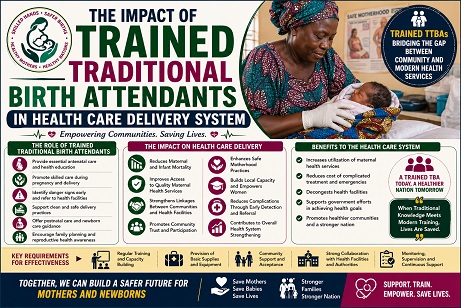
Findings from research questionnaire items 1-4 revealed that out of the total respondents, 50% agreed that Traditional Birth Attendants play crucial on reproductive health, while 50% disagreed. The respondents that disagreed are the same with those agreed, this is in correspondence with Sibley and Lynn (2011), although Traditional Birth Attendants (TBAs) may not have any formal training on how to attend pregnant women, many are highly experienced in well woman care including how to recognize and respond appropriately to complications of pregnancy. WHO (2010) posited that Traditional Birth Attendants (TBAs) have essential components on reproductive health knowledge and skills including local customs, traditions, and perceptions regarding childbirth and new-born care. Therefore, they are the key actors in reducing maternal and infant mortality as well as morbidity of the mothers, but need to be supervised.
Research Question 2
Why is it important to trained Traditional Birth Attendants (TBAs)?
Findings from research questionnaire items 5-8 revealed that out of the total respondents, 72.5% agreed that it is important to train Traditional Birth Attendants (TBAs), while 27.5% disagreed. In connection with the above, Grieco and Turner (2015) pointed out that if nothing was done to train Traditional Birth Attendants (TBAs) by 2015 there would be 2.5 million maternal deaths, 2.5 million child deaths and 49 million maternal disabilities in the sub-Saharan region. Furthermore, Cosmnisky (2013) posited that most Traditional Birth Attendants (TBAs), had traditional beliefs as to the cause of neonatal sickness, and training would lead them to change their beliefs in favour of infection.
The Impact Of Trained Traditional Birth Attendants In Health Care Delivery System
Research Question 3
What are the impacts of training Traditional Birth Attendants (TBAs)?
Findings from research questionnaire items 9-12 revealed that out of the total respondents, 80% agreed that there are impacts in training Traditional Birth Attendants (TBAs), while 20% disagreed. In consonance with the above, Brennan (2011) explained the impact of training TBAs. According to him, “the key outcome measure was maternal postpartum genital tract infection diagnosed by a symptom complex of any two out of three symptoms: foul discharge, fever, lower abdominal pain. During the evaluation it was found that trained Traditional Birth Attendants (TBAs) were significantly more likely to practice hygienic delivery than untrained Traditional Birth Attendants (TBAs) and hence possibility of avoiding infections which are common to deliveries assisted by non-skilled birth attendants.” According to World Health Organization (2010), training of Traditional Birth Attendants (TBAs) improved their skills, increase the number of live births, and also improve the links between modern health services and the community.
5.3 Summary
This study aimed at examining “The Impact of Trained Traditional Birth Attendants in Health Care Delivery System in Obot Akara Local Government Area, Akwa Ibom State.” To guide the study, three (3) objectives were set thus: To examine the role of TBAs on reproductive health, to find out the need of training traditional birth attendants, and to determine the impacts of training of traditional birth attendants. Three (3) research questions were also formulated and related literatures were reviewed based on the set objectives.
The study employed a descriptive survey method. The sample size of 100 respondents was selected using stratified random sampling technique. The main instrument for data collection was questionnaire. Data collected were analysed using simple percentages and were presented in tables. Findings revealed the role of TBAs on reproductive health; it also revealed the need to train Traditional Birth Attendants, and the impacts of training traditional birth attendants. Based on these findings, conclusion was drawn and suggestions were made in the study.
5.4 Implication of the Study
Studies have shown that TBAs cannot prevent or treat most life-threatening obstetric complications unless they are well trained. However, TBAs could be very effective if a formal link could be made between them and the well-equipped formal health sector. Studies have also found that TBAs can be trained to identify delivery and newborn complications. Timely interventions by a skilled attendant are vital to decrease neonatal deaths as well. The study has revealed that, trained TBAs provide better services as compared to untrained. Hence, there is a need for progressive improvement in the knowledge and practices among untrained TBAs regarding newborn care.
5.5 Conclusion
The role of traditional birth attendants in provision of health care in resource poor countries is still important because of the current inadequacy of human resource for health. In developing countries for years to come, Traditional Birth Attendants (TBAs) will remain the main providers of child deliveries in rural areas. Recruitment and training of TBA using adult learning techniques is important. The programs should focus on basic Primary Health Care (PHC) program especially on symptoms of risky cases that need to be referred to formal health services and hygiene to prevent mother and child from infections. Creation of dialogue, trustworthiness, patient, tolerance, willingness to collaborate, transparent and familiarity during training are keys when working with TBAs as partners in health care and share experiences.
5.6 Recommendations
Based on the findings of this study, the following recommendations are made that:
- Government should ensure the training of Traditional Birth Attendants (TBAs) so as to reduce maternal morbidity and mortality rate.
- Health workers should organize seminar and workshop for Traditional Birth Attendants (TBAs) from time to time to enable them know what to do in cases of complications during delivery.
- Government should equipped Traditional Birth Attendants (TBAs) with necessary instruments needed for successful delivery.
- In remotest areas, other health workers e.g. skill birth attendants should be considered to extend the coverage of maternal and neonatal care.
- Traditional Birth Attendants (TBAs) should refer immediately any complication that is beyond their control the health centre.
5.7 Limitation of the Study
This study faced some limitations due to poor attitude of th respondents and lack of understanding of some of the questionnaire items. Some respondents feared their personal information will be made public, but they were reassured of confidentiality.
5.8 Suggestion for Further Study
Based on the findings of the study, the researcher suggested that further study be conducted on “The dangers of untrained Traditional Birth Attendants (TBAs) on pregnancy outcome.”