African Pentecostalism a Case Study of the Redeemed Christian Church of God Nigeria

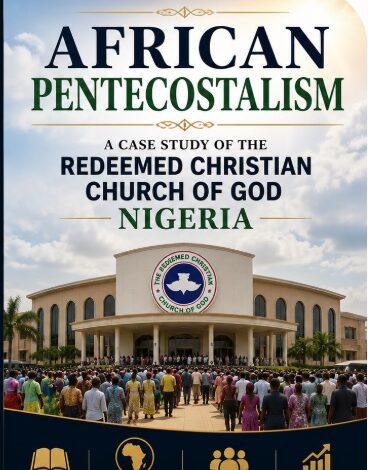
African Pentecostalism a Case Study of the Redeemed Christian Church of God Nigeria
1.1 Background to the study
The motto of the Redeemed Christian Church of God (RCCG) is “Jesus Christ the same yesterday, and today, and forever”. This is a text derived from New Testament book of Hebrew (13:8). This text summarises the central rule of behaviour as well as organising principle of the church. However, the same “changelessness” which is attributed to Jesus Christ by the text of the church’s motto, cannot be said of the church itself.
Established fifty-one years ago in a suburb of Lagos, Nigeria, the RCCG has gone almost gone full circle through the vicissitudes of “days of small things” to periods of intense evangelistic fervour and search for doctrinal anchor and purity, to the present explosion into socio-political power, economic privilege and spiritual aristocracy. This history of the RCCG bears out a central truth of the New Testament, which is summarised neatly thus: the world as we know it is changing (1 Cor. 7:31b). This study investigates and documents the changes that have taken place in the history of RCCG from inception to the present.
At the beginning of the present study in 2000, the basic facts about RCCG could be stated thus: The RCCG is a church in Nigeria established in 1952. It is a member of the Pentecostal Fellowship of Nigeria (PFN), the umbrella body of pentecostal churches in the country. RCCG’s founder and first leader was the Reverend Josiah Olufemi Akindayomi. He was converted into Christianity from Yoruba traditional religion, particularly Ogun worship by the Church Missionary Society (CMS) in Ondo town in the early 1920s. Some years later he joined the Eternal Sacred Order of Cherubim and Seraphim movement (C&S), one of the early Aladura movements in Yorubaland and rose to the rank of apostle and prophet. In 1952 he left the C&S authority and he established his own religious group which became known as
the Redeemed Christian Church of God. When this founder died in 1980, the group had grown to have 39 branches in the southwest region of Nigeria. Before Josiah died, he had appointed a successor, Dr Enoch Adeboye, who was then a lecturer at the University of Lagos, Nigeria. In 1981 the successor took over office as leader. It was during this period that the church rapidly expanded both in Nigeria and outside the country. By the middle of 2000, the RCCG had more than three thousand branches, with close to a hundred of these established outside the country. This church is the object of the present study. However, in order to understand the history of the RCC, it is necessary to describe briefly the social and political context in which it exists.
Nigeria is a religiously plural society made up of people who practise a diversity of religions. This religious diversity is illustrated firstly by the existence of three main religious groups, namely: the adherents of traditional religions often called African Traditional Religions (ATR), Muslims and Christians. Secondly, each of these three traditions is internally diverse, particularly Christianity.
African Pentecostalism a Case Study of the Redeemed Christian Church of God Nigeria
Within Christianity alone, there exists a great amount of diversity in terms of smaller strands of traditions and churches and ministries. The first attempts to christianise Nigeria were in the fifteenth and eighteenth centuries when Portuguese commercial boats sailed to Warri with Roman Catholic missionaries. The missionaries were able to get to the kingdom of Benin, made some converts and built some churches, but these attempts did not last (Ojo 1998). The second attempts to bring Christianity to Nigeria was in 1842, this time, it came in its institutional variety.
In 1842 and 1843 the Church Missionary Society (CMS) and the Wesleyan Methodist Missionary Society respectively sent missionaries to Badagry in Nigeria to assist former slaves from Freetown. From this period on, different mission churches such as the Baptists, the CMS and the Roman Catholic Church founded different missions in the country. The mission churches made their initial converts from members of the indigenous religions and sometimes from Islam in parts of the country with Muslim population such as the Yorubaland. In such places as Peel (2000) shows, it was Islam and Christian missions that competed for the souls of members of indigenous religions.
By March 1888 the first case of a break away from a mission church took place. This was the founding of the Native Baptist Church by some Yoruba laity who seceded from the American Baptist Mission as a result of their opposition to American missionary leadership
(Ayegboyin and Ishola 1997: 14). This event marked the inauguration of an unprecedented phenomenon of indigenous forms of Christianity, as the United Native African Church was established in 1891. Soon after, there were schisms and secessions from the mission churches, a situation that further diversified the religious landscape. This early strand of indigenous Christianity is designated as Ethiopianism, a term first used by Bengt Sundkler (1961: 55) to describe incidences of this type among the Zulu of South Africa, and interpreted as the rebellion of local Christians against White missionary domination.
1.2 Objectives of the Study
From what is generally known about the church, several questions arise which form the objectives of our study.
The church extended faster within the nineteen-year period (1981-2000) after the death of its founder than the previous twenty-eight year (1952-1980) period. This study intends to account for this phenomenal growth of the church during the post-founder period. What factors have facilitated the expansion of the RCCG in both Nigeria and outside the country?
The late twentieth century, which was the period of rapid growth for the RCCG, is also generally recognised as the era of globalisation (Giddens 1990; 2000; Robertson 1992; Held et al. 1999). Pentecostalism is also regarded by some scholars as an aspect of “global culture” (Poewe 1994; Varga 1999; Berger 2000; Corten and Marshall-Fratani 2001; Jenkins 2002). As a member of the PFN which exercised influence in the entire
country, in what ways can the expansion of RCCG be accounted as a form of religious globalisation?Two aspects of globalisation have been highlighted in the literature: one, the assimilation of external ideas and influences, and two, the spreading outward of specific ideas and practices. If the first is the appropriation of global influences, the second is the exercise of global aspiration.
Some scholars have argued that expansion of pentecostalism in Africa is because of incorporation of external influences and the cultivation of instruments of extraversion, especially with other pentecostal groups especially in Western Europe and the United States of America (Brouwer et al 1996; Gifford 1991: 9-19; 1998: 307-348). Is the expansion of the RCCG because of global influences from outside resulting from the cultivation of “overseas links” (Gifford 1998: 314) or because of its global aspirations based on its local rootedness? The present study intends to provide empirical material for an understanding of the interplay between the global and local forces.
African Pentecostalism a Case Study of the Redeemed Christian Church of God Nigeria
The RCCG has its roots in the Aladura movement that started in Yorubaland in the 1920s. One persistent issue in the studies of this movement is its local cultural identity and continuity with Yoruba traditional religion. Some scholars maintain it is a syncretic movement. Robert Cameron Mitchell, for example, writes that some of the prophets of the Aladura movement “encourage a new form of syncretistic magic” (Mitchell 1963: 51). Avoiding the overt use of the concept of syncretism, Benjamin Ray (1993: 266) also writes that “the Aladura churches” constitute “a distinctive synthesis of Yoruba and Christian beliefs and practices”. More generally, Yoruba culture has been described as syncretistic in nature, that is, being able to absorb foreign influences.
Ulli Beier (1988, 2001) has described this syncretic nature of the Yoruba culture as a demonstration of creativity and strength in the search for survival. For him, the Yoruba have “an extraordinary capacity for synchretism” [sic] which accounts for the survival of their culture and identity (Beier 1988: 65). Beier argues that “the flexibility and adaptability of Yoruba culture” is a cultural strategy for continued relevance (Beier 2001: 49). Since the RCCG has its roots in Yoruba culture and the Aladura movement, the study intends to examine the role of cultural continuity and syncretic processes in the history of the RCCG. Also, it examines in what ways the church could be described as a local form of pentecostalism and its vitality be accounted for by its local rootedness.