Review of The King’s Verdict by Bernard Dickson
Introduction
Literature has historically functioned as a medium for interrogating societal norms, political structures, and ethical dilemmas. It serves not merely as a form of entertainment but as a reflective tool through which the complexities of human existence and governance are critically examined. Bernard Dickson’s The King’s Verdict exemplifies this tradition, portraying the dramatization of power, justice, and communal responsibility within a socio-political framework that resonates with contemporary realities. As a playwright, Dickson engages with his cultural milieu by foregrounding thematic concerns that are both contextually grounded and universally significant.
In this work, Dickson constructs a narrative that critiques the mechanisms of authority and legal administration while simultaneously questioning the moral compass of leadership. The play emerges as a potent commentary on the tension between tradition and reform, the fragility of justice in hierarchical systems, and the individual’s role in upholding or subverting communal ethics. Through symbolic characterization, dramatic conflict, and the invocation of socio-cultural motifs, The King’s Verdict interrogates the legitimacy of power and the consequences of its misapplication. Thus, the play not only entertains but also educates and provokes, compelling audiences to reflect on the enduring issues of governance, accountability, and moral judgment through the following themes.
The Theme of Poverty in African Literature
Constantly, African literature explores the theme of destitution. This is because poverty functions as a symbolic representation of the deplorable circumstances that a significant portion of the population on the continent is compelled to endure. African authors have shed light on the intricate facets of poverty and the detrimental effects it has on communities and individuals through their literary contributions. In their plays, these authors have explored the sociopolitical and economic dimensions of destitution in Africa. Their nuanced viewpoints have effectively debunked misunderstandings and prejudices surrounding the subject matter.
The playwright illustrates this in the opening scene of act 4, which transpires amidst the monarch and the chiefs’ dispute concerning Uyediya and her daughter. The meeting’s objective is to discuss the royal family’s noncompliance with the indigenous customs. Upon the arrival of the principal and his counsel, they presented documentation pertaining to a prior agreement they had made with Adanma’s father to financially support her education in his incapacity to do so. She will be required to marry him or repay the principal and interest thereafter. The conference was subsequently rescheduled for the evening of the subsequent day. The dramatist depicts a typical African poor society in the situation just described, one in which the affluent can do anything to the detriment of those who are less fortunate.
Review of The King’s Verdict by Bernard Dickson
The Theme of Patriarchy
A “patriarchy” refers to a societal structure wherein the likelihood of males holding positions of moral authority, political leadership, social privilege, and property ownership is greater than that of women. The continuation of gender inequality and the oppression of women is a defining characteristic of this culture. Patriarchy has exerted a substantial influence on cultural norms, institutional frameworks, and individual conduct across numerous nations over the course of human history. The author employs the characters of “Urediya” and her daughter “Adanma” to symbolize an overarching patriarchal motif that permeates the entirety of the book: women are not granted autonomy in decision-making.
In order to gain a comprehensive understanding of the issue at hand, it is critical to examine the way patriarchy affects each facet of society. It influences the formulation of conceptions regarding what constitutes masculinity and femininity, as it impacts gender norms and expectations. Patriarchal systems frequently sustain gender biases that impose restrictions on the political, economic, and educational opportunities available to women. Preconceived notions impede the capacity of women, as exemplified in the drama by “Urediya” and her daughter “Adanma,” to acquire such opportunities.
The Theme of Culture and Tradition against Women
The theme of culture and tradition against women refers to the societal norms, customs, and practices that discriminate against or oppress women based on cultural beliefs and traditional values. This theme explores how cultural and traditional factors can perpetuate gender inequality, restrict women’s rights and freedoms, and limit their opportunities for personal and professional growth.
The playwright portray using “Urediya” and her daughter “Adanma” for example in act two scene one which scene began with the arrival of Mazi Orji at Urediya’s home and his plan of marrying Adanma to Okeke as a result of her late husband’s inability to pay his supposed debts to Mazi Okeke, as tradition dictates. It dictates that when a debtor is unable to pay off his debt, the creditor can take whatever he desires from the debtor’s possession, which Urediya rejects which did not play well for her and her daughter.
THE ROLES OF ANY THREE CHARACTERS TO THE DEVELOPMENT OF THE PLOT IN BERNARD DICKSON’S “THE KING’S VERDICT”
-
Adanma – The Protagonist and Symbol of Resistance
Adanma is the daughter of Urediya and the central character around whom the major conflict of the play revolves. She symbolizes youthful resistance to patriarchal oppression and embodies the quest for female empowerment through education. After the death of her father, traditional customs demand that she be given in marriage to Mazi Okeke to settle her father’s debt. This demand places her at the heart of a moral and cultural dilemma whether to submit to oppressive tradition or pursue her own dreams.
Adanma’s refusal to marry Okeke is not merely a personal act of defiance but a challenge to the very foundations of a patriarchal society that commodifies women. Her desire to go to school and become an agent of change highlights the theme of education as a liberating force. Her confrontation with the Igwe, during which she appeals for justice and the right to self-determination, significantly shifts the plot from passive acceptance of custom to active resistance. By aligning with Romanus the king’s son and revealing their strategic plan, Adanma becomes the catalyst for the climactic change in the kingdom’s laws. Her character development from a grieving daughter to a social reformer marks the emotional and ideological center of the play.
- Urediya – The Protective Mother and Voice of Moral Conscience
Urediya, the widow of Ejike and Adanma’s mother, plays a crucial role in defending her daughter’s rights and challenging cultural conventions. She represents the plight of widows in traditional African societies who are often left vulnerable after the death of their husbands. In the play, Urediya is pressured by Mazi Orji, who proposes that her daughter be married to Okeke in lieu of a debt allegedly owed by her deceased husband. Her rejection of this exploitative arrangement reveals her strength, moral clarity, and unwillingness to allow her daughter to be treated as property.
Urediya’s role is vital in grounding the play’s thematic concerns in lived experience. Through her, Bernard Dickson portrays the often silenced but powerful resistance of women who fight not only for their own dignity but also for the future of their children. Her presence strengthens the emotional core of the story and reflects the burdens women bear when they become custodians of both cultural continuity and transformation. Her moral opposition to the exploitation of tradition builds momentum toward the eventual verdict delivered by the king.
Review of The King’s Verdict by Bernard Dickson
- Igwe (The King) –The Arbiter of Tradition and Agent of Transformation
The Igwe is the traditional ruler and central authority figure in the play. Initially, he embodies the entrenched values of the patriarchal system, reinforcing customs that favor creditors and marginalize women. His early rulings reflect a commitment to preserving societal order as dictated by tradition, even when these customs clearly disadvantage individuals like Adanma.
However, the Igwe’s character undergoes a significant transformation over the course of the play. As various appeals are brought before him including those from Adanma, her mother, and eventually his own son Romanus he is forced to confront the limitations and injustices of the customs he upholds. His role evolves from being a passive enforcer of cultural norms to an active reformer who ultimately prioritizes justice and progress.
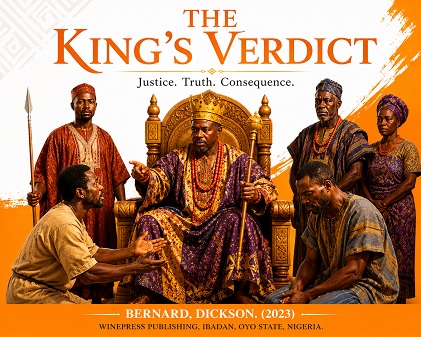
In the final act, the Igwe delivers the titular “verdict” by overturning the oppressive tradition and mandating that all girls in the kingdom be enrolled in school. This act not only resolves the central conflict but also signals a paradigm shift in societal values. The Igwe’s transformation underscores the potential for change within traditional systems when leaders are willing to listen and adapt. His verdict thus signifies hope for a more equitable society and affirms the play’s central message of justice, gender equity, and social reform.
Review of The King’s Verdict by Bernard Dickson
Summary
Bernard Dickson’s The King’s Verdict is a profound dramatic exploration of societal structures that uphold gender inequality and perpetuate oppressive traditions. Through its thematic preoccupations with patriarchy, the conflict between culture and women’s rights, and the pursuit of justice and societal reform, the play interrogates long-standing practices that marginalize women, especially widows and young girls, within a traditional African (Igbo) setting. These themes are not presented in abstraction but are embodied in the lived experiences of the characters, making the narrative both engaging and socially resonant.
Central to the development of the plot are characters such as Adanma, who personifies resistance against patriarchal oppression and champions the cause of education and empowerment; Urediya, whose unwavering protection of her daughter illustrates the silent but potent resistance of women against societal injustices; and the Igwe (King), whose transformation from a custodian of oppressive customs to an agent of societal reform captures the possibility of change within traditional leadership structures. Through these characters, Dickson crafts a compelling narrative that moves from individual suffering to collective liberation, ultimately culminating in a royal decree that mandates education for girls and condemns exploitative practices.
Conclusion
In conclusively, The King’s Verdict by Bernard Dickson offers a powerful critique of the patriarchal and cultural systems that have historically subjugated women in African societies. By weaving together strong thematic concerns with well-developed characters who challenge or reinforce these societal norms, Dickson not only entertains but educates his audience on the urgent need for social reform. The play ultimately affirms that progress is possible when individuals and leaders are courageous enough to question tradition and advocate for justice. Through the transformation of both characters and societal laws, The King’s Verdict leaves its audience with a hopeful message: that a more equitable and enlightened society is achievable through resistance, education, and leadership willing to embrace change.
References
Bernard, Dickson. (2023). The King’s Verdict. Winepress Publishing, Ibadan, Oyo State, Nigeria.